


Former Democratic Progressive Party (DPP) chairman Shih Ming-teh's (
Despite her disapproval of her ex-husband's campaign against Chen Shui-bian (陳水扁), Shih's former wife Chen Li-chu (陳麗珠) showed up at the Legislative Yuan compound yesterday morning before DPP Legislator Lin Kuo-ching (林國慶) was scheduled to hold a press conference to reveal the letter.
Lin was forced to scrap his announcement and let Chen Li-chu tell her tale.
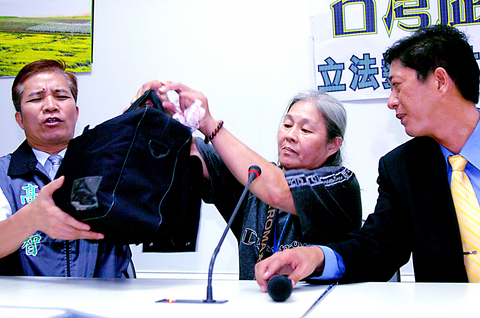
PHOTO: SEAN CHAO, TAIPEI TIMES
"I'm the owner of the letter, so I should be the one to tell the public what really happened," she said.
"I've put up with him [Shih] for over 40 years and have never done anything to hurt him. I don't understand why he is so cruel to me. I really don't," Chen Li-chu said.
She threatened to expose what she claimed were "immoral" incidents and "incest" in Shih's family if he and his family continued to provoke her by calling her a "whore" and denying the authenticity of the letter to Chiang. She did not elaborate.
The tearful 60-something Chen Li-chu said that she had taken the train from Kaohsiung to Taipei on Monday night, hoping to stop Lin before he revealed the contents of the letter.
She said that she had been offered NT$2 million (US$62,500) for the letter, but had turned it down.
"It's priceless. I would not sell it even for NT$20 billion, because it contains evidence of the Chinese Nationalist Party's [KMT] hideous crimes," she said.
Lin said that he had obtained a copy of the letter from a friend of Chen Li-chu. Shih had written the original in pencil and had given it to Chen Li-chu to smuggle out of prison, after which it had been transcribed in ink.
Chen Li-chu said that although she was disappointed with President Chen, he was nonetheless the country's elected leader.
Chen Li-chu brought a heavy black bag to the press conference, saying it contained thousands of letters Shih had written to her and the then KMT government during his incarceration, as well as the government's responses.
She also thanked the president for giving Shih NT$2 million (US$61,260) to help pay for their daughter Shih Shueh-hui's (
Chen Li-chu said that she did not know where the money had come from until she read a report in a newspaper a few days ago, but said that Shih had given her only NT$200,000.
DPP Legislator Wang Shih-cheng (
Wang called on Shih to present a clear account of how much money he had received from the president and how he spent it.
While Shih's lawyer has said that Shih spent only NT$6 million on a condominium which Wang claimed had been a gift from fugitive tycoon Chen Yu-hao (
Even if Shih did spend NT$6 million on the condo, Wang said, he still owed the public an explanation why he did not list the condo in his 2001 financial declaration.
Shih's lawyer, who used a purchase contract to show that Shih had bought the property for NT$6 million, has said that Shih was considering filing a lawsuit against Wang.
Wang said yesterday that he would welcome a lawsuit, because he had "key evidence" to divulge to the court.
Shih, at a press conference held yesterday to announce that his anti-Chen campaign had achieved its fundraising goal of NT$100 million, made no mention of the letter.
He refused to take questions from reporters.
Ho De-fen (
"Even if Shih did [write the letter], it would have been understandable for someone in his position. Except for former DPP chairman Lin I-hsiung (
She said that Shih would not respond to allegations aimed at him.
also see stories:
NPA to deploy `special police' for sit-in
DPP legislators want funds raised by Shih to be frozen

A signaling system malfunction disrupted high-speed rail (HSR) services beginning at 8am today, with trains temporarily reduced to three northbound and three southbound trains per hour as authorities conduct inspections. The malfunction occurred on a section of track in Miaoli County during pre-operation checks early this morning, forcing northbound and southbound trains to use a single track, the HSR operator said. The regular schedule has been replaced with three hourly trains offering only nonreserved seating in each direction, stopping at every station, it said, adding that business class cars would still have reserved seating. Departures from terminal stations are scheduled at the top

Taiwan is still in the process of assessing the possibility of recruiting workers from Eswatini, the Ministry of Foreign Affairs said yesterday, adding that its goal is to help Eswatini upgrade its vocational training centers. If there are plans to recruit workers from Eswatini, safeguarding national security, protecting public health and ensuring the employment rights of Taiwanese would be prerequisites, Department of West Asian and African Affairs Director-General Yen Chia-liang (顏嘉良) told a news conference. Key considerations would also include filling labor shortages in specific industries, and fostering bilateral professional and technical exchanges, he said. Yen was asked about the progress of labor

A US uncrewed surface vessel (USV) encountered multiple Chinese warships during an autonomous transit of the Taiwan Strait, US defense company Seasats said in a statement on Wednesday. Seasats announced that a Lightfish USV had completed the first autonomous transit of the Taiwan Strait. Over five days, the USV traversed the entire length of the Strait while constantly monitoring surface vessel traffic, the company said. The Lightfish encountered multiple Chinese warships, one of which was a Chinese People’s Liberation Army Navy (PLAN) Type 056 corvette, it said. The Chinese vessels were operating “well within Taiwan’s exclusive economic zone without transmitting their identity via the

VERBOSE VESSELS: A CGA cutter and a China Coast Guard exchanged verbal barbs for more than a day in Taiwanese-controlled waters before the Chinese vessel left The Taiwanese and Chinese coast guards had a standoff near the strategically located Pratas Islands (Dongsha Islands, 東沙群島) in the north of the South China Sea, the Coast Guard Administration (CGA) said yesterday. The two sides engaged in intense radio exchanges over sovereignty claims during the 33-hour standoff. China Coast Guard vessel 3501 eventually left the restricted waters, 26.6 nautical miles (49.2km) west of the Pratas Islands, at 5pm yesterday, the CGA said. Lying approximately between southern Taiwan and Hong Kong, the Taiwan-controlled Pratas are seen by some security experts as vulnerable to Chinese attack due to their distance — more than


 RSS
RSS