


Vice Minister of the Interior Yen Wan-chin (
The former director of the Yangmingshan National Park Service Center, Tsai By-lu (
"Yen behaved suspiciously during the investigation. He might destroy or falsify evidence, or confer with the other defendants if he was able to communicate with them, so the Taipei District Court approved the prosecutors' application to take Yen into custody," Taipei District Court spokesman Liu Shou-sung (劉壽嵩) said yesterday.
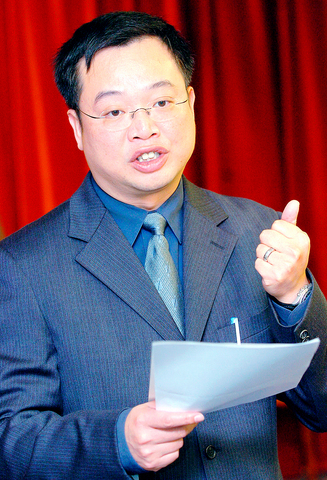
PHOTO: CHANG CHIA-MING, TAIPEI TIMES
Yen is the highest level political appointee in the Democratic Progressive Party (DPP) government to be investigated for corruption.
Premier Su Tseng-chang (蘇貞昌) accepted his resignation yesterday.
Yen had previously served as deputy DPP secretary-general and the director of the party's Chinese affairs department.
DPP Chairman Yu Shyi-kun said yesterday that the party would soon launch its own investigation into Yen's activities. If it is proven that Yen was involved in bribery, the party will expel him, Yu said.
Yen is a member of the New Tide faction and leader William Lai (
The investigation into Yen centers around the plan to construct a cable car system connecting Beitou with Yangmingshan National Park.
Last December the Rich Development Corp, a construction firm, won a build-operate-transfer bid to construct the cable car system. It proposed building four cable car stations, and the Yangmingshan National Park Service Center granted the firm permits for construction in March. The company began construction work in May.
Soon after the permits had been awarded, however, Taipei prosecutors received complaints alleging that the permits had been awarded illegally and alleging bribery.
Prosecutors said their investigation led them to suspect that Yen knew that the company failed to qualify for the construction permit and needed to improve its proposal and that he asked Tsai to grant the permits anyway.
Prosecutors said they had monitored Rich Development's telephone calls and heard people talk about bribery.
Prosecutors said they had also found it suspicious that Tsai approved permits for a total of 183 hot spring hotels and restaurants to be built around the cable car stations just a few days before he retired from his park job last month.
The permits were granted without environmental impact assessments being conducted, which was illegal, prosecutors said.
On Wednesday prosecutors led a search of 26 locations for evidence, including Yen's office and the Yangmingshan National Park Service Center.
Meanwhile, the Taipei City Government yesterday denied any involvement in the corruption scandal and said that it had followed all regulations in planning and executing the project.
Lee Shu-chuan (李四川), director of the Bureau of Public Works' new construction department, said the original cable car project, which was approved by the Executive Yuan in 1995, included the construction of a cable car system from Qinshui Park (親水公園) in Xinbeitou to Yangmingshan National Park, cable car stations and stores, but did not include the construction of hot spring hotels.
He said the interior ministry had added a training dormitory and hot springs hotel to the project when it issued a bulletin announcing approval of the project, thereby allowing contractors to develop those two kinds of buildings in the area.
"It's the ministry's responsibility to ask the Environmental Protection Administration about the construction of those buildings since it added the two items," Lee said.
While the city government is the supervising agency for the entire project, it actually has little authority because 90 percent of the construction sites are within the national park area, Lee said, putting them under the authority of the Yangmingshan National Park Administration.
Taipei Mayor Ma Ying-jeou (馬英九) stood by his officials yesterday, saying that the scandal had nothing to do with the city government.
The cable-car project was scheduled to be completed next June, but city officials said the corruption probe might delay that timetable.
Additional reporting by Jewel Huang and Jean Lin

‘NO SECURITY RISK’: The Railway Bureau reassured the public that the technicians’ activities were limited to technical guidance and did not involve sensitive systems The Railway Bureau yesterday said it had invited eight Chinese technicians to assist with an airport MRT construction project. The bureau issued the confirmation after an Internet user said Chinese nationals had entered the construction zone of Taiwan Taoyuan International Airport’s Terminal 3 project. They asked why “individuals from an enemy state” were allowed access to such a major national infrastructure project, which raised serious concerns over Taiwan’s industrial safety, sensitive systems and information security. The bureau’s Northern Region Engineering Branch Office said subcontractor Taiwan Handle Industrial Co (台灣手把工業) of the Taoyuan airport MRT’s “Contract No. CU05 Project A14 Station Civil, MEP &

The National Chungshan Institute of Science and Technology yesterday showcased its locally developed variants of the Vision 60 robotic patrol dog, which it plans to deploy on the nation’s outlying territories in the South China Sea. The variants were produced under the Joint Lab project — created by the institute and domestic companies — and assembled with domestically produced motors, lenses and artificial intelligence (AI) systems alongside licensed tech from the US, Missile and Rocket Systems Research Division deputy director Jen Kuo-kang (任國光) told the media event at a military base in Taipei’s Dazhi (大直) area. Taiwan has built up its strengths

NOT IMMEDIATE: Taiwan has a chance to appeal the proposed 10 percent tariff before it starts, while other countries face a 12.5 percent tariff from the trade office Taiwan is among 60 economies determined by the US to have failed to impose or enforce a ban on the importation of goods produced with forced labor, according to a notice released on Tuesday by the Office of the US Trade Representative (USTR), which proposed imposing an additional 10 percent or more tariff on them. The USTR in a statement said that following an investigation, it had determined under Section 301 of the Trade Act of 1974 that the failure of the 60 economies to impose and effectively enforce a prohibition on the importation of goods produced with forced labor is

RIGHT DIRECTION: Taiwan’s efforts to prevent forced labor include a proposal to ‘fully prohibit’ employers from withholding workers’ documents, an official said Taiwan is to establish a mechanism to restrict imports of goods linked to forced labor, the Executive Yuan said yesterday, after the US proposed imposing additional tariffs on Taiwanese goods over labor concerns. “The Ministry of Labor and the Ministry of Economic Affairs are to establish an interministerial review procedure,” Executive Yuan spokesperson Michelle Lee (李慧芝) said at a news briefing in Taipei. “The government is to use the Foreign Trade Act [貿易法] as the legal basis to restrict imports of goods produced with forced labor” and bring its supply chain governance more in line with international standards on human rights, resilience


 RSS
RSS