


North Korean leader Kim Jong-Il vowed no compromise and said he was braced for "all-out war" as tension mounted yesterday before a UN vote on whether to impose sanctions on Pyongyang for its missile tests.
Japan, which has led the push with the US to punish the North, said it would not rule out a preemptive strike on North Korea in case of any direct nuclear threat. Seoul accused Tokyo of aggravating the situation.
As China and Russia held firm against the UN draft resolution to impose further sanctions on the impoverished North, a US envoy stressed the need for a diplomatic solution on disarmament and urged Pyongyang to return to stalled talks on its nuclear program.
Kim, in his first reported remarks since Pyongyang test-fired seven missiles into the sea last Wednesday, was unyielding.
"The general has declared that not even a tiny concession will be made to the imperialist US invaders, our archenemy," said a broadcast on North Korean state television.
Kim, who never speaks himself in public, said that if the US took "revenge," it would mean "all-out war."
"It is not empty talk for the DPRK [the Democratic People's Republic of Korea] to respond with revenge to any revenge by the enemy and with all-out war to an all-out war," the TV said.
It added: "It is out of the general's conviction, desire and courage that we should respond to the enemy's knife with a sword and to the enemy's gun with a cannon."
Last week's missile launch included the new Taepodong-2, which was believed to be capable of reaching Alaska or Hawaii, but which quickly crashed into the Sea of Japan.
Japanese Foreign Minister Taro Aso said Tokyo had the right to carry out a preemptive attack in the face of a serious threat despite its pacifist post-World War II Constitution.
"It is impossible for us to do nothing until we are attacked by a country which says it has nuclear weapons and could fire missiles against Japan," Aso, an outspoken hawk, told NHK public television.
Aso stood firm on the UN resolution. The Security Council, where Japan has tried in vain to win the same veto power as sanctions opponents China and Russia, will decide later today when to vote on the draft.
"If we give in to just one veto power, then we will end up sending the wrong message to the international community," Aso said.
South Korea criticized Tokyo yesterday for its "shrill voice."
"There is nothing good in heightening tensions on the Korean Peninsula and worsening inter-Korean relations. This will not help at all to settle the nuclear issue or the missile issue," said a statement from the office of President Roh Moo-Hyun's spokesman.
Meanwhile, Christopher Hill, the US delegate to the six-party nuclear negotiations, said he was ready to meet one-on-one with the North if it returns to the six-nation talks.
He insisted that all nations were speaking with "one voice" on North Korea.
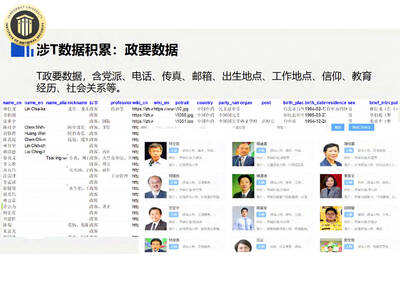
NETWORK-MAPPING PROJECT: The database contains 170 detailed files of Taiwanese politicians and about 23 million records of household registration data in Taiwan China has developed a network-mapping project targeting political figures and parties in Taiwan to monitor public opinion during elections and to craft tailored influence campaigns aimed at dividing Taiwanese society, according to documents leaked by Chinese technology firm GoLaxy (中科天璣). The documents, collected by Taipei-based Doublethink Lab, showed a database was specifically created to gather detailed information on Taiwanese political figures, including their political affiliations, job histories, birthplaces, residences, education, religion and a brief biography about them. Several notable Taiwanese politicians are in the database, including President William Lai (賴清德), former president Tsai Ing-wen (蔡英文), Minister of Foreign Affairs Lin Chia-lung (林佳龍),

KEY INDUSTRY: The vice premier discussed a plan to create a non-red drone supply chain by next year, which has been allocated a budget of more than NT$7.2 billion The government has budgeted NT$44.2 billion (US$1.38 billion) to cultivate Taiwan’s uncrewed aerial vehicle (UAV) industry over the next five years, which would make the nation a major player in the industry’s democratic supply chain in the Asia-Pacific region, Premier Cho Jung-tai (卓榮泰) said yesterday. Cho made the remarks during a visit to the facilities of Cub Elecparts Inc (為升電裝). Democratic Progressive Party (DPP) Legislator Chen Su-yueh (陳素月) and Chinese Nationalist Party (KMT) Legislator Hsieh Yi-fong (謝依鳳) also participated in the trip. Cub Elecparts has transitioned from the automotive industry to the defense industry, which is the top priority among the nation’s
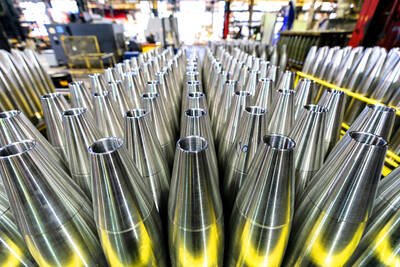
UPGRADED MISSILE: The Chungshan Institute of Science and Technology is reportedly to conduct a live-fire test of the Hsiung Feng III anti-ship missile on Thursday next week The US Army is planning to build new facilities to boost explosives production and strengthen its supply chain, a move aimed at addressing munitions shortages and supporting obligations to partners including Taiwan, Ukraine and Israel, Defense News reported. The army has issued a sources sought notice for a proposed Center of Excellence at the Blue Grass Army Depot in Kentucky, the report said. The facility would serve as a hub within the US industrial base for the production of key military explosives, including research department explosives (RDX) and high melting explosives (HMX), while also supporting research and development of next-generation materials. The proposed
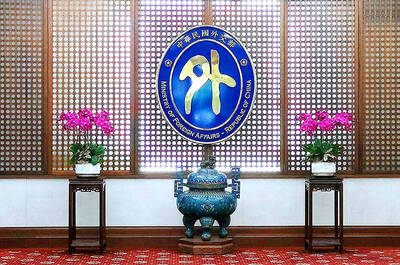
SOUTH KOREA DISPUTE: If Seoul continues to ignore its request, Taiwan would change South Korea’s designation on its arrival cards, the foreign ministry said If South Korea does not reply appropriately to a request to correct Taiwan’s name on its e-Arrival card system before March 31, the government would take corresponding measures to change how South Korea is labeled on the online Taiwan Arrival Card system, the Ministry of Foreign Affairs said yesterday. South Korea’s e-Arrival card system lists Taiwan as “China (Taiwan)” in the “point of departure” and “next destination” fields. Taipei has asked Seoul to change the wording. Since March 1, South Koreans who hold government-issued Alien Resident Certificates (ARC) have been identified as from “South Korea” rather than the “Republic of Korea,” the


 RSS
RSS