


Mike Slabaugh doesn't have a stomach. Neither do his 10 cousins.
Growing up, they watched helplessly as a rare hereditary stomach cancer killed their grandmother and some of their parents, aunts and uncles.
Determined to outsmart the cancer, they turned to genetic testing. Upon learning they had inherited grandmother Golda Bradfield's flawed gene, they had two options: Risk the odds that they might not develop cancer, with a 70 percent chance they would; or have their stomachs removed. The latter would mean a challenging life of eating very little, very often.
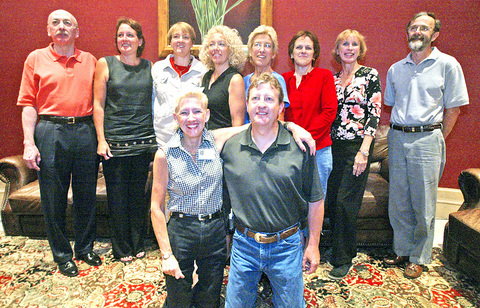
PHOTO: AP
All the cousins chose the operation. Doctors say they're the largest family to have preventive surgery to protect themselves from hereditary stomach cancer.
"We're not only surviving, we're thriving," said Slabaugh 16 months after his operation at Stanford University Medical Center in Palo Alto, California.
Advances in genetic testing are increasingly giving families with bad genes a chance to see the future, sometimes with the hope of pre-emptive action.
Slabaugh, who lives in Dallas, Texas, reunited with his many scattered cousins recently in Las Vegas just two months after the last in the group -- Bill Bradfield of Farmington, New Mexico -- had his operation. Several hadn't seen each other for decades while others met for the first time.
"Rather than live in fear, they tackled their genetic destiny head-on," said Dr. David Huntsman of the University of British Columbia, who found the gene mutation in the family.
The form of stomach cancer that runs in the Bradfield family, called hereditary diffuse gastric cancer, is extremely rare with about 100 families diagnosed worldwide.
The CDH1 gene mutation was first discovered in 1998 in a large New Zealand family with a history of stomach cancer. Those with the mutation have a 70 percent risk of stomach cancer.
It killed Golda Bradfield in 1960. She passed the faulty gene to seven of her children. Six died of the disease in their 40s and 50s.
The grandchildren learned of the defective gene after one of them, David Allen, died of stomach cancer in 2003. His doctor had sent a blood sample to Huntsman's lab, which confirmed the mutation.
Soon after, the remaining 17 got tested. Eleven who had the bad gene had surgery.
"I wake up every morning and think, `This is a free day. I get a bonus today,'" Slabaugh, 52, said.
During surgery, doctors remove the entire stomach and surrounding lymph nodes and attach the bottom of the esophagus to the intestine to create a pouch. Without a stomach, patients typically lose significant weight and must eat smaller meals more often.
While the stomachs of all six of the cousins who were operated on at Stanford looked normal before surgery, a study of the tissue revealed early tumor growths, said Dr. Jeff Norton, the surgeon.

SILENCING CRITICS: In addition to blocking Taiwan, China aimed to prevent rights activists from speaking out against authoritarian states, a Cabinet department said The Ministry of Foreign Affairs (MOFA) yesterday condemned transnational repression by Beijing after RightsCon, a major digital human rights conference scheduled to be held in Zambia this week, was abruptly canceled due to Chinese pressure over Taiwanese participation. This year’s RightsCon, the world’s largest conference discussing issues “at the intersection of human rights and technology,” was scheduled to take place from tomorrow to Friday in Lusaka, and expected to draw 2,600 in-person attendees from 150 countries, along with 1,100 online participants. However, organizers were forced to cancel the event due to behind-the-scenes pressure from China, the ministry said, expressing its “strongest condemnation”
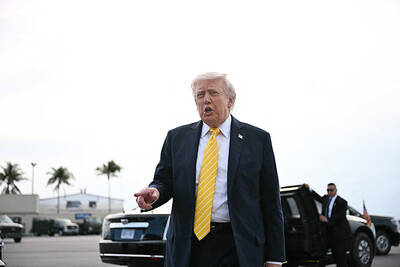
Iran’s Islamic Revolutionary Guard Corp (IRGC) yesterday said the US faced a choice between an “impossible” military operation or a “bad deal” with Tehran, after US President Donald Trump disparaged Iran’s latest peace proposal. Negotiations between the two countries have been deadlocked since a ceasefire came into effect on April 8, with only one round of direct peace talks held so far. Iran’s Tasnim and Fars news agencies reported that Tehran had submitted a 14-point proposal to mediator Pakistan, but Trump was quick to cast doubt on it. “I will soon be reviewing the plan that Iran has just sent to us, but

A group affiliated with indicted Chinese immigrant Xu Chunying (徐春鶯) is to be dissolved for monitoring Chinese immigrants in Taiwan, a source said yesterday. Xu, the secretary-general of the Cross-Strait Marriage and Family Service Alliance, was indicted on March 24 on charges of violating the Anti-Infiltration Act (反滲透法). The alliance “illegally monitored" Chinese immigrants living in Taiwan on behalf of the Chinese Communist Party (CCP) and the Ministry of the Interior is expected to dissolve the organization in the coming days under provisions of the Civil Associations Act (人民團體法), the source said. Xu, who married a Taiwanese in 1993 and became a Republic

Taiwanese shares yesterday posted a record daily gain of more than 1,700 points to close above 40,000 points for the first time, led by large-cap semiconductor stocks such as Taiwan Semiconductor Manufacturing Co (TSMC, 台積電) and MediaTek Inc (聯發科) amid optimism about the artificial intelligence (AI) boom. The TAIEX ended up 1,778.51 points, or 4.57 percent, at 40,705.14 after moving between 39,228.39 and 40,755.52, while the New Taiwan dollar closed up NT$0.038 at NT$31.610 per US dollar, ending three consecutive sessions of declines. Turnover on the main board totaled NT$1.007 trillion (US$31.9 billion), with foreign institutional investors buying a net NT$66.98 billion


 RSS
RSS