


World leaders resisted setting exact financial targets for the fight against AIDS at a major conference, drawing criticism from activists who claimed they do not want to shoulder the financial burden of trying to stop the epidemic.
However, rights groups also said there were some gains from the conference that wrapped up on Friday, including a push for drug users to be given sterile injecting equipment and recognition that the fight against AIDS will require up to US$23 billion each year by 2010.
The meeting was meant to review efforts to fight AIDS and prepare national plans to fight the virus over the next 10 years. It came after a UN report said that 40 million people worldwide are living with HIV/AIDS, and 8,000 die every day from the virus.
"The epidemic continues to outpace us," UN Secretary-General Kofi Annan said. "Last year, globally, there were more new infections than ever before, and more people died than ever before."
Overall, activists said the nonbinding final declaration was a missed opportunity, and 69 groups denounced it outright. They said it lacked the kind of bold, galvanizing proposals included in a plan of action that was agreed to at a similar conference in 2001.
The resistance to financial targets came mostly from the leading donor nations, including the US, the EU, Japan and Australia, who feared that if they set goals for AIDS funding, they would be the ones expected to bear the biggest burden.
They settled for a promise to set "ambitious national targets" this year so nations can achieve universal access to prevention, treatment, care and support by 2010. The world spent US$8.3 billion to fight AIDS last year.
Civil rights groups acknowledge that few of the earlier goals were met, but they said those targets provided a yardstick to measure the progress against AIDS.
"It's true, many of the targets that were set in 2001 weren't met, but that's also extremely important information [while doing] the post-mortem and examine why that was the case," said Asia Russell, director for international policy with the Philadelphia-based Health Global Access Program.
Some delegates had also hoped that after five years, world leaders would have been more open to specifically mentioning those most at risk to the virus, including prostitutes, gay men and intravenous drug users.
Instead, they stuck to the same language from 2001, only referring to "vulnerable groups."
"I wish we could have been a bit more frank in our document about telling the truth," said Britain's development secretary, Hilary Benn.
"Abstinence is fine for those who are able to abstain, but human beings like to have sex and they should not die because they do have sex," she said.
Still, the meeting was not the disaster some had feared. Early on in the negotiations, some Islamic countries had resisted even the reference to "vulnerable groups," and the US was opposed to any financial targets at all.
The atmosphere changed after government officials arrived from their countries and took over negotiations from UN diplomats based in New York. UN General Assembly President Jan Eliasson also intervened with a draft that he urged officials to live with.
Some civil rights groups pointed to language on young people, including "comprehensive, evidence based prevention strategies" and the use of condoms. Conservative nations had resisted efforts to deliver comprehensive sex education to children.
The push for education gained support from US first lady Laura Bush, who told the General Assembly that more people must understand how the deadly virus is transmitted.
She called on countries to improve literacy so their citizens can make better choices.
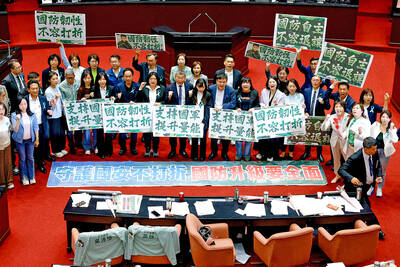
WHAT WAS ALL THAT FOR? Jaw Shaw-kong said that Cheng Li-wen had pushed for more drastic cuts and attacked him, just for the outcome to be nearly identical to his bill The legislature yesterday passed a supplementary budget bill to fund the purchase of separate packages of US military equipment, with the combined amount of spending capped at NT$780 billion (US$24.8 billion). The Chinese Nationalist Party (KMT) and Taiwan People’s Party (TPP) used their legislative majority to pass the bill, which runs until 2033 and has two main funding provisions. One was for NT$300 billion of arms sales already approved by the US for Taiwan on Dec. 17 last year, the other was for NT$480 billion for another arms package expected to be announced by Washington. The bill, which fell short of the NT$1.25
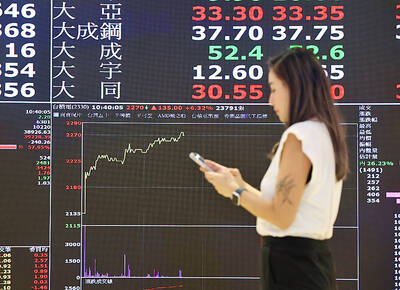
Taiwanese shares yesterday posted a record daily gain of more than 1,700 points to close above 40,000 points for the first time, led by large-cap semiconductor stocks such as Taiwan Semiconductor Manufacturing Co (TSMC, 台積電) and MediaTek Inc (聯發科) amid optimism about the artificial intelligence (AI) boom. The TAIEX ended up 1,778.51 points, or 4.57 percent, at 40,705.14 after moving between 39,228.39 and 40,755.52, while the New Taiwan dollar closed up NT$0.038 at NT$31.610 per US dollar, ending three consecutive sessions of declines. Turnover on the main board totaled NT$1.007 trillion (US$31.9 billion), with foreign institutional investors buying a net NT$66.98 billion
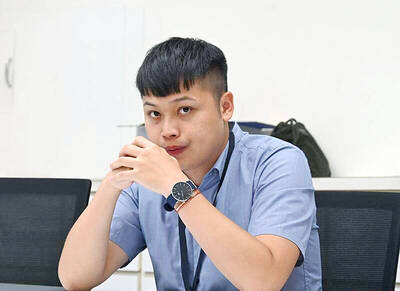
A former television news host and six military personnel — active and retired — have been indicted on espionage charges, Kaohsiung prosecutors said yesterday. Lin Chen-you (林宸佑), a former CTi News host and YouTuber, last year allegedly made videos at the direction of a Chinese agent criticizing the Democratic Progressive Party’s recall campaign, the Ciaotou District Prosecutors’ Office told a news conference in Kaohsiung. He allegedly received 4,325 tether coins for the videos from an unidentified person surnamed Huang (黃), believed to be an agent of a hostile foreign power, they said. Lin, also known as Ma Te (馬德), has a show named
NON-INTERFERENCE: The US called Taiwan a trusted and capable partner, while an African Union leader urged nations to reflect on respect for sovereign choices Taiwan is a “trusted and capable” partner of the US and Taipei’s global relationships, including with Eswatini, provide significant benefits, the US Department of State said of President William Lai’s (賴清德) trip to the southern African kingdom. Lai arrived in the former Swaziland on Saturday on a surprise visit after a planned trip last month was canceled when Seychelles, Mauritius and Madagascar denied overflight permission for his aircraft due to Chinese pressure. “Taiwan is a trusted and capable partner of the United States and many others, and its relationships around the world provide significant benefits to the citizens of those countries,


 RSS
RSS