


The public is almost evenly split over whether the US would come to Taiwan's defense if China attacked, an opinion poll suggested yesterday.
The poll conducted by the Taiwan Thinktank on the meeting last week between US President George W. Bush and Chinese President Hu Jintao (
Political scientist Lo Chih-cheng (
However, Lo added that this view was at odds with public opinion in the US, as past surveys there on public support for the US sending troops to defend Taiwan averaged at only 30 percent.
Perception gap
"There is an obvious gap between what the Taiwanese people think they can get and what the American public are willing to give to Taiwan," Lo said.
The survey also showed that 60 percent of respondents did not believe remarks made by Hu during his visit to the US that "China has been dedicating itself to maintaining world peace and stability." Only 30 percent of Chinese Nationalist Party (KMT) supporters said they believed Hu when answering the same question, according to the poll.
Lo said the result showed it was a misconception that Taiwanese people only focused on the "soft side" of China -- namely its economic attractions -- and that they have noticed both the positive and negative aspects of China's rise.
Joint efforts
Meanwhile, the poll also showed that 77 percent of respondents favored the idea of Taiwan, China and the US jointly managing cross-strait stability.
Twenty-six percent of respondents, meanwhile, felt that the Bush-Hu meeting had damaged US-Taiwan relations.
The poll was conducted last weekend with a sample size of 1,099 people.
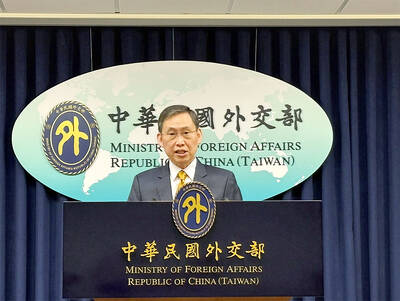
A Ministry of Foreign Affairs official yesterday said that a delegation that visited China for an APEC meeting did not receive any kind of treatment that downgraded Taiwan’s sovereignty. Department of International Organizations Director-General Jonathan Sun (孫儉元) said that he and a group of ministry officials visited Shenzhen, China, to attend the APEC Informal Senior Officials’ Meeting last month. The trip went “smoothly and safely” for all Taiwanese delegates, as the Chinese side arranged the trip in accordance with long-standing practices, Sun said at the ministry’s weekly briefing. The Taiwanese group did not encounter any political suppression, he said. Sun made the remarks when
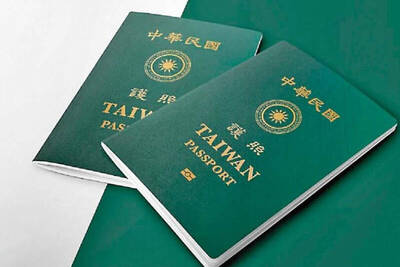
The Taiwanese passport ranked 33rd in a global listing of passports by convenience this month, rising three places from last month’s ranking, but matching its position in January last year. The Henley Passport Index, an international ranking of passports by the number of designations its holder can travel to without a visa, showed that the Taiwan passport enables holders to travel to 139 countries and territories without a visa. Singapore’s passport was ranked the most powerful with visa-free access to 192 destinations out of 227, according to the index published on Tuesday by UK-based migration investment consultancy firm Henley and Partners. Japan’s and
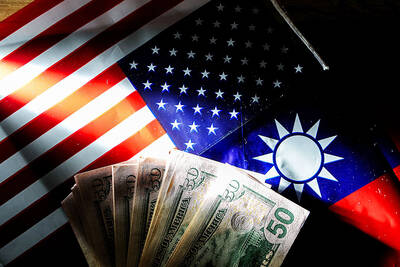
BROAD AGREEMENT: The two are nearing a trade deal to reduce Taiwan’s tariff to 15% and a commitment for TSMC to build five more fabs, a ‘New York Times’ report said Taiwan and the US have reached a broad consensus on a trade deal, the Executive Yuan’s Office of Trade Negotiations said yesterday, after a report said that Washington is set to reduce Taiwan’s tariff rate to 15 percent. The New York Times on Monday reported that the two nations are nearing a trade deal to reduce Taiwan’s tariff rate to 15 percent and commit Taiwan Semiconductor Manufacturing Co (TSMC, 台積電) to building at least five more facilities in the US. “The agreement, which has been under negotiation for months, is being legally scrubbed and could be announced this month,” the paper said,
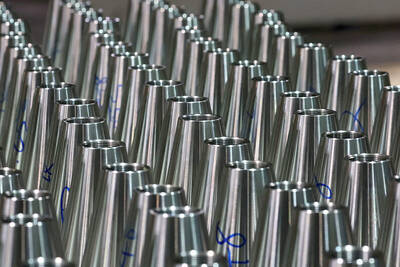
MIXED SOURCING: While Taiwan is expanding domestic production, it also sources munitions overseas, as some, like M855 rounds, are cheaper than locally made ones Taiwan and the US plan to jointly produce 155mm artillery shells, as the munition is in high demand due to the Ukraine-Russia war and should be useful in Taiwan’s self-defense, Armaments Bureau Director-General Lieutenant General Lin Wen-hsiang (林文祥) told lawmakers in Taipei yesterday. Lin was responding to questions about Taiwan’s partnership with allies in producing munitions at a meeting of the legislature’s Foreign Affairs and National Defense Committee. Given the intense demand for 155mm artillery shells in Ukraine’s defense against the Russian invasion, and in light of Taiwan’s own defensive needs, Taipei and Washington plan to jointly produce 155mm shells, said Lin,


 RSS
RSS