


President Hu Jintao (胡錦濤) has urged China's 2.5 million-member military to ensure national unity by beefing up its combat skills, amid harsh warnings to Taiwan against moving toward formal independence.
"We must strive to improve the capability of the armed forces to deal with crises, maintain peace, contain conflicts and win wars," Hu was quoted as saying in Sunday's official People's Liberation Army Daily and other newspapers.
Hu's comments on Saturday to China's top brass contained few specifics and he was not quoted as directly mentioning Taiwan.
However, China's recent military buildup -- including a 14.7 percent increase in military spending this year -- is believed to be largely directed at Taiwan.
China has lambasted President Chen Shui-bian (
"We must resolutely carry out our sacred responsibility of defending national sovereignty, unity, and territorial integrity and security," said Hu, pictured wearing an army green uniform without insignia as chairman of the Central Military Commission, which controls the military.
Hu told the group of senior officers the next five years will be a "an important period" for the nation's military modernization.
"The 11th five-year plan [from 2006 to 2010] is a crucial period for the establishment of a comparatively prosperous society," Hu said, according to the People's Daily, the Communist Party's mouthpiece.
"It is also an important period for defense and army modernization," he told the officers, assembled in Beijing as delegates to the ongoing National People's Congress.
China announced last week that its military budget for this year would rise to US$35 billion, the latest in a series of double-digit annual increases dating back to the early 1990s.
A Pentagon report last year estimated that China's defense spending was two to three times the publicly announced figure and that the military balance with Taiwan was tipping in Beijing's favor.
"We must persist in fulfilling the sacred task of defending national sovereignty, unity, territorial integrity and security," Hu said, according to the People's Daily.
Hu said efforts should be stepped up to equip the army with modern information technology and to improve its combat efficiency through high-tech means.
"We should strive to improve the capability of the armed forces to deal with crises, maintain peace, contain wars and win victory in possible wars," he said.
Inspired by swift US victories in post-Cold War conflicts, China has been striving to transform its military from an organization that relied on strength in numbers to a leaner, more sophisticated fighting force.
It announced in January it had demobilized 200,000 members of its military over the previous three years, but even after those personnel cuts, it remained the world's largest with 2.3 million troops.
Hu is believed to be faced with the challenge of creating a loyal following among the nation's top brass.
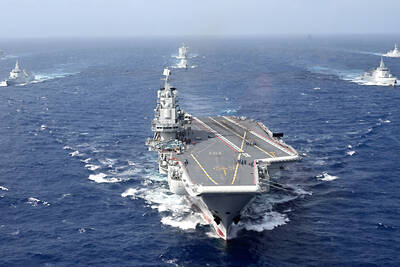
PROVOCATIVE: Chinese Deputy Ambassador to the UN Sun Lei accused Japan of sending military vessels to deliberately provoke tensions in the Taiwan Strait China denounced remarks by Japan and the EU about the South China Sea at a UN Security Council meeting on Monday, and accused Tokyo of provocative behavior in the Taiwan Strait and planning military expansion. Ayano Kunimitsu, a Japanese vice foreign minister, told the Council meeting on maritime security that Tokyo was seriously concerned about the situation in the East China and South China seas, and reiterated Japan’s opposition to any attempt to change the “status quo” by force, and obstruction of freedom of navigation and overflight. Stavros Lambrinidis, head of the EU delegation to the UN, also highlighted South China Sea
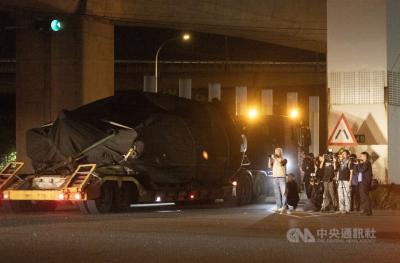
The final batch of 28 M1A2T Abrams tanks purchased from the US arrived at Taipei Port last night and were transported to the Armor Training Command in Hsinchu County’s Hukou Township (湖口), completing the military’s multi-year procurement of 108 of the tanks. Starting at 12:10am today, reporters observed more than a dozen civilian flatbed trailers departing from Taipei Port, each carrying an M1A2T tank covered with black waterproof tarps. Escorted by military vehicles, the convoy traveled via the West Coast Expressway to the Armor Training Command, with police implementing traffic control. The army operates about 1,000 tanks, including CM-11 Brave Tiger
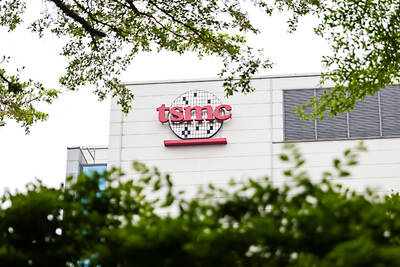
Taiwan Semiconductor Manufacturing Co (TSMC, 台積電), the world’s largest contract chipmaker, said it expects its 2-nanometer (2nm) chip capacity to grow at a compound annual rate of 70 percent from this year to 2028. The projection comes as five fabs begin volume production of 2-nanometer chips this year — two in Hsinchu and three in Kaohsiung — TSMC senior vice president and deputy cochief operating officer Cliff Hou (侯永清) said at the company’s annual technology symposium in Silicon Valley, California, last week. Output in the first year of 2-nanometer production, which began in the fourth quarter of last year, is expected to
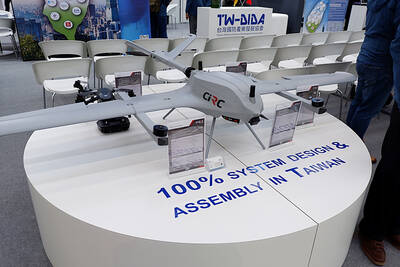
Taiwan’s drone exports surged past US$100 million in the first quarter, exceeding last year’s full-year total, with the Czech Republic emerging as the largest buyer, the Ministry of Economic Affairs said. Exports of complete drones reached US$115.85 million in the period, about 1.2 times the total recorded for all of last year, the ministry said in a report. Exports to the Czech Republic accounted for about US$100 million, far outpacing other markets. Poland, last year’s top destination, recorded about US$11.75 million in the first quarter. Taiwan’s drone exports have expanded rapidly in the past few years, with last year’s total


 RSS
RSS