


Retitled Wulin Warriors: Legend of the Seven Stars, the Taiwanese puppet series Pili was broadcast on Saturday for the first time in the US on the Cartoon Network.
The series, originally known outside of Taiwan as Thunderforce, is the most popular puppet series in the country.
Broadway Video Enterprises and GoodTimes Entertainment finalized an exclusive deal last year, acquiring worldwide television, merchandising, licensing and home rental rights to Thunderforce.
According to US media reports, Terry Kalagian, Cartoon Network's vice president of acquisitions and co-productions, said that the company was excited about bringing to television a whole new kind of action show for children.
"It's a combination of Eastern action with a Western bent," Kalagian said. "It's just what you would expect out of butt-kicking marionettes."
Britta von Schoeler, vice president of Broadway Video Enterprises, said that Wulin Warriors is a one-of-a-kind franchise and will turn into something much more than "Taiwan's little secret."
"As the popularity of Asian-influenced entertainment continues to grow around the world, genre fans are always on the look-out for the next cool import. The series delivers on many levels -- from its unique look featuring martial arts puppetry blended with animated special effects to its action-packed storyline," Schoeler said.
However, some of the original dialogue has been cut, and the puppets now speak fluent English instead of Hoklo (commonly known as Taiwanese).
Some puppet fans expressed discontent over the changes made to the series and are afraid that it will turn out to be an action cartoon that doesn't represent local culture.
However, one puppet fan said that the changes were necessary as they would help foreign viewers appreciate the series more easily.
"After they become interested in the series, they will do further research and understand what the original series was like as well as the whole history of Taiwanese puppets," said the fan, surnamed Hsu. "It will help spread Taiwanese culture."
The predecessor of Pili, the hugely popular Yun Chou Warriors, was one of the first puppet TV shows to screen in Taiwan and was watched by so many people when it aired in 1970 that it ended up banned for several years because it "caused students to skip classes and farmers to abandon their fields," as one fan said.
Another puppet fan surnamed Lin said that he could recall when an exam question had asked who the nation's founding father was. Many students answered the name of the warrior hero in the series instead of Sun Yat-sen (
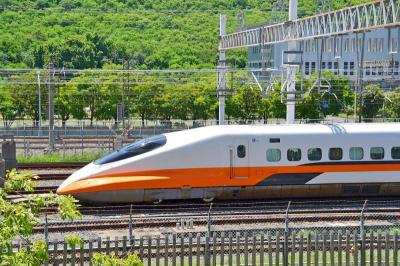
A signaling system malfunction disrupted high-speed rail (HSR) services beginning at 8am today, with trains temporarily reduced to three northbound and three southbound trains per hour as authorities conduct inspections. The malfunction occurred on a section of track in Miaoli County during pre-operation checks early this morning, forcing northbound and southbound trains to use a single track, the HSR operator said. The regular schedule has been replaced with three hourly trains offering only nonreserved seating in each direction, stopping at every station, it said, adding that business class cars would still have reserved seating. Departures from terminal stations are scheduled at the top

Taiwan is still in the process of assessing the possibility of recruiting workers from Eswatini, the Ministry of Foreign Affairs said yesterday, adding that its goal is to help Eswatini upgrade its vocational training centers. If there are plans to recruit workers from Eswatini, safeguarding national security, protecting public health and ensuring the employment rights of Taiwanese would be prerequisites, Department of West Asian and African Affairs Director-General Yen Chia-liang (顏嘉良) told a news conference. Key considerations would also include filling labor shortages in specific industries, and fostering bilateral professional and technical exchanges, he said. Yen was asked about the progress of labor
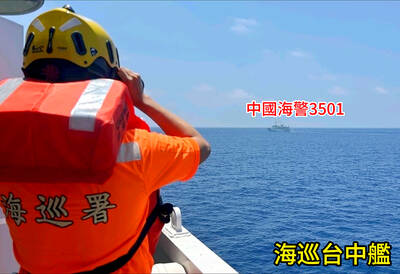
VERBOSE VESSELS: A CGA cutter and a China Coast Guard exchanged verbal barbs for more than a day in Taiwanese-controlled waters before the Chinese vessel left The Taiwanese and Chinese coast guards had a standoff near the strategically located Pratas Islands (Dongsha Islands, 東沙群島) in the north of the South China Sea, the Coast Guard Administration (CGA) said yesterday. The two sides engaged in intense radio exchanges over sovereignty claims during the 33-hour standoff. China Coast Guard vessel 3501 eventually left the restricted waters, 26.6 nautical miles (49.2km) west of the Pratas Islands, at 5pm yesterday, the CGA said. Lying approximately between southern Taiwan and Hong Kong, the Taiwan-controlled Pratas are seen by some security experts as vulnerable to Chinese attack due to their distance — more than

A US uncrewed surface vessel (USV) encountered multiple Chinese warships during an autonomous transit of the Taiwan Strait, US defense company Seasats said in a statement on Wednesday. Seasats announced that a Lightfish USV had completed the first autonomous transit of the Taiwan Strait. Over five days, the USV traversed the entire length of the Strait while constantly monitoring surface vessel traffic, the company said. The Lightfish encountered multiple Chinese warships, one of which was a Chinese People’s Liberation Army Navy (PLAN) Type 056 corvette, it said. The Chinese vessels were operating “well within Taiwan’s exclusive economic zone without transmitting their identity via the


 RSS
RSS