


Vice President Annette Lu (呂秀蓮) urged the government to reject a pair of pandas offered by China, saying the bears are part of a ploy to encourage Taiwan to unify with the communist nation, a news report said yesterday.
In an interview with the Chinese-language United Daily News, Lu said Taiwan should turn away the pair of one-year-old pandas that China has recently selected as a gift to give to Taiwan.
"The pandas are the modern version of Wang Chao-chun (王昭君)," Lu said, referring to the famous beauty who was offered as a concubine to the king of the Huns by Emperor Yuan in China's Han dynasty (about 100 A.D.)
Beijing hopes the pandas will strengthen Taiwanese public support for unification with China. But Taiwan, wary of any gifts from its rival, has not said whether it will accept the animals.
The two pandas were chosen from 11 pandas at the Wolong Nature Reserve in western China.
Keepers in charge of the selected pandas have said they have been singing to the bears in Taiwanese, noting that music is a language with no boundaries.
"The pandas are cute and I like them very much," Lu said. "But why were they forced to take lessons in the Taiwanese dialect?"
"If you really like the pandas, don't let them come to Taiwan but rather go and see them," she said.
Meanwhile, Mainland Affairs Council (MAC) Vice Chairman Liu Te-shun (劉德勳) said yesterday that the Chinese government should remove its bans and censorship measures as soon as possible. Liu made the remarks at the council's weekly press conference.
The MAC released a table which listed the different measures the Chinese authorities have taken in the past three years to regulate the media.
"Freedom of speech is a universal right. We wish the Chinese government would not continue violating it," Liu said.
He said that the government is greatly concerned about China's anti-democratic measures, as they block the Chinese people from accessing diverse information and stop them from expressing themselves freely.
China's recent decision to shut down Freezing Point, an influential weekly, and ask the world's largest search engine, Google. to launch a Web site that will censor results to meet the government's requirements incurred an avalanche of criticism.
Apart from those incidents, the MAC said that the Chinese had taken another 40 measures as part of its crackdown on freedom of speech in the last three years.
"China's Propaganda Department also admitted that it has withdrawn79 publications from circulation," Liu said.
Reacting to Chinese Nationalist Party (KMT) Chairman Ma Ying-jeou's (馬英九) suggestion to allow Chinese students to study in Taiwan's higher education system, Liu said that such a move would require considerable debate.
"It is not just a question of education. The government needs to take many things into account, like the impact on Taiwan's employment market," Liu said.
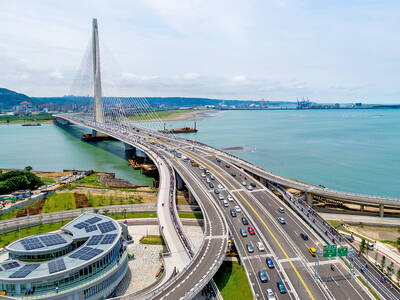
The Ministry of Transportation and Communications yesterday inaugurated the Danjiang Bridge across the Tamsui River in New Taipei City, saying that the structure would be an architectural icon and traffic artery for Taiwan. Feted as a major engineering achievement, the Danjiang Bridge is 920m long, 211m tall at the top of its pylon, and is the longest single-pylon asymmetric cable-stayed bridge in the world, the government’s Web site for the structure said. It was designed by late Iraqi-British architect Zaha Hadid. The structure, with a maximum deck of 70m, accommodates road and light rail traffic, and affords a 200m navigation channel for boats,
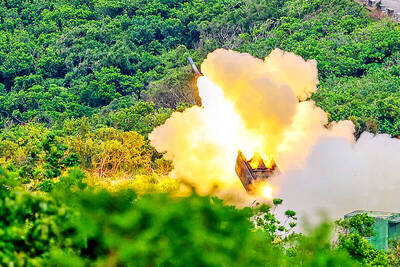
PRECISION STRIKES: The most significant reason to deploy HIMARS to outlying islands is to establish a ‘dead zone’ that the PLA would not dare enter, a source said A High Mobility Artillery Rocket System (HIMARS) would be deployed to Penghu County and Dongyin Island (東引) in Lienchiang County (Matsu) to force the Chinese military to retreat at least 100km from the coastline, a military source said yesterday. Taiwan has been procuring HIMARS and Army Tactical Missile Systems (ATACMS) from the US in batches. Once all batches have been delivered, Taiwan would possess 111 HIMARS units and 504 ATACMS, which have a range of 300km. Considering that “offense is the best defense,” the military plans to forward-deploy the systems to outlying islands such as Penghu and Dongyin so that

WHAT WAS ALL THAT FOR? Jaw Shaw-kong said that Cheng Li-wen had pushed for more drastic cuts and attacked him, just for the outcome to be nearly identical to his bill The legislature yesterday passed a supplementary budget bill to fund the purchase of separate packages of US military equipment, with the combined amount of spending capped at NT$780 billion (US$24.8 billion). The Chinese Nationalist Party (KMT) and Taiwan People’s Party (TPP) used their legislative majority to pass the bill, which runs until 2033 and has two main funding provisions. One was for NT$300 billion of arms sales already approved by the US for Taiwan on Dec. 17 last year, the other was for NT$480 billion for another arms package expected to be announced by Washington. The bill, which fell short of the NT$1.25

‘CLEAR MESSAGE’: The bill would set up an interagency ‘tiger team’ to review sanctions tools and other economic options to help deter any Chinese aggression toward Taiwan US Representative Young Kim has introduced a bill to deter Chinese aggression against Taiwan, calling for an interagency “tiger team” to preplan coordinated sanctions and economic measures in response to possible Chinese military or political action against Taiwan. “[Chinese President] Xi Jinping [習近平] has directed the People’s Liberation Army to be ready to invade Taiwan by 2027. China has a plan. America should have one too,” Kim said in a news release on Thursday last week. She introduced the “Deter PRC [People’s Republic of China] aggression against Taiwan act” to “ensure the US has a coordinated sanctions strategy ready should


 RSS
RSS