


Japan's military is stepping up its defense of islands also claimed by China and Taiwan, and will propose talks with India on diplomatic and security issues as part of attempts to counter China's growing military might in Asia, a report said yesterday.
The report came days after Japanese Foreign Minister Taro Aso said Beijing poses "a considerable military threat" because it has nuclear weapons and is boosting its military spending. China called the remarks irresponsible and groundless.
According to Japan's largest business newspaper, the Nihon Keizai Shimbun, Japan's Self-Defense Forces will conduct joint exercises with the US Marine Corps this month and develop short-range torpedoes tailored for combat in shallow waters to strengthen its ability to repulse a possible Chinese invasion of the disputed East China Sea islands.
Japan envisions a scenario in which China would invade the islets, called the Diaoyutais (
About 125 Japanese troops will be sent to San Diego, California, in January for joint exercises with US Marines simulating a landing on an occupied island, the report said.
Self-Defense Forces officials could not immediately be reached for comment on the report, but earlier said the two countries plan joint training by the end of March.
The Nihon Keizai also said Japan will propose bilateral talks with India on diplomatic and security issues -- and on holding regular visits by their respective defense ministers -- in part to discuss ways to curb China's growing influence in Asia.
Aso will also raise the issue on a trip to India starting Tuesday, it said. He is slated to meet President Abdul Kalam and Prime Minister Manmohan Singh, and is also scheduled to visit Pakistan.
Japan plans to propose regular discussions between the Japanese and Indian foreign ministers on both nations' bids for permanent UN Security Council seats, the creation of a pan-Asian economic and strategic community, and military affairs in Asia, it said.
Aso also will invite Indian Defense Minister Shri Pranab Mukherjee to visit Japan in the spring, the Nihon Keizai said.
Japan-China tensions have grown along with Beijing's spectacular rise as an economic and military power.
The two countries are sparring over issues including territorial and resource disputes, history and Japan's military alliance with the US.
Relations soured further several days ago, when Beijing denounced Tokyo for claiming that Chinese spies drove a Japanese consulate employee to commit suicide last year in Shanghai.
Tokyo has given no further details, but Japanese media say the consulate employee was a communications specialist who took his life after Chinese agents pressured him for secret information. Beijing has denied the allegations.
also see story:
Japan tried to `hide' suicide

The Tourism Administration yesterday announced that it would reward repeat international visitors with incentives of up to NT$8,000 to boost inbound tourism. The incentives are available to all international tourists, it said, adding that repeat visitors would be rewarded with NT$5,000 and would receive an additional NT$3,000 if they bring travel companions. The nation received 2,990,657 inbound visitors during the first quarter, marking a 3.8 percent increase from the same period last year, agency data showed. Japanese nationals are among groups visiting Taiwan the most. About 1.48 million Japanese tourists arrived last year, a year-on-year increase of more than 12
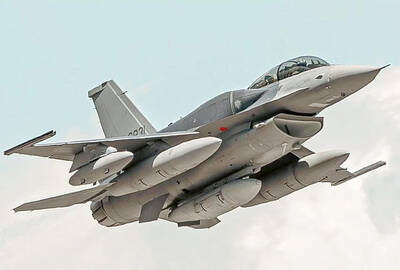
66 FIGHTER JETS: The aircraft is likely undergoing preparations for its transfer to Taiwan — a significant step forward in the nation’s modernization program, a lawmaker said The first of Taiwan’s order of F-16V Block 70 aircraft has been sighted in Texas ahead of delivery, Democratic Progressive Party (DPP) Legislator Wang Ting-yu (王定宇) said. Taiwan’s first F-16V Block 70 two-seat aircraft, tail number 6831, was seen flying from Lockheed Martin’s production facility in Greenville, South Carolina, to Naval Air Station Joint Reserve Base Fort Worth in Texas, Wang wrote on Facebook yesterday. The plane is likely undergoing preparations for its transfer to Taiwan, marking a significant step forward in the Republic of China Air Force’s modernization program, Wang said, citing military analysts. The F-16V Block 70 is a new-build version
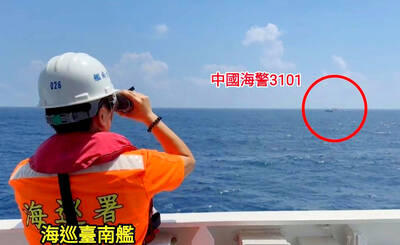
‘BRAZEN’: The holiday did not stop China from activities that infringe on Taiwan’s maritime jurisdiction, but the CGA is ready to defend the nation, Kuan Bi-ling said Beijing is intensifying maritime pressure on Taiwan, but the nation will never yield, Ocean Affairs Council Deputy Minister Sung Chen-en (宋承恩) said. The Coast Guard Administration (CGA) has adopted a “shadowing and monitoring” approach to avoid falling into a Chinese trap to escalate tensions and deepen the conflict, Sung said in an interview published yesterday in the Chinese-language Liberty Times (the Taipei Times’ sister newspaper). China Coast Guard formations patrolling waters east of Taiwan, as well as official Chinese vessels entering areas around Itu Aba Island (Taiping Island, 太平島) and Pratas Islands (Dongsha Islands, 東沙群島) show Beijing’s attempts to significantly step up
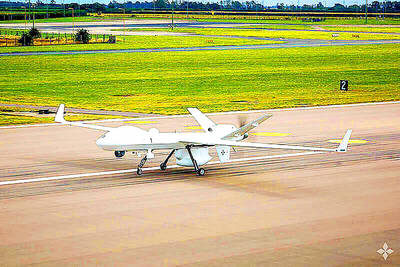
BOOST: By operating the same advanced systems as the US military, Taiwan would be better positioned to share and integrate intelligence with partners, an expert said The first batch of MQ-9B SkyGuardian drones has arrived in Taiwan, and is being assembled and tested by drone manufacturer General Atomics and the military ahead of flight trials as part of the air force’s acquisition to bolster its aerial surveillance capabilities, a source said yesterday. The air force allocated a budget of NT$21.7 billion (US$687 million) from 2022 to 2029 to procure four MQ-9B uncrewed aerial vehicles (UAVs) manufactured by General Atomics along with associated equipment such as ground control stations. The US has agreed to deliver the four MQ-9Bs to Taiwan in two batches this year and next


 RSS
RSS