


The passage of Typhoon Talim, which entered southeastern China yesterday afternoon after being weakened by the mountains of Taiwan, left its mark throughout the country because of its strong winds and heavy rains.
Talim cut power lines, toppled billboards and tore up trees, while heavy rain led to flooding in some towns in central Taiwan.
Forecasters said that residents in the south should remain alert to heavy rain in the following days because of unstable currents wandering around southwestern Taiwan.
As of press time, statistics released by the Executive Yuan suggested that Talim has caused three deaths and left 59 people injured, 787,000 families without electricity, 48,000 household users without water supply and 287,000 users of fixed telephone lines disconnected.
One 67-year-old man surnamed Chen (陳) was drowned in a channel near his house, in Peimen (北門) Township, Tainan County. A 43-year-old man, surnamed Lou (羅), was also drowned in an irrigation channel near his house in Taian (泰安) Township, Miaoli County.
According to the Executive Yuan, most victims received their injuries after being hit by falling shop signs or other flying items.
Officials said at least 1,207 residents in remote townships in six counties had been relocated in 47 temporary shelters for the sake of safety.
"The winds were really fierce and it was very dangerous driving through the torrential rains last night," said a taxi driver surnamed Tsai. "I heard a loud bang and saw scaffolding had crashed into the street right next to my car. It was a close shave."
Beginning yesterday, flights resumed at local airports and the trains restarted their operations.
As of 5pm yesterday, the financial losses in the agriculture sector had exceeded NT$358 million, as crop farms, fish ponds and other facilities had been flooded.
The Central Weather Bureau yesterday afternoon lifted the land warning for the storm, but reminded people in the south of inevitable torrential rains in the following days. By press time, accumulative rainfall measured in Taoyuan (
Hsieh Ming-chang (
"We predict that accumulative rainfall will exceed 1,000mm in the south and 800mm in other places," Hsieh said.
also see stories:
Talim cuts into Taoyuan's water
Editorial: Learning respect for typhoons

A signaling system malfunction disrupted high-speed rail (HSR) services beginning at 8am today, with trains temporarily reduced to three northbound and three southbound trains per hour as authorities conduct inspections. The malfunction occurred on a section of track in Miaoli County during pre-operation checks early this morning, forcing northbound and southbound trains to use a single track, the HSR operator said. The regular schedule has been replaced with three hourly trains offering only nonreserved seating in each direction, stopping at every station, it said, adding that business class cars would still have reserved seating. Departures from terminal stations are scheduled at the top

DRONE CENTRAL: Taiwan aims to become Asia’s democratic hub for drones, with most exports focused on high-quality military-grade models, an official said Taiwan’s drone industry is expected to expand significantly by 2030, producing 100,000 units per month and exporting half of them, the Ministry of Economic Affairs said yesterday. Current drone production capacity is about 15,000 units per month, but the industry can quickly scale up as demand increases, Industrial Development Administration Director-General Chiou Chyou-huey (邱求慧) told a news conference in Taipei. Taiwan’s drone output grew 2.5-fold last year to NT$12.9 billion (US$408.3 million) under a government program to develop the uncrewed vehicle sector, he said. The Executive Yuan in October last year approved plans to invest NT$44.2 billion into domestic production of uncrewed aerial

VERBOSE VESSELS: A CGA cutter and a China Coast Guard exchanged verbal barbs for more than a day in Taiwanese-controlled waters before the Chinese vessel left The Taiwanese and Chinese coast guards had a standoff near the strategically located Pratas Islands (Dongsha Islands, 東沙群島) in the north of the South China Sea, the Coast Guard Administration (CGA) said yesterday. The two sides engaged in intense radio exchanges over sovereignty claims during the 33-hour standoff. China Coast Guard vessel 3501 eventually left the restricted waters, 26.6 nautical miles (49.2km) west of the Pratas Islands, at 5pm yesterday, the CGA said. Lying approximately between southern Taiwan and Hong Kong, the Taiwan-controlled Pratas are seen by some security experts as vulnerable to Chinese attack due to their distance — more than
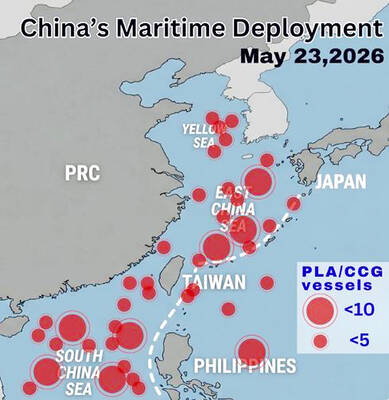
WARNING: China should stop engaging in actions that undermine regional peace and stability, as it would only build resentment among people across the Strait, the CGA said China has deployed more than 100 navy, coast guard and other vessels in waters from the Yellow Sea to the South China Sea and the western Pacific since US President Donald Trump and Chinese President Xi Jinping (習近平) met in Beijing, National Security Council Secretary-General Joseph Wu (吳釗燮) said yesterday. “In this part of the world, #China is the one & only PROBLEM wrecking the #StatusQuo & threatening regional peace & stability,” Wu wrote on X. In a separate post, he said Beijing was coercing Taiwan’s maritime domain, calling it illegal and provocative, after the Coast Guard Administration (CGA) expelled a


 RSS
RSS