


President Chen Shui-bian (
Chen praised the Tibetan spiritual leader as "the world's greatest religious leader" and expressed hope that the Buddhist icon would make a third visit to Taiwan to "allow an opportunity for believers in Taiwan to be showered in his wisdom and cheerful presence."
Noting Taiwan and Tibet's similar predicaments, in which both have suffered due to Chinese military expansionism, the president said "Taiwan can identify with Tibet's experience, and is willing to step up efforts enhancing exchanges and cooperation between Taiwan and Tibet."
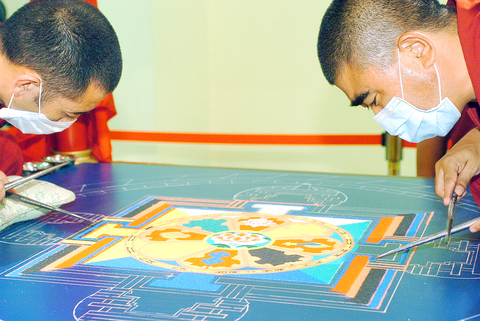
PHOTO: LU CHUN-WEI, TAIPEI TIMES
Chen made the remarks when touring an exhibition yesterday which featured many rarely seen photos, hand-written letters and documents relating to the Dalai Lama, as well as other presentations that showcased Tibetan culture.
The exhibition, staged as part of the events celebrating the 14th Dalai Lama's 70th birthday, was sponsored by the Tibetan Religious Foundation of His Holiness the Dalai Lama (
Recalling the Tibetan leader's second visit to Taiwan in March 2001 during which Chen met the lama in the Presidential Office, the president said "the Dalai Lama's blithesome laughter and profound sayings" had left a strong impression on him.
Chen continued, saying that the Tibet issue has also over the years gained increasing international attention and support under the leadership of the Dalai Lama, who the president lauded as having led the Tibetan government-in-exile "with wisdom and compassion."
Opposed to the demands of hardline Tibetans for the use of violence to achieve independence from Chinese rule, the Dalai Lama called for greater autonomy for his homeland, and fled in 1959 after Beijing crushed an anti-Chinese uprising in the landlocked country.
He was awarded the Nobel Peace Prize in 1989 for his non-violent struggle for freedom.
The Tibetan "god-king" and the Tibetan government-in-exile are currently seated in the Indian city of Dharamsala.
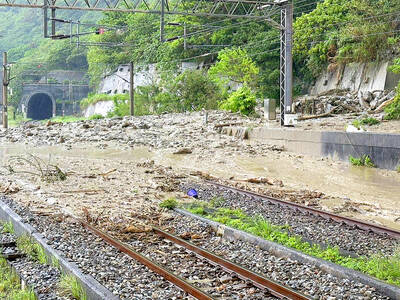
ROLLER-COASTER RIDE: More than five earthquakes ranging from magnitude 4.4 to 5.5 on the Richter scale shook eastern Taiwan in rapid succession yesterday afternoon Back-to-back weather fronts are forecast to hit Taiwan this week, resulting in rain across the nation in the coming days, the Central Weather Administration said yesterday, as it also warned residents in mountainous regions to be wary of landslides and rockfalls. As the first front approached, sporadic rainfall began in central and northern parts of Taiwan yesterday, the agency said, adding that rain is forecast to intensify in those regions today, while brief showers would also affect other parts of the nation. A second weather system is forecast to arrive on Thursday, bringing additional rain to the whole nation until Sunday, it
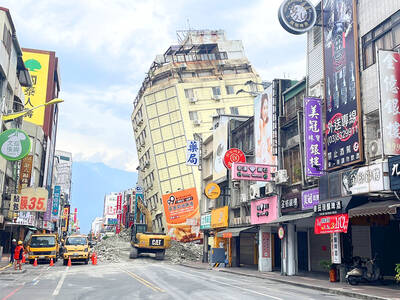
LANDSLIDES POSSIBLE: The agency advised the public to avoid visiting mountainous regions due to more expected aftershocks and rainfall from a series of weather fronts A series of earthquakes over the past few days were likely aftershocks of the April 3 earthquake in Hualien County, with further aftershocks to be expected for up to a year, the Central Weather Administration (CWA) said yesterday. Based on the nation’s experience after the quake on Sept. 21, 1999, more aftershocks are possible over the next six months to a year, the agency said. A total of 103 earthquakes of magnitude 4 on the local magnitude scale or higher hit Hualien County from 5:08pm on Monday to 10:27am yesterday, with 27 of them exceeding magnitude 5. They included two, of magnitude

OVERWHELMING SUPPORT: The bill with US$2 billion in Foreign Military Financing Program funds and US$1.9 billion to replenish defense articles passed the House 385-34 Taiwan is to continue working with the US to ensure peace in the Taiwan Strait, the Ministry of National Defense said yesterday after the US House of Representatives approved a US$95 billion foreign aid package with funding for Taiwan. The bills were passed with bipartisan support in a rare Saturday session after votes had been delayed for months by House Republicans. After clearing the House, the bills — containing US$8 billion for Taiwan and the Indo-Pacific region, along with US$60.8 billion for Kyiv, and US$26 billion for Israel and humanitarian aid for civilians in conflict zones — would be combined into a
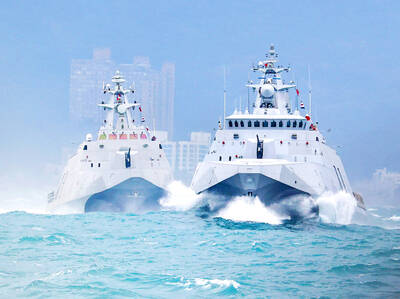
The navy next month is expected to commission into service two more domestically built Tuo Chiang-class stealth missile corvettes, a source said yesterday. The Hsu Chiang (旭江, PGG-621) and the Wu Chiang (武江, PGG-623) would be officially commissioned in a ceremony early next month, the source said, speaking on condition of anonymity. The corvettes, launched in February and June last year respectively, were delivered to the navy in February. They are the third and fourth Tuo Chiang-class stealth missile corvettes to be produced. The Tuo Chiang-class corvette is a domestically designed and manufactured class of fast and stealthy multipurpose corvette built for the


 RSS
RSS