


China's state television broadcasts were interrupted for nearly 15 minutes by video about the banned Falun Gong spiritual group, a spokesman for a Hong Kong-based satellite company said yesterday.
Falun Gong -- which China has labeled an "evil cult" and tried to suppress -- denied tampering with the programming beamed across the country.
The interference occurred on signals from the APSTAR 6 satellite on Sunday evening, and affected 25 channels -- 13 belonging to state-run CCTV and 12 provincial or city channels, spokesman Brian Lo for Hong Kong-based APT Satellite Holdings Ltd, which operates the satellite, said.
Lo declined to describe the inserted footage in detail, but said that whoever was responsible had tried to jam the satellite's signals for an hour but only managed to insert 14-and-a-half minutes of video, Lo said.
He said the interrupted programming was beamed to Shanghai and Shenzhen. Other provinces and regions affected included Guangdong, Hunan, Yunnan, Inner Mongolia, Ningxia and Zhejiang.
Lo said his company hasn't been able to trace the jamming signal and had reported the matter to Hong Kong's police and telecommunications authority. Police did not immediately comment.
Spokeswoman Diana Fu of the Office of the Telecommunications Authority said the department will study whether there are anti-jamming measures it can recommend to APT.
A Hong Kong-based spokeswoman for Falun Gong, which mixes slow-motion exercise and Buddhist and Taoist teachings, denied the group was behind the satellite jamming, saying it doesn't have the resources to do it.
"I don't think it's something ... we can do because we're just ordinary volunteers," Sophie Xiao said.
She characterized the allegations as a smear campaign against the spiritual group.

A signaling system malfunction disrupted high-speed rail (HSR) services beginning at 8am today, with trains temporarily reduced to three northbound and three southbound trains per hour as authorities conduct inspections. The malfunction occurred on a section of track in Miaoli County during pre-operation checks early this morning, forcing northbound and southbound trains to use a single track, the HSR operator said. The regular schedule has been replaced with three hourly trains offering only nonreserved seating in each direction, stopping at every station, it said, adding that business class cars would still have reserved seating. Departures from terminal stations are scheduled at the top

Taiwan is still in the process of assessing the possibility of recruiting workers from Eswatini, the Ministry of Foreign Affairs said yesterday, adding that its goal is to help Eswatini upgrade its vocational training centers. If there are plans to recruit workers from Eswatini, safeguarding national security, protecting public health and ensuring the employment rights of Taiwanese would be prerequisites, Department of West Asian and African Affairs Director-General Yen Chia-liang (顏嘉良) told a news conference. Key considerations would also include filling labor shortages in specific industries, and fostering bilateral professional and technical exchanges, he said. Yen was asked about the progress of labor

VERBOSE VESSELS: A CGA cutter and a China Coast Guard exchanged verbal barbs for more than a day in Taiwanese-controlled waters before the Chinese vessel left The Taiwanese and Chinese coast guards had a standoff near the strategically located Pratas Islands (Dongsha Islands, 東沙群島) in the north of the South China Sea, the Coast Guard Administration (CGA) said yesterday. The two sides engaged in intense radio exchanges over sovereignty claims during the 33-hour standoff. China Coast Guard vessel 3501 eventually left the restricted waters, 26.6 nautical miles (49.2km) west of the Pratas Islands, at 5pm yesterday, the CGA said. Lying approximately between southern Taiwan and Hong Kong, the Taiwan-controlled Pratas are seen by some security experts as vulnerable to Chinese attack due to their distance — more than
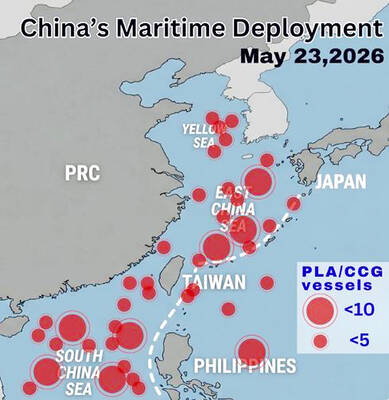
WARNING: China should stop engaging in actions that undermine regional peace and stability, as it would only build resentment among people across the Strait, the CGA said China has deployed more than 100 navy, coast guard and other vessels in waters from the Yellow Sea to the South China Sea and the western Pacific since US President Donald Trump and Chinese President Xi Jinping (習近平) met in Beijing, National Security Council Secretary-General Joseph Wu (吳釗燮) said yesterday. “In this part of the world, #China is the one & only PROBLEM wrecking the #StatusQuo & threatening regional peace & stability,” Wu wrote on X. In a separate post, he said Beijing was coercing Taiwan’s maritime domain, calling it illegal and provocative, after the Coast Guard Administration (CGA) expelled a


 RSS
RSS