


British Foreign Secretary Jack Straw, whose country holds the EU presidency in the second half of this year, said on Thursday that there is little chance of the EU lifting its ban on arms sales to China.
Straw said there was still considerable opposition in Europe, given China's human-rights record and tension between China and Taiwan.
"That is reflected in a series of resolutions in the European Parliament. So that is the difficulty at the moment," he told a group of journalists from across the EU.
The EU embargo was imposed after the Chinese military crushed student protests at Tiananmen Square in June 1989.
EU nations have been debating an end to the measure for several years and Straw's comment indicated the issue will not be settled soon.
Britain assumed the EU presidency yesterday. As such, it will set the EU agenda for the rest of the year and is unlikely to lobby for a lifting of the ban. Britain, along with the Netherlands, Denmark and Sweden, is most opposed to lifting the ban because of China's shaky human-rights record and Beijing's strident language in its dealing with Taiwan.
London is also wary of aggravating trans-Atlantic ties. The US has voiced concern about an end to the European arms ban, especially after China adopted the "Anti-Secession" Law recently authorizing military action against Taiwan.
Washington fears sales of high-tech arms to China's rapidly modernizing People's Liberation Army, the world's largest military by troop numbers, could increase its abilities to threaten US allies in Asia, including Japan and Taiwan, as well as its nearly 230,000 troops in the region.
Responding to such concerns, the EU is beefing up a code of conduct to govern eventual arms sales to China by the bloc's 25 member states.
"My guess is that there is still no consensus" to end the ban, Straw said.

SILENCING CRITICS: In addition to blocking Taiwan, China aimed to prevent rights activists from speaking out against authoritarian states, a Cabinet department said The Ministry of Foreign Affairs (MOFA) yesterday condemned transnational repression by Beijing after RightsCon, a major digital human rights conference scheduled to be held in Zambia this week, was abruptly canceled due to Chinese pressure over Taiwanese participation. This year’s RightsCon, the world’s largest conference discussing issues “at the intersection of human rights and technology,” was scheduled to take place from tomorrow to Friday in Lusaka, and expected to draw 2,600 in-person attendees from 150 countries, along with 1,100 online participants. However, organizers were forced to cancel the event due to behind-the-scenes pressure from China, the ministry said, expressing its “strongest condemnation”
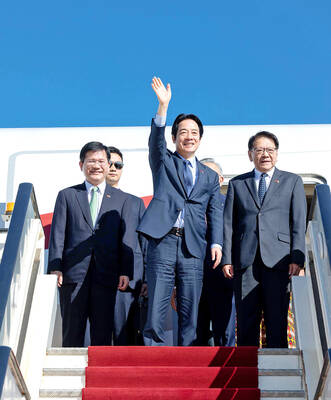
DELAYED BUT DETERMINED: The president’s visit highlights Taiwan’s right to international engagement amid regional pressure from China President Willaim Lai (賴清德) yesterday arrived in Eswatini, more than a week after his planned visit to Taiwan’s sole African ally was suspended because of revoked overflight permits. “The visit, originally scheduled for April 22, was postponed due to unforeseen external factors,” Lai wrote on social media. “After several days of careful arrangements by our diplomatic and national security teams, we successfully arrived today.” Lai said he looked forward to further deepening Taiwan-Eswatini relations through closer cooperation in the economy, agriculture, culture and education, as well as advancing the nation’s international partnerships. The president was initially scheduled to arrive in time to celebrate
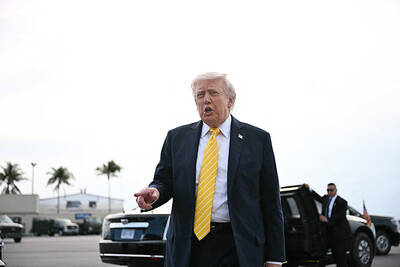
Iran’s Islamic Revolutionary Guard Corp (IRGC) yesterday said the US faced a choice between an “impossible” military operation or a “bad deal” with Tehran, after US President Donald Trump disparaged Iran’s latest peace proposal. Negotiations between the two countries have been deadlocked since a ceasefire came into effect on April 8, with only one round of direct peace talks held so far. Iran’s Tasnim and Fars news agencies reported that Tehran had submitted a 14-point proposal to mediator Pakistan, but Trump was quick to cast doubt on it. “I will soon be reviewing the plan that Iran has just sent to us, but

A group affiliated with indicted Chinese immigrant Xu Chunying (徐春鶯) is to be dissolved for monitoring Chinese immigrants in Taiwan, a source said yesterday. Xu, the secretary-general of the Cross-Strait Marriage and Family Service Alliance, was indicted on March 24 on charges of violating the Anti-Infiltration Act (反滲透法). The alliance “illegally monitored" Chinese immigrants living in Taiwan on behalf of the Chinese Communist Party (CCP) and the Ministry of the Interior is expected to dissolve the organization in the coming days under provisions of the Civil Associations Act (人民團體法), the source said. Xu, who married a Taiwanese in 1993 and became a Republic


 RSS
RSS