


The launch in Taiwan of Asia's first Aboriginal Television channel cements Aboriginal access to the media and advances the rights of Taiwan's indigenous people, President Chen Shui-bian (
Addressing the launch ceremony of the Indigenous Television Network (ITV), Chen said he had high hopes that the station would communicate the diversity of Taiwan's 12 Aboriginal tribes to the public and pass down the nation's indigenous cultural heritage to young Aborigines.
"Now that the camera and the microphone have been handed to the indigenous peoples, we expect ITV to seize this opportunity to disseminate minority viewpoints and their distinctive cultures and languages," Chen said.
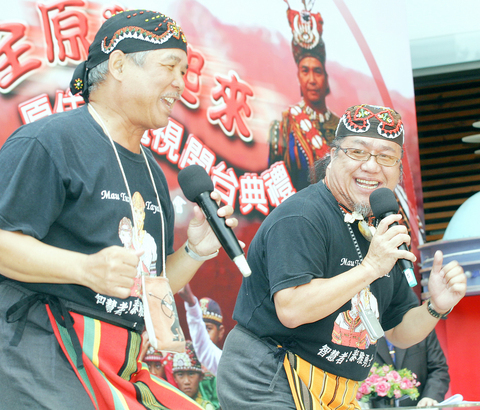
PHOTO: TAI TA-HSIANG, TAIPEI TIMES
Thanks to five years of effort by the government, the media industry and Aboriginal-rights advocates, the launch of ITV yesterday followed a six-month trial broadcast that started last December.
Performances of traditional song and dance by renowned Aboriginal artists featured throughout the launch, which was held in front of the Taiwan Television Station (TTV), the parent network responsible for operation of the channel.
After delivering his speech, Chen pressed a button with Premier Frank Hsieh (謝長廷), Council of Indigenous Peoples (CIP) Chairman Walis Pelin and Government Information Office (GIO) Minister Pasuya Yao (姚文智) to symbolize the start of the TV station's operations.
ITV promises to present programs showcasing Aboriginal culture and which move beyond stereotyped images portrayed in the media to date.
Taiwan's 460,000 indigenous people are expected to have access to ITV via satellite and other receivers, even in remote mountainous and coastal areas, according to GIO officials.
Some Aboriginal advocates, however, continued to express concerns over poor reception in some communities and an excessive number of commercials.
They criticized TTV's use of commercials on the Hakka television channel, which has been operated by TTV since July 2003, and said they feared ITV would receive the same treatment.
"For example, the program hosts often refer to Aborigines as `they,' as if we were some foreign creature from another world," said Voyu (
Sylvia Feng (
In addition to representing Aboriginal groups, Feng said, this would help train new talent and further reduce unemployment in the Aboriginal population.
The Aboriginal Education Law (
However, the plan stalled in 2003 over concerns in the Legislative Yuan that a large number of Aborigines would not be able to receive the channel because of the poor reception in mountainous areas.
The legislature eventually passed the NT$300 million (US$9.5 million) budget last year.
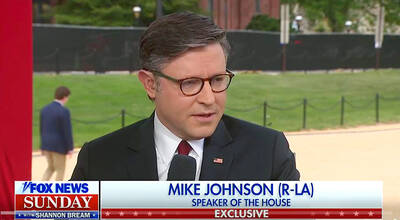
RESOLUTE BACKING: Two Republican senators are planning to introduce legislation that would impose immediate sanctions on China if it attempts to invade Taiwan US House of Representatives Speaker Mike Johnson on Sunday reaffirmed US congressional support for Taiwan, saying the US and “all freedom-loving people” have a stake in preventing China from seizing Taiwan by force. Johnson made the remarks in an interview with Fox News Sunday on US President Donald Trump’s summit with Chinese President Xi Jinping (習近平) last week. In an interview that aired on Friday on Fox News, just as Trump wrapped up a high-stakes visit to China, he said he has yet to green-light a new US$14 billion arms package to Taiwan and that it “depends on China.” “It’s a very good

DRONE CENTRAL: Taiwan aims to become Asia’s democratic hub for drones, with most exports focused on high-quality military-grade models, an official said Taiwan’s drone industry is expected to expand significantly by 2030, producing 100,000 units per month and exporting half of them, the Ministry of Economic Affairs said yesterday. Current drone production capacity is about 15,000 units per month, but the industry can quickly scale up as demand increases, Industrial Development Administration Director-General Chiou Chyou-huey (邱求慧) told a news conference in Taipei. Taiwan’s drone output grew 2.5-fold last year to NT$12.9 billion (US$408.3 million) under a government program to develop the uncrewed vehicle sector, he said. The Executive Yuan in October last year approved plans to invest NT$44.2 billion into domestic production of uncrewed aerial
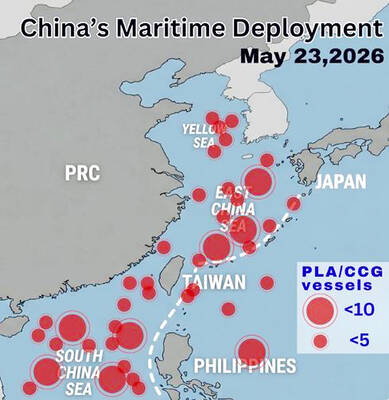
WARNING: China should stop engaging in actions that undermine regional peace and stability, as it would only build resentment among people across the Strait, the CGA said China has deployed more than 100 navy, coast guard and other vessels in waters from the Yellow Sea to the South China Sea and the western Pacific since US President Donald Trump and Chinese President Xi Jinping (習近平) met in Beijing, National Security Council Secretary-General Joseph Wu (吳釗燮) said yesterday. “In this part of the world, #China is the one & only PROBLEM wrecking the #StatusQuo & threatening regional peace & stability,” Wu wrote on X. In a separate post, he said Beijing was coercing Taiwan’s maritime domain, calling it illegal and provocative, after the Coast Guard Administration (CGA) expelled a
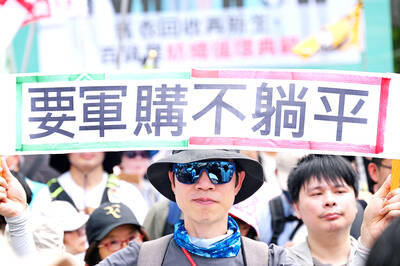
More than 8,000 people took part in a rally in Taipei yesterday to express support for more defense spending, after the opposition slashed the Cabinet’s proposed NT$1.25 trillion (US$39.6 billion) special defense budget and capped it at NT$780 billion. The demonstrators urged the Cabinet to propose another bill. Taiwan Economic Democracy Union convener Lai Chung-chiang (賴中強) said the main problem of the passed budget plan is the removal of funding for critical items, not just that the total amount is smaller. Critical budget items included purchasing or developing uncrewed vehicles, Strong Bow (強弓) missile systems, additional ammunition, artificial intelligence-powered combat systems and Taiwan-US


 RSS
RSS