

Premier Frank Hsieh (謝長廷) yesterday said the Chinese Nationalist Party's (KMT) chairmanship campaign had influenced the territorial dispute with Japan, citing the presence of opposition lawmakers on the naval vessel that traveled near disputed waters.
"Some of the people who boarded the frigate did so out of concern for the fishermen, but some of them are doing it instead for their own campaigns," he said. "This fishing dispute is a complicated issue and the government can't take rash actions that might lead us to become an international laughingstock."
"The government is dedicated to protecting our fishermen, but we have to be meticulous with every step that we take," he added.
Hsieh said he disapproved of certain politicians riling the public over the fishing dispute, and said that international law was the basis for a resolution to the issue.
"I suggested to our fishermen that they could install a Global Positioning System on their boats, which might help them to confirm their location at sea," he said.
Hsieh said that the government would do its utmost to protect the rights and interests of the fishermen and to protect the country's sovereign territory, adding that the entire affair may attract international attention and therefore give the government more leverage in negotiations.
However, he said, emotional remarks would not be helpful in settling disagreements with Tokyo.
Coast Guard Administration Minister Shi Hwei-yow (許惠祐) yesterday said that protecting fishermen was the coast guard's task, and that the Ministry of National Defense should play only an assisting role. He said the roles of the two agencies were clear cut.
Hsu said the coast guard would establish a task force during the fishing season to deal with such matters and would also beef up patrols around disputed waters.
Democratic Progressive Party Secretary-General Lee Yi-yang (李逸洋) criticized Wang and Taipei Mayor Ma Ying-jeou (馬英九) for "taking advantage" of the fishing row to enhance their credibility as candidates for the KMT chairmanship.
Lee slammed Wang for misusing the office of legislative speaker and forcing the defense ministry to dispatch a naval vessel to boost his campaign.
He also said that Ma had disregarded Taiwan's strategic interests by saying that it is worth being more aggressive toward Japan if necessary.

FRIDAY, SATURDAY: While Typhoon Champi might weaken, officials warned about large waves, while some transport services and tourist spots have been affected Typhoon Champi is forecast to have the greatest effect on Taiwan tomorrow and on Saturday, with a sea warning issued late last night and a land warning expected afternoon today, the Central Weather Administration (CWA) said yesterday. The storm’s projected track has shifted slightly westward and it could begin moving away from Taiwan toward Japan’s Kyushu island on Saturday, with the warnings potentially lifted as early as Saturday afternoon, CWA forecaster Chang Cheng-chuan (張承傳) said. As of yesterday afternoon, Champi was about 910km east-southeast of Oluanpi (鵝鑾鼻), Taiwan proper’s southernmost point, CWA data showed. Its maximum sustained winds had weakened slightly to
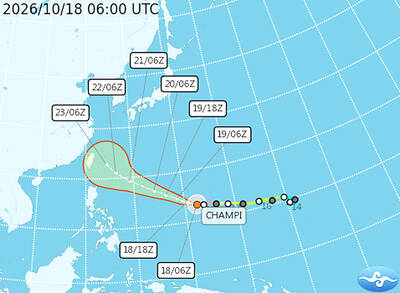
A sea warning for Typhoon Champi could be issued as early as Wednesday night, possibly followed by a land warning on Thursday night or Friday, as the storm approaches Taiwan, the Central Weather Administration (CWA) said yesterday. The typhoon is expected to have its greatest impact on Taiwan on Friday and Saturday, bringing heavy rain to central and northern Taiwan and to Yilan and Hualien counties in the east, CWA forecaster Liu Pei-teng (劉沛滕) said. As of 2pm yesterday, Champi was about 2,470km east-southeast of Oluanpi (鵝鑾鼻), Taiwan’s southernmost tip, moving westnorthwest at 20kph. It had maximum sustained winds of 191kph and a
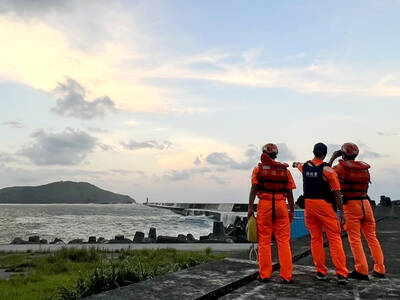
The Coast Guard Administration (CGA) yesterday urged China not to exploit typhoons to assert jurisdiction over the Taiwan Strait. The CGA issued the remarks after it found that China was shadowing eight Japan Coast Guard ships that sheltered in Taiwan proper’s western waters due to Typhoon Champi. Eight Japan Coast Guard (JCG) vessels sailed southward along the Taiwan Strait median line from 6am on Thursday, reaching waters southwest of Penghu County’s Cimei Island (七美島), outside Taiwan’s contiguous zone, which extends 24 nautical miles (44.4km) from the territorial sea baseline, it said. As the Japanese ships prepared for the typhoon, they were followed by
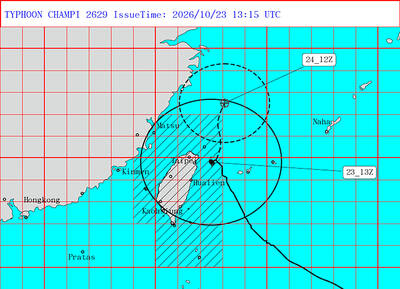
STAY CAUTIOUS: Rain is expected to begin easing this afternoon, but a CWA forecaster said that if the storm stalls or loops on its approach, heavy winds are likely Typhoon Champi, which caused widespread damage and injuries, and prompted road closures and evacuations across Taiwan yesterday, is expected to continue to bring heavy rain this morning, with up to 900mm of rain forecast for mountainous areas of New Taipei City, Taoyuan and Yilan County, the Central Weather Administration (CWA) said yesterday. At one point a super typhoon and one of the strongest storms in the Pacific this year, Champi was packing gusts of about 191kph near its center as of 8:30pm, the CWA said. Taipei, New Taipei City, Keelung, Taoyuan, Hsinchu city and county, Taichung; and Yilan, Miaoli, Changhua, Nantou, Yunlin


 RSS
RSS