


Israel sought yesterday to end a row with chief ally Washington over a controversial Chinese arms deal ahead of a visit by China's top diplomat, saying it regretted any possible damage to US interests.
US Secretary of State Condoleezzaa Rice -- by coincidence in Israel on the same day as Chinese Foreign Minister Li Zhaoxing (
Foreign Minister Silvan Shalom insisted Israel had "acted in good faith" amid continued fallout from a deal to upgrade Harpy Killer drones that Israel sold to China.
"I regret that these sales could have damaged the interests of the United States, but we were acting in good faith," Shalom told public radio before meeting Rice in Jerusalem.
Following her discussions with Israeli Prime Minister Ariel Sharon and Shalom, the top US diplomat suggested progress had been made on the fallout.
"I think everyone knows our concerns with arms sales to China ... I appreciate that the Israeli government has been working on this issue," she said at a news conference.
"I believe the Israelis now understand our concerns and I am certain as good partners can ... we will come to strong resolutions that allow us to proceed."
Israeli foreign ministry spokesman Mark Regev also said he expected the rift to be cleared up.
"As far as I know there is an understanding that these things will be behind us soon," he told reporters. It is "our hope that we'll make arrangements with the United States" to resolve the matter, he added.
But Regev would not say whether such arrangements would entail a complete halt to Israeli dealings with China or the possibility of case-by-case approval by the US on Israeli arms deals.
Rice only last week indicated her unhappiness with Israel over its transfer of military equipment and technology to China, despite rounds of what she called "very difficult discussions."
The Pentagon has confirmed imposing some restrictions on arms sales and technology transfers to Israel following the drones deal.
The row has cast a rare shadow over Israeli-US relations, with the influential chairman of the Knesset's foreign affairs and defense committee Yuval Steinitz describing the situation as a "crisis."
After his talks with Rice, Shalom is scheduled to meet Sunday with Li, whose visit to the region is a further sign of Beijing's deepening involvement in the quest for peace in the Middle East.
The Chinese foreign minister is also set to meet with Palestinian leader Mahmud Abbas in the West Bank town of Ramallah on Monday. Abbas was in Beijing last month while Shalom also visited the Chinese capital late last year.
Shalom hailed what he called a "huge improvement" in relations between Israel and China, but issued a veiled warning to Beijing to soften its traditional pro-Palestinian stance.
"Any country that wants to get involved in the peace process should take balanced positions vis-a-vis the Israelis and Palestinians," he said.

‘NO SECURITY RISK’: The Railway Bureau reassured the public that the technicians’ activities were limited to technical guidance and did not involve sensitive systems The Railway Bureau yesterday said it had invited eight Chinese technicians to assist with an airport MRT construction project. The bureau issued the confirmation after an Internet user said Chinese nationals had entered the construction zone of Taiwan Taoyuan International Airport’s Terminal 3 project. They asked why “individuals from an enemy state” were allowed access to such a major national infrastructure project, which raised serious concerns over Taiwan’s industrial safety, sensitive systems and information security. The bureau’s Northern Region Engineering Branch Office said subcontractor Taiwan Handle Industrial Co (台灣手把工業) of the Taoyuan airport MRT’s “Contract No. CU05 Project A14 Station Civil, MEP &

A US uncrewed surface vessel (USV) encountered multiple Chinese warships during an autonomous transit of the Taiwan Strait, US defense company Seasats said in a statement on Wednesday. Seasats announced that a Lightfish USV had completed the first autonomous transit of the Taiwan Strait. Over five days, the USV traversed the entire length of the Strait while constantly monitoring surface vessel traffic, the company said. The Lightfish encountered multiple Chinese warships, one of which was a Chinese People’s Liberation Army Navy (PLAN) Type 056 corvette, it said. The Chinese vessels were operating “well within Taiwan’s exclusive economic zone without transmitting their identity via the

‘BOOMING’: ’ The number of partners we have here is incredible. You can see from their stock prices. They’re doing so well, they’re so happy,’ Jensen Huang said Nvidia Corp’s spending in Taiwan has ballooned to about US$150 billion a year, 10 times the US$10 billion to US$15 billion the company spent five years ago, Nvidia chief executive officer Jensen Huang (黃仁勳) said yesterday, suggesting Taiwan’s strategic importance in the global artificial intelligence (AI) supply chain. “Taiwan is the epicenter of the AI revolution. This is where the chips come, packaging comes. This is where the systems are made. This is where AI supercomputers were created,” Huang said at a meeting for the company’s employees in Beitou-Shilin Technology Park (北投士林科技園區) in Taipei, the planned site of Nvidia’s Taipei headquarters. “Taiwan
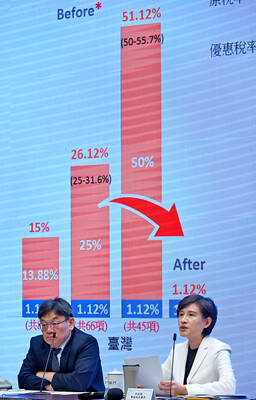
GREATER REACH? Auto parts and wood products would face tariffs of up to 15%, matching those targeting the EU, Japan and South Korea, Vice Premier said The US has announced that preferential tariff treatment for Taiwan’s non-semiconductor Section 232 goods would take effect retroactively from May 1, the Executive Yuan said yesterday. The US government yesterday posted a notice on the Federal Register’s public inspection Web site previewing tariff concessions for Taiwan under a memorandum of understanding (MOU) on Taiwan-US investment after two months of negotiations. The MOU signed on Jan. 15 stipulated three major preferential tariff arrangements: a 15 percent “reciprocal” tariff rate for Taiwan without stacking most-favored nation (MFN) rates; preferential Section 232 treatment for semiconductors and related products; and preferential Section 232 treatment for non-semiconductor


 RSS
RSS