


Lebanon's first parliamentary polls without heavy-handed Syrian meddling began yesterday, and loyalty to the former premier whose assassination catalyzed the turmoil that drove Syrian forces out was displayed at the capital's ballot boxes.
The family of slain Lebanese prime minister Rafik Hariri -- widow Nazek, sons Fahd and Ayman and daughter Hind -- led the voting, arriving within an hour of the opening of polls at 7am.
"I have high hopes today that we will uncover the truth of who planned and carried out the crime against my beloved husband, who in life built this country and in his martyrdom achieved national unity," Nazek Hariri told reporters after casting her ballot at a Verdun polling station before she headed to downtown Beirut to pray at her slain husband's grave.
Many observers expect the polls to sweep the anti-Syrian opposition to power and install a new parliament, removing the last of Syria's political control. Syrian forces withdrew last month, ending a 29-year military dominance, after mass demonstrations in Lebanon and relentless international pressure sparked by the February assassination.
More than 100 foreign observers from the EU and the UN were watching the vote for irregularities, the first time Lebanon has permitted foreign scrutiny. The organization of French-speaking countries also sent a delegation.
It was also the first election where Syrian or Lebanese intelligence agents or their allies did not appear to be influencing voters.
"There is no pressure," said Mohieddine Badran, a 57-year-old barber who said he voted for the Hariri ticket because "they are clean guys" who would carry out the slain leader's program.
The spiritual leader of Sunni Muslims, the sect to which the Hariris belong, joined in calling for people to go out and vote.
"Today is the day of gratitude for the great martyr Rafik Hariri," said Mohammed Rashid Kabbani, the Grand Mufti of the Republic, after voting. "Indifference could negatively affect the outcome."

‘NO SECURITY RISK’: The Railway Bureau reassured the public that the technicians’ activities were limited to technical guidance and did not involve sensitive systems The Railway Bureau yesterday said it had invited eight Chinese technicians to assist with an airport MRT construction project. The bureau issued the confirmation after an Internet user said Chinese nationals had entered the construction zone of Taiwan Taoyuan International Airport’s Terminal 3 project. They asked why “individuals from an enemy state” were allowed access to such a major national infrastructure project, which raised serious concerns over Taiwan’s industrial safety, sensitive systems and information security. The bureau’s Northern Region Engineering Branch Office said subcontractor Taiwan Handle Industrial Co (台灣手把工業) of the Taoyuan airport MRT’s “Contract No. CU05 Project A14 Station Civil, MEP &

A US uncrewed surface vessel (USV) encountered multiple Chinese warships during an autonomous transit of the Taiwan Strait, US defense company Seasats said in a statement on Wednesday. Seasats announced that a Lightfish USV had completed the first autonomous transit of the Taiwan Strait. Over five days, the USV traversed the entire length of the Strait while constantly monitoring surface vessel traffic, the company said. The Lightfish encountered multiple Chinese warships, one of which was a Chinese People’s Liberation Army Navy (PLAN) Type 056 corvette, it said. The Chinese vessels were operating “well within Taiwan’s exclusive economic zone without transmitting their identity via the
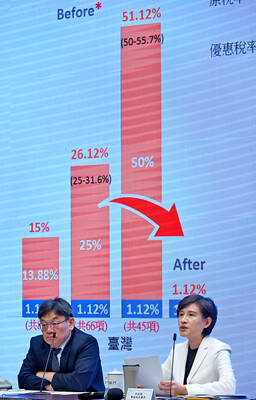
GREATER REACH? Auto parts and wood products would face tariffs of up to 15%, matching those targeting the EU, Japan and South Korea, Vice Premier said The US has announced that preferential tariff treatment for Taiwan’s non-semiconductor Section 232 goods would take effect retroactively from May 1, the Executive Yuan said yesterday. The US government yesterday posted a notice on the Federal Register’s public inspection Web site previewing tariff concessions for Taiwan under a memorandum of understanding (MOU) on Taiwan-US investment after two months of negotiations. The MOU signed on Jan. 15 stipulated three major preferential tariff arrangements: a 15 percent “reciprocal” tariff rate for Taiwan without stacking most-favored nation (MFN) rates; preferential Section 232 treatment for semiconductors and related products; and preferential Section 232 treatment for non-semiconductor

The National Chungshan Institute of Science and Technology yesterday showcased its locally developed variants of the Vision 60 robotic patrol dog, which it plans to deploy on the nation’s outlying territories in the South China Sea. The variants were produced under the Joint Lab project — created by the institute and domestic companies — and assembled with domestically produced motors, lenses and artificial intelligence (AI) systems alongside licensed tech from the US, Missile and Rocket Systems Research Division deputy director Jen Kuo-kang (任國光) told the media event at a military base in Taipei’s Dazhi (大直) area. Taiwan has built up its strengths


 RSS
RSS