


Anxious to avoid a repeat of last week's turmoil at CKS International Airport, police last night deployed 3,000 officers in a successful bid to prevent protesters from occupying the airport as Chinese Nationalist Party (KMT) Chairman Lien Chan (連戰) returned from China.
Protesters who tried to sneak into the airport were taken away, including several pan-green camp legislators and a number of unidentified people in black clothes suspected to be gangsters supportive of the pan-blue camp.
There were sporadic tussles at the airport and on the freeway leading to the airport where police stopped motorists who attempted to protest Lien's return. No major injuries were reported.
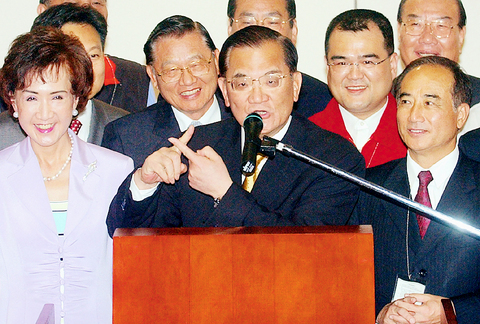
PHOTO: AP
A failed independent legislative candidate was arrested on arrival at the terminal for allegedly threatening the peace.
"I didn't break the law," Ke Tze-hai (
Minister of the Interior Su Jia-chyuan (
Four prosecutors were also on hand to issue arrest warrants for any person who protested inside the airport.
Barbed-wire barricades were erected on roads leading to the airport and vehicles were checked by police to prevent protesters from reaching the terminal. Police also guarded Lien's residence and KMT headquarters in Taipei.
The Taiwan Solidarity Union (TSU) yesterday called on around 100 party members to support lawmakers who wore masks bearing the words "protest" and "Lien sells out Taiwan." Their attempt to stage a sit-in inside the terminal was blocked by the police.
Democratic Progressive Party (DPP) legislators Lin Kuo-ching (
As they were led away, the legislators shouted, "The police are being unfair! We have broken no laws!"
DPP Legislator Wang Shih-chien (王世堅), who was heavily involved in last week's protest, was stopped on the Nankan Interchange long before reaching the airport and argued with police. Wang continued to the airport, however, and protested the detention of his colleagues.
Several unidentified people in black clothing carrying batons attempted to enter the airport and were detained.
Lien was received at the airport by Legislative Speaker Wang Jin-pyng (
In a short statement, Lien recounted the highlights of his trip but did not reveal any new details on his meeting with Chinese President Hu Jintao (胡錦濤).
Lien said he would make details of his trip known over the next few days. He concluded his brief statement with a reminder to support the KMT in the National Assembly elections on May 14.
Lien then returned to his home without incident under an escort of more than 500 police.
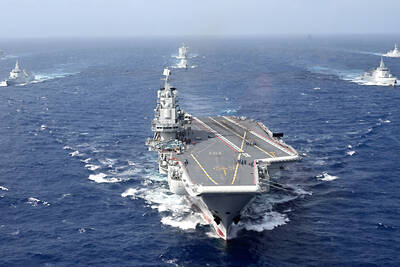
PROVOCATIVE: Chinese Deputy Ambassador to the UN Sun Lei accused Japan of sending military vessels to deliberately provoke tensions in the Taiwan Strait China denounced remarks by Japan and the EU about the South China Sea at a UN Security Council meeting on Monday, and accused Tokyo of provocative behavior in the Taiwan Strait and planning military expansion. Ayano Kunimitsu, a Japanese vice foreign minister, told the Council meeting on maritime security that Tokyo was seriously concerned about the situation in the East China and South China seas, and reiterated Japan’s opposition to any attempt to change the “status quo” by force, and obstruction of freedom of navigation and overflight. Stavros Lambrinidis, head of the EU delegation to the UN, also highlighted South China Sea

SILENCING CRITICS: In addition to blocking Taiwan, China aimed to prevent rights activists from speaking out against authoritarian states, a Cabinet department said The Ministry of Foreign Affairs (MOFA) yesterday condemned transnational repression by Beijing after RightsCon, a major digital human rights conference scheduled to be held in Zambia this week, was abruptly canceled due to Chinese pressure over Taiwanese participation. This year’s RightsCon, the world’s largest conference discussing issues “at the intersection of human rights and technology,” was scheduled to take place from tomorrow to Friday in Lusaka, and expected to draw 2,600 in-person attendees from 150 countries, along with 1,100 online participants. However, organizers were forced to cancel the event due to behind-the-scenes pressure from China, the ministry said, expressing its “strongest condemnation”
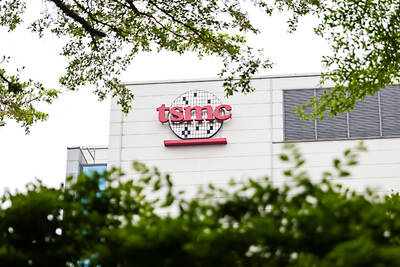
Taiwan Semiconductor Manufacturing Co (TSMC, 台積電), the world’s largest contract chipmaker, said it expects its 2-nanometer (2nm) chip capacity to grow at a compound annual rate of 70 percent from this year to 2028. The projection comes as five fabs begin volume production of 2-nanometer chips this year — two in Hsinchu and three in Kaohsiung — TSMC senior vice president and deputy cochief operating officer Cliff Hou (侯永清) said at the company’s annual technology symposium in Silicon Valley, California, last week. Output in the first year of 2-nanometer production, which began in the fourth quarter of last year, is expected to
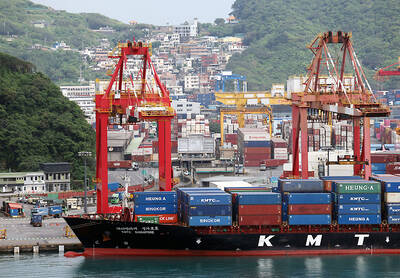
Taiwan’s economy grew far faster than expected in the first quarter, as booming demand for artificial intelligence (AI) applications drove a surge in exports, spilling over into investment and consumption, the Directorate-General of Budget, Accounting and Statistics (DGBAS) said yesterday. GDP growth was 13.69 percent year-on-year during the January-to-March period, beating the DGBAS’ February forecast by 2.23 percentage points and marking the most robust growth in nearly four decades, DGBAS senior official Chiang Hsin-yi (江心怡) told a news conference in Taipei. The result was powered by exports, which remain the backbone of Taiwan’s economy, Chiang said. Outbound shipments jumped 51.12 percent year-on-year to


 RSS
RSS