


The Taiwan Solidarity Union (TSU) said that it will stage a sit-in at CKS International Airport today to "welcome" Chinese Nationalist Party (KMT) Chairman Lien Chan (連戰) on his return from China, while the Democratic Progressive Party (DPP) said that it will not ban its members from going to the airport.
According to TSU Legislator Lo Chih-ming (
"We are calling on our other supporters to refrain from going because we don't want to see any of them get hurt," Lo said. "We will bring only face masks and placards, nothing else."
Lo is under investigation for his role in the violent demonstrations that took place last Tuesday when Lien left for China. Police are investigating whether Lo incited violence.
DPP caucus whip Lai Ching-te (
"It is a democratic norm to stage protests or marches," he said. "However, they have to be legal, and we will not tell our members not to go."
Lai said that the caucus' stance on the matter is consistent with that of the DPP headquarters: The party would not mobilize anyone to go and would not prevent any individual party members from mobilizing other people in the name of the party.
Those who opt to go have to abide by the law and act rationally, he said.
Lai also called on the National Police Agency and Aviation Police Office to thoroughly examine the reason for causing last Tuesday's violent incident and prevent similar occurrence from happening again.
DPP Legislator Wang Shih-chien (
Criticizing the timing of Lien's visit as "wrong" and his action as "inappropriate," Lai criticized Lien for pushing "the KMT to replace the People First Party (PFP) and other pro-China parties and becoming the most aggressive vanguard of unification forces."
"What he said in China is full of the `Greater China' thinking," he said. "He never mentioned anything about Taiwanese people's opposition to the `Anti-Secession' Law or the existence of the Republic of China, nor did he ask the Chinese government to remove the missiles targeted at us."
As Lien has said that he would endeavor to put into practice the five-point communique reached between him and Chinese President Hu Jintao (胡錦濤), Lai said that he is afraid that such an effort might cause social unrest and trigger conflicts.
"I am afraid it will trigger clashes between pro-unification and pro-independence forces, a battle between those safeguarding the government's authority and those attempting to strip the government of its power," he said. "It may also create conflict a between nationalism and democracy."
Legal controversy
When asked to comment on whether Lien has violated any laws during his trip, Lai said that his caucus will respect the judgment made by the Mainland Affairs Council and Ministry of Justice.
While some DPP lawmakers yesterday griped about the president's inconsistent remarks about Lien's trip, Lai said that it was part of the beauty of democracy and the spirit of the DPP. Another DPP caucus whip, Chen Chin-jun (
"President Chen has changed his rhetoric several times since his meeting with People First Party (PFP) Chairman James Soong (
No warning
DPP Legislator Julian Kuo (
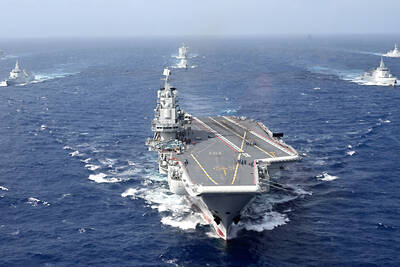
PROVOCATIVE: Chinese Deputy Ambassador to the UN Sun Lei accused Japan of sending military vessels to deliberately provoke tensions in the Taiwan Strait China denounced remarks by Japan and the EU about the South China Sea at a UN Security Council meeting on Monday, and accused Tokyo of provocative behavior in the Taiwan Strait and planning military expansion. Ayano Kunimitsu, a Japanese vice foreign minister, told the Council meeting on maritime security that Tokyo was seriously concerned about the situation in the East China and South China seas, and reiterated Japan’s opposition to any attempt to change the “status quo” by force, and obstruction of freedom of navigation and overflight. Stavros Lambrinidis, head of the EU delegation to the UN, also highlighted South China Sea
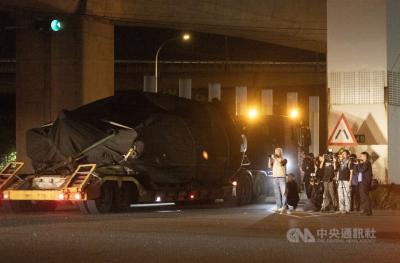
The final batch of 28 M1A2T Abrams tanks purchased from the US arrived at Taipei Port last night and were transported to the Armor Training Command in Hsinchu County’s Hukou Township (湖口), completing the military’s multi-year procurement of 108 of the tanks. Starting at 12:10am today, reporters observed more than a dozen civilian flatbed trailers departing from Taipei Port, each carrying an M1A2T tank covered with black waterproof tarps. Escorted by military vehicles, the convoy traveled via the West Coast Expressway to the Armor Training Command, with police implementing traffic control. The army operates about 1,000 tanks, including CM-11 Brave Tiger
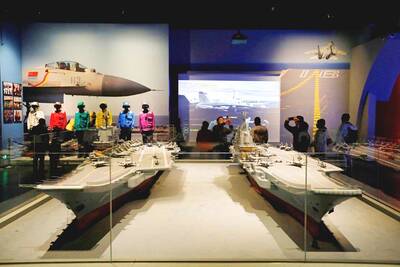
China on Wednesday teased in a video an aircraft carrier that could be its fourth, and the first using nuclear power, while making an allusion to Taiwan and vowing to further build up its islands, as it looks to boost maritime power, secure resources and bolster territorial claims. The video, issued on the eve of the 77th founding anniversary of the Chinese People’s Liberation Army Navy, featured fictional officers with names that are homophones of three commissioned aircraft carriers, the Liaoning (遼寧), Shandong (山東) and Fujian (福建). Titled Into the Deep, it showed a 19-year-old named “Hejian” (何劍) joining the group, sparking
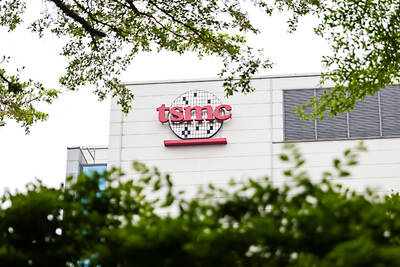
Taiwan Semiconductor Manufacturing Co (TSMC, 台積電), the world’s largest contract chipmaker, said it expects its 2-nanometer (2nm) chip capacity to grow at a compound annual rate of 70 percent from this year to 2028. The projection comes as five fabs begin volume production of 2-nanometer chips this year — two in Hsinchu and three in Kaohsiung — TSMC senior vice president and deputy cochief operating officer Cliff Hou (侯永清) said at the company’s annual technology symposium in Silicon Valley, California, last week. Output in the first year of 2-nanometer production, which began in the fourth quarter of last year, is expected to


 RSS
RSS