


US Marines broke down doors and raided houses yesterday on the second day of an offensive aimed at cracking down on insurgent activity in several troubled cities west of Baghdad.
Meanwhile, militants announced they were releasing a pair of kidnapped Indonesian journalists missing since last week in a new video delivered anonymously to Associated Press Television News. It was not possible to verify the video's authenticity or determine when it was made. The hostages whereabouts were not known.
Shiites and their clergy-backed United Iraqi Alliance met yesterday in Baghdad to renew discussions over who their prime ministerial candidate would be. But instead of narrowing the choices down, the field for potential candidates has grown to four, maybe even five, insiders said.
The two main candidates so far had been the former Pentagon favorite Ahmad Chalabi, a secular Shiite, and Ibrahim al-Jaafari, the interim vice president.
Six explosions boomed through the capital before midday. The cause of the blasts was not immediately known. Footage showed US troops treating a US soldier apparently injured in one of the blasts, which overturned a Humvee in the southern Doura neighborhood.
In Ramadi, US Marines fanned out across the city, setting up checkpoints, searching cars and sealing off sections of the city to prevent people from entering or leaving as they carried out raids.
Iraqi Major Abdul Karim al-Faraji said troops detained a prominent Sunni Muslim sheik, Mohammed Nasir Ali al-Ijbie, who heads the al-Bufaraj tribe, along with 12 of his relatives.
As the Shiite majority prepared to take control of the country's first freely elected government, tribal chiefs representing Sunni Arabs in six provinces issued a list of demands -- including participation in the government and drafting a new constitution -- after previously refusing to acknowledge the vote's legitimacy.
"We made a big mistake when we didn't vote," said Sheik Hathal Younis Yahiya, 49, a representative from northern Nineveh. "Our votes were very important."
He said threats from insurgents -- not sectarian differences -- kept most Sunnis from voting.
Sunnis make up 20 percent of Iraq's population of 26 million; Shiites make up 60 percent.
Just west of the capital, US Marines and Iraqi security forces launched a joint operation Sunday to crack down on insurgents and terrorists in several troubled cities, the military said, three months after a weeklong battle to drive out insurgents who controlled the volatile city of Fallujah.
The Marines succeeded in gaining control of the city in Anbar province, but the insurgency has continued.
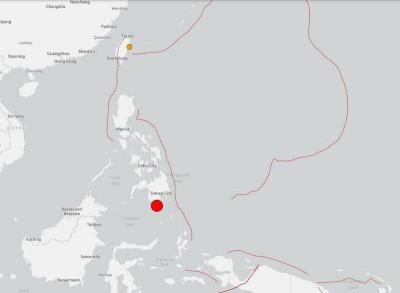
A magnitude 7.8 earthquake struck off the southern coast of Mindanao in the Philippines at 7:38am today, prompting the US Tsunami Warning System to issue an alert for neighboring countries, including Taiwan. The system issued a purple alert indicating a "tsunami threat." The potential threat zone includes Taiwan, the Philippines, Papua New Guinea, Yap and Palau. Philippine authorities were assessing the damage from the quake, with the office of civil defense seeking to verifying initial reports that 15 people had been killed and 129 injured in the region, mostly from falling debris. Arlene Hollero, disaster chief of Maasim town in the Philippines' Sarangani Province,
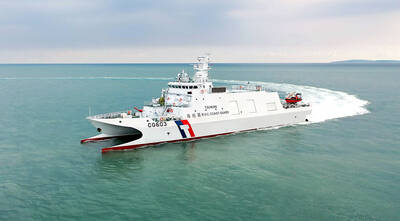
‘GRAY ZONE’ PRESSURE: Beijing’s activities are intended to create the deceitful impression that China has jurisdiction over the area around Taiwan, the CGA said Taiwan’s rights over its territorial waters and exclusive economic zone must not be violated by any country, the Mainland Affairs Council said yesterday, adding that it will not accept any unprovoked actions. The council issued the remarks in response to the China Coast Guard conducting maritime enforcement drills near eastern Taiwan and claiming to fully exercise China’s maritime administrative law enforcement authority. The Coast Guard Administration (CGA) has been closely monitoring the situation and is taking concrete steps to defend the nation’s sovereignty and secure its waters, the council said. China has no sovereign rights over the waters off eastern
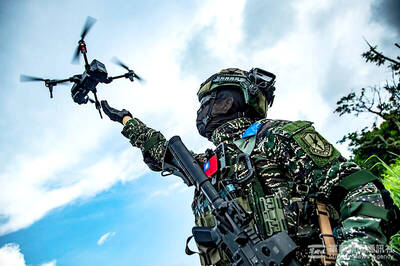
RESILIENCE: Taiwan plays a key role in semiconductors, energy, information infrastructure and advanced manufacturing, AIT Director Raymond Greene said Taiwan’s continued investment in deterrence and resilience remains vital, especially in uncrewed systems and other emerging technologies, American Institute in Taiwan (AIT) Director Raymond Greene said yesterday. Greene made the remarks at the annual National Strategic Summit on Supply Chain Resilience held by the Research Institute for Democracy, Society and Emerging Technology (DSET), a government-backed think tank. As Taiwan last year became the US’ fourth-largest trading partner and supply chain security is becoming more important, cooperation in emerging technologies continues to deepen between the two countries, he said. The US is committed to accelerating innovation, building key infrastructure, strengthening cooperation

The National Chungshan Institute of Science and Technology yesterday showcased its locally developed variants of the Vision 60 robotic patrol dog, which it plans to deploy on the nation’s outlying territories in the South China Sea. The variants were produced under the Joint Lab project — created by the institute and domestic companies — and assembled with domestically produced motors, lenses and artificial intelligence (AI) systems alongside licensed tech from the US, Missile and Rocket Systems Research Division deputy director Jen Kuo-kang (任國光) told the media event at a military base in Taipei’s Dazhi (大直) area. Taiwan has built up its strengths


 RSS
RSS