


Thaksin Shinawatra yesterday became the first Thai prime minister to win a second successive term and a single-party mandate with a crushing election victory despite an opposition campaign based on fear of dictatorship.
Estimates of final results gave his Thai Rak Thai party about 370 of the 500 seats in parliament, well above pre-poll forecasts and allowing the ex-telecoms tycoon to form the first one-party government in Thailand's coalition and coup-prone history.
An initial exit poll after Sunday's election gave his party 399 seats.
Thaksin won his huge majority after delivering on the populist platform that swept him to power in 2001 when he promised cheap health care and rural handouts.
Final results, delayed by complaints of fraud and cheating, were expected later yesterday, but Thaksin has already claimed victory, the opposition has conceded and its leader has resigned.
"The numbers are more than enough to establish a one-party government," Thaksin declared on Sunday after it became clear that he had won an unprecedented second term.
He said yesterday that he hoped to form the new government by early next month.
The Democrat party all but conceded defeat before balloting began, but had hoped to gain enough votes with its potential allies to mount censure motions and stop amendment of the 1997 Constitution, the fruit of decades of sometimes bloody struggle against dictatorial regimes.
Taking responsibility for the loss, Democrat leader Banyat Bantadtan announced his resignation. Deputy leader Abhisit Vejjajiva, young and regarded as more dynamic than Banyat, is expected to take over the country's oldest party.
Pointing to attacks by Thaksin against democratic institutions, including the press, during his last four years, critics fear the prime minister will seek to strike out some of the Constitution's more liberal provisions.
Wassana Permlab, chief of the Election Commission, said more than 70 percent of the electorate turned out to vote, surpassing the 69 percent in the 2001 election. Balloting among the 44.8 million eligible voters was mandatory, but violators are seldom prosecuted.
A police officer assigned to guard a Democrat party candidate was fatally shot in southern Thailand, Wassana said, but otherwise no major incidents were reported.
Twenty parties fielded 2,289 candidates, but it appeared that only five parties would win seats in the House of Representatives. Thaksin indicated that he would probably not include his current partner and the third-ranked party, the Chart Thai, in his new government.
Thaksin, 55, is a self-made telecom millionaire who founded Thai Rak Thai and rode to victory four years ago on public disenchantment with the country's slow recovery from the 1997-1998 financial crisis.

LEVERAGE: China did not ‘need to fire a shot’ to deny Taiwan airspace over Africa when it owns ‘half the continent’s debt,’ a US official said, calling it economic warfare The EU has raised concerns about overflight rights following the delay of President William Lai’s (賴清德) planned state visit to the Kingdom of Eswatini after three African nations denied overflight clearance for his charter at the last minute. Taiwanese allies Paraguay and Saint Kitts and Nevis, as well as several US lawmakers and the Inter-Parliamentary Alliance on China (IPAC) condemned China for allegedly pressuring the countries. Lai was scheduled to fly directly to Taiwan’s only African ally from yesterday to Sunday to celebrate the 40th anniversary of King Mswati III’s accession and his 58th birthday, but Seychelles, Mauritius and Madagascar suddenly revoked
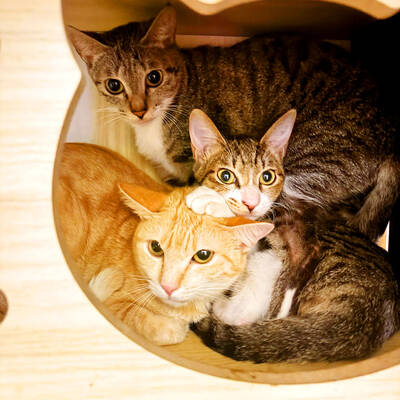
The number of pet cats in Taiwan surpassed that of pet dogs for the first time last year, reaching 1,742,033, a 32.8 percent increase from 2023, the Ministry of Agriculture said yesterday, citing a survey. By contrast, the number of pet dogs declined slightly by 1.2 percent over the same period to 1,462,528, the ministry said. Despite the shift, households with dogs still slightly outnumber those with cats by 1.2 percent. However, while the number of households with multiple dogs has remained relatively stable, households keeping more than two cats have increased, contributing to the overall rise in the feline population. The trend

China on Wednesday teased in a video an aircraft carrier that could be its fourth, and the first using nuclear power, while making an allusion to Taiwan and vowing to further build up its islands, as it looks to boost maritime power, secure resources and bolster territorial claims. The video, issued on the eve of the 77th founding anniversary of the Chinese People’s Liberation Army Navy, featured fictional officers with names that are homophones of three commissioned aircraft carriers, the Liaoning (遼寧), Shandong (山東) and Fujian (福建). Titled Into the Deep, it showed a 19-year-old named “Hejian” (何劍) joining the group, sparking

ESWATINI TRIP: The ‘irresponsible actions’ of three African nations set a dangerous precedent and they should be held accountable, a US representative said The US Senate Foreign Relations Committee on Thursday urged Washington not to normalize Chinese pressure, while a US lawmaker called on the US government to hold countries accountable for yielding to Beijing’s pressure to block President William Lai’s (賴清德) planned trip to Eswatini. Lai had been scheduled to visit Eswatini to attend birthday events for King Mswati III of Eswatini this week, but on Tuesday, the eve of his planned departure on Wednesday, the Presidential Office said the trip was “suspended” after the Seychelles, Mauritius and Madagascar unexpectedly withdrew overflight permission. “China reportedly pressured Mauritius, Seychelles, and Madagascar to deny airspace access


 RSS
RSS