


Palestinians urged Israel yesterday to expand a prisoner release to ensure the success of a summit both sides hope will result in a formal declaration to end violence.
Israel had disappointed the Palestinian leadership by refusing to include those jailed for deadly attacks among the 900 prisoners whom Israeli Prime Minister Ariel Sharon and top Cabinet ministers agreed on Thursday to release in a goodwill gesture.
But the summit itself, which is scheduled for Tuesday, between Sharon and new Palestinian President Mahmoud Abbas in Egypt's Red Sea resort of Sharm el-Sheikh, appeared set to go ahead.
"Israel stuck to its criteria of not releasing those it described as having `blood on their hands,'" Palestinian negotiator Saeb Erekat said after talks with Israeli officials about the issue broke up late on Thursday without agreement being reached.
"That means that all the prisoners who were jailed before [interim peace deals] in 1993 will not be released," he said.
Freedom for some 8,000 prisoners, especially Islamic militants and veteran inmates, is key to Abbas' aim of consolidating power, ending bloodshed and reviving a US-backed peace "road map" charting mutual steps to Palestinian statehood.
If unresolved as the summit draws nearer, the prisoners issue could loom large in meetings new US Secretary of State Condoleezza Rice is scheduled to hold with Sharon and Abbas during a visit to the region tomorrow and Monday.
During deliberations on a confidence-building package for the Palestinians on Thursday, Sharon faced strong opposition from several Cabinet members to suggestions by other ministers to bend the terms for release, political sources said.
Rice, in London, said efforts to achieve Middle East peace were now "moving effectively" and cited Abbas' views on "the necessity to have a peaceful resolution" of the conflict.
"The fact is, though, that there will have to be action to make certain that terrorists cannot continue to frustrate both his plans and to endanger the lives of Israelis," she told a news conference.
Israeli officials said a first batch of 500 prisoners would be freed next week, after the summit, with 400 to follow over a period of three months.
Israel's plan also calls for a troop pullback from five West Bank cities, starting in Jericho next week, after the talks.
Meanwhile, Israeli security officials yesterday morning said they had 50 intelligence warnings of Palestinian militants planning to launch attacks, Israeli media reported.
The officials said that most of the attacks were being prepared by independent cells of Fatah militants. They accused the southern Lebanese Islamic fundamentalist Hezbollah movement of funding the renegade cells.
Hezbollah seeks to destroy the relative calm of the past two weeks, ahead of next Tuesday's summit in Egypt, they said.
The accusations follow a day of renewed attempts by militants in the West Bank and Gaza to launch attacks, despite an informal ceasefire extracted by Abbas from leaders of the radical Hamas and Islamic Jihad movement.
Also see story:
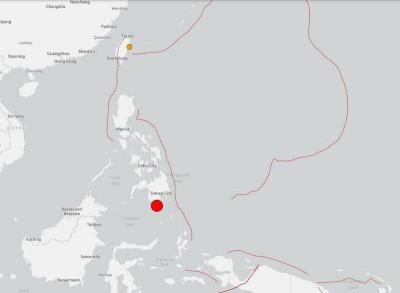
A magnitude 7.8 earthquake struck off the southern coast of Mindanao in the Philippines at 7:38am today, prompting the US Tsunami Warning System to issue an alert for neighboring countries, including Taiwan. The system issued a purple alert indicating a "tsunami threat." The potential threat zone includes Taiwan, the Philippines, Papua New Guinea, Yap and Palau. Philippine authorities were assessing the damage from the quake, with the office of civil defense seeking to verifying initial reports that 15 people had been killed and 129 injured in the region, mostly from falling debris. Arlene Hollero, disaster chief of Maasim town in the Philippines' Sarangani Province,

‘GRAY ZONE’ PRESSURE: Beijing’s activities are intended to create the deceitful impression that China has jurisdiction over the area around Taiwan, the CGA said Taiwan’s rights over its territorial waters and exclusive economic zone must not be violated by any country, the Mainland Affairs Council said yesterday, adding that it will not accept any unprovoked actions. The council issued the remarks in response to the China Coast Guard conducting maritime enforcement drills near eastern Taiwan and claiming to fully exercise China’s maritime administrative law enforcement authority. The Coast Guard Administration (CGA) has been closely monitoring the situation and is taking concrete steps to defend the nation’s sovereignty and secure its waters, the council said. China has no sovereign rights over the waters off eastern
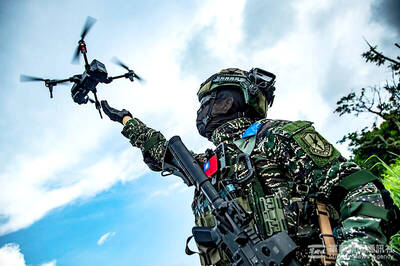
RESILIENCE: Taiwan plays a key role in semiconductors, energy, information infrastructure and advanced manufacturing, AIT Director Raymond Greene said Taiwan’s continued investment in deterrence and resilience remains vital, especially in uncrewed systems and other emerging technologies, American Institute in Taiwan (AIT) Director Raymond Greene said yesterday. Greene made the remarks at the annual National Strategic Summit on Supply Chain Resilience held by the Research Institute for Democracy, Society and Emerging Technology (DSET), a government-backed think tank. As Taiwan last year became the US’ fourth-largest trading partner and supply chain security is becoming more important, cooperation in emerging technologies continues to deepen between the two countries, he said. The US is committed to accelerating innovation, building key infrastructure, strengthening cooperation

The National Chungshan Institute of Science and Technology yesterday showcased its locally developed variants of the Vision 60 robotic patrol dog, which it plans to deploy on the nation’s outlying territories in the South China Sea. The variants were produced under the Joint Lab project — created by the institute and domestic companies — and assembled with domestically produced motors, lenses and artificial intelligence (AI) systems alongside licensed tech from the US, Missile and Rocket Systems Research Division deputy director Jen Kuo-kang (任國光) told the media event at a military base in Taipei’s Dazhi (大直) area. Taiwan has built up its strengths


 RSS
RSS