


The US budget deficit is likely to hit a record US$427 billion in fiscal 2005, going deeper into the red as a result of a special funding request for Iraq and the war on terrorism, new estimates showed on Tuesday.
Senior Bush administration officials disclosed the latest deficit estimate as they outlined their special US$80-billion request for operations in Iraq, Afghanistan and elsewhere as part of the global war on terror.
If accurate, the deficit would eclipse the US$412-billion deficit in the 2004 fiscal year. But as a percentage of GDP the deficit would be 3.5 percent, down slightly from 3.6 percent in fiscal 2004 and well below deficit levels of the 1980s.
The estimated shortfall for the fiscal year to Sept. 30 came the same day the Congressional Budget Office (CBO) projected a deficit of US$368 billion.
But the CBO noted that the law governing its projections requires its estimates to be based solely on spending and revenue measures already on the books.
Under these baseline estimates, the deficit would ease to US$295 billion in fiscal 2006 and US$261 billion in fiscal 2007.
The nonpartisan CBO said however that its estimates "omit a significant amount of spending that will occur this year -- and conceivably for some time in the future -- for US military operations in Iraq and Afghanistan and for other efforts in the war on terrorism."
The CBO's long-range outlook, which goes through fiscal 2015, projects the US government will remain in the red until fiscal 2012.
The cumulative deficits would be US$1.188 trillion in the 2006-2010 period and US$855 billion in the 2006-2015 period, the CBO estimated.
The long-range outlook, meanwhile, is based on the expiration of existing tax cuts engineered by President George W. Bush.
It also makes no provision for Bush's plan to overhaul the social-security retirement system with private accounts.
CBO Director Douglas Holtz-Eakin said the projections assume a strengthening economy, but that the deficits are likely to persist because of the growth in social security retirement and medical costs in the Medicare and Medicaid programs.
"It's important to remember that even though the economy may outperform even CBO's forecasts, we are unlikely to grow our way out of the long-term budget issues," he said. "That is because even with discretionary spending restraint, we have to keep our eye on the ball and recognize that it is the long-term growth in mandatory spending, particularly in Medicare and Medicaid, which are our greatest fiscal pressures."
John Lonksi, economist at Moody's Investors Service, said the deficit estimate had little immediate impact on financial markets because, "It's nearly impossible to predict with any accuracy what the budget deficit's going to look like 10 years from now."
Asked about the projected return to surplus in 2012, Lonksi said, "I wouldn't count on it," adding that this would mean "drastic measures" including unpopular spending cuts.
The White House meanwhile said it remains committed to halving the budget deficit by 2009.
"The president has a plan to cut the deficit in half over the next five years, and we're on track to meet that goal," White House spokesman Scott McClellan said.
But the Concord Coalition, a think tank dedicated to sound budget finances, said the latest projections were troublesome.
The forecasts "show a worsening budget outlook and the first ominous signs of fiscal strain brought on by the baby boomers' retirement," it said.
"No one should be lulled into thinking that this is a good news report," Concord Coalition executive director Robert Bixby said. "To the contrary, it is further confirmation that fiscal policy is on a dangerous path. Even with a strong economy, annual deficits are likely to hover between US$400 billion and US$500 billion for the next five years. After that, the combination of tax-cut extensions and growing entitlement costs threatens an upward spiral of deficits and debt that cannot be sustained."

‘NO SECURITY RISK’: The Railway Bureau reassured the public that the technicians’ activities were limited to technical guidance and did not involve sensitive systems The Railway Bureau yesterday said it had invited eight Chinese technicians to assist with an airport MRT construction project. The bureau issued the confirmation after an Internet user said Chinese nationals had entered the construction zone of Taiwan Taoyuan International Airport’s Terminal 3 project. They asked why “individuals from an enemy state” were allowed access to such a major national infrastructure project, which raised serious concerns over Taiwan’s industrial safety, sensitive systems and information security. The bureau’s Northern Region Engineering Branch Office said subcontractor Taiwan Handle Industrial Co (台灣手把工業) of the Taoyuan airport MRT’s “Contract No. CU05 Project A14 Station Civil, MEP &

A US uncrewed surface vessel (USV) encountered multiple Chinese warships during an autonomous transit of the Taiwan Strait, US defense company Seasats said in a statement on Wednesday. Seasats announced that a Lightfish USV had completed the first autonomous transit of the Taiwan Strait. Over five days, the USV traversed the entire length of the Strait while constantly monitoring surface vessel traffic, the company said. The Lightfish encountered multiple Chinese warships, one of which was a Chinese People’s Liberation Army Navy (PLAN) Type 056 corvette, it said. The Chinese vessels were operating “well within Taiwan’s exclusive economic zone without transmitting their identity via the

‘BOOMING’: ’ The number of partners we have here is incredible. You can see from their stock prices. They’re doing so well, they’re so happy,’ Jensen Huang said Nvidia Corp’s spending in Taiwan has ballooned to about US$150 billion a year, 10 times the US$10 billion to US$15 billion the company spent five years ago, Nvidia chief executive officer Jensen Huang (黃仁勳) said yesterday, suggesting Taiwan’s strategic importance in the global artificial intelligence (AI) supply chain. “Taiwan is the epicenter of the AI revolution. This is where the chips come, packaging comes. This is where the systems are made. This is where AI supercomputers were created,” Huang said at a meeting for the company’s employees in Beitou-Shilin Technology Park (北投士林科技園區) in Taipei, the planned site of Nvidia’s Taipei headquarters. “Taiwan
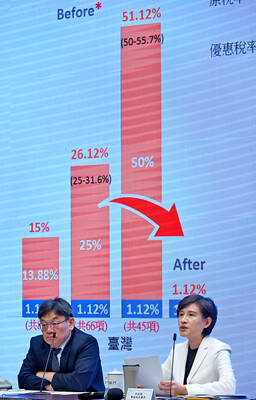
GREATER REACH? Auto parts and wood products would face tariffs of up to 15%, matching those targeting the EU, Japan and South Korea, Vice Premier said The US has announced that preferential tariff treatment for Taiwan’s non-semiconductor Section 232 goods would take effect retroactively from May 1, the Executive Yuan said yesterday. The US government yesterday posted a notice on the Federal Register’s public inspection Web site previewing tariff concessions for Taiwan under a memorandum of understanding (MOU) on Taiwan-US investment after two months of negotiations. The MOU signed on Jan. 15 stipulated three major preferential tariff arrangements: a 15 percent “reciprocal” tariff rate for Taiwan without stacking most-favored nation (MFN) rates; preferential Section 232 treatment for semiconductors and related products; and preferential Section 232 treatment for non-semiconductor


 RSS
RSS