


A car bomb exploded in the holy Shiite city of Karbala yesterday, killing at least 12 people and wounding more than 30, and insurgents also struck in Baghdad, shooting dead three Election Commission employees.
Shortly afterwards, a separate explosion struck a market in Najaf -- another Shiite religious city south of Karbala. The blast took place near the city's Imam Ali mosque, but there were no immediate reports of any dead or wounded.
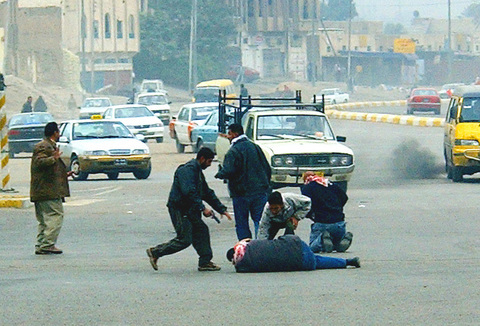
PHOTO: AP
The main hospital said 30 people were killed and at least 65 wounded, but an official emphasized that it was a provisional toll and the numbers could rise. He said all appeared to be civilians and there were many women and children among them.
It was the second attack in five days in Karbala, home to two important Shiite shrines.
Election Workers
In Baghdad, insurgents dragged three employees of Iraq's Electoral Commission from a car and shot them dead, the latest in a series of attacks designed to disrupt plans for the poll.
A spokesman for the Electoral Commission said three junior employees had been killed in the assault but said it was unclear if they were targeted because they worked with the commission, which is charged with conducting next month's vote.
"We don't know if they were targeted specifically," spokesman and Commission board member Farid Ayar said.
Witnesses said insurgents opened fire on the vehicle before dragging three people from it and shooting them. The car was set on fire and the bodies left lying near the burning wreckage.
Guerrillas armed with AK-47 assault rifles and pistols then set up a roadblock on the street, stopping and searching every car that passed, pointing their guns in through the windows.
Fierce gunbattles ensued, witnesses said, as police tried for several hours to get to the scene of the attack. US military helicopters flew low over the area, which echoed with gunfire and small explosions, residents said.
Militants kidnapped and are threatening to kill 10 Iraqis employed by a US security company unless the firm pulls out of Iraq, a caller from the militants told Reuters. A tape broadcast by Arab satellite channels yesterday showed the hostages.
Saddam Trial
Meanwhile, former Iraqi dictator Saddam Hussein is preparing a legal challenge in the US to his trial for war crimes, a newspaper reported yesterday, citing leaked papers prepared by his defense team.
Clive Stafford Smith, a British human rights lawyer, has prepared a 50-page brief which contains advice to take the case to US courts to ensure he receives a fair trial, the Sunday Times reported after saying it had seen the document.
The action is to ensure that Saddam receives the basic legal rights given to those tried in the US, such as full access to his defense team and an independent judge and jury, the newspaper said.
It said the leaked brief is entitled "The Iraqi Special Tribunal as Victors' Justice -- the Inherent Illegality and Bias of the Whole Process."
The brief argues that US law should prevail in the case because the trial is effectively being taken at the behest of the US government.
On Saturday, Saddam's feared cousin "Chemical Ali" and a former defense minister were questioned by an investigating judge, launching the first phase in war crimes trials of leaders of the toppled Iraqi government.
The hearings are expected to eventually see the former strongman and 11 aides charged with war crimes, crimes against humanity and genocide, officials said.

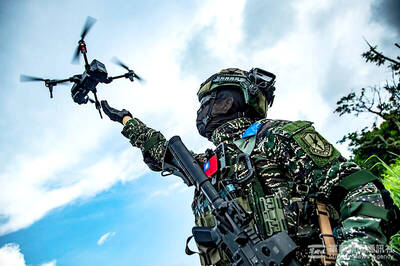
RESILIENCE: Taiwan plays a key role in semiconductors, energy, information infrastructure and advanced manufacturing, AIT Director Raymond Greene said Taiwan’s continued investment in deterrence and resilience remains vital, especially in uncrewed systems and other emerging technologies, American Institute in Taiwan (AIT) Director Raymond Greene said yesterday. Greene made the remarks at the annual National Strategic Summit on Supply Chain Resilience held by the Research Institute for Democracy, Society and Emerging Technology (DSET), a government-backed think tank. As Taiwan last year became the US’ fourth-largest trading partner and supply chain security is becoming more important, cooperation in emerging technologies continues to deepen between the two countries, he said. The US is committed to accelerating innovation, building key infrastructure, strengthening cooperation

The National Chungshan Institute of Science and Technology yesterday showcased its locally developed variants of the Vision 60 robotic patrol dog, which it plans to deploy on the nation’s outlying territories in the South China Sea. The variants were produced under the Joint Lab project — created by the institute and domestic companies — and assembled with domestically produced motors, lenses and artificial intelligence (AI) systems alongside licensed tech from the US, Missile and Rocket Systems Research Division deputy director Jen Kuo-kang (任國光) told the media event at a military base in Taipei’s Dazhi (大直) area. Taiwan has built up its strengths

RIGHT DIRECTION: Taiwan’s efforts to prevent forced labor include a proposal to ‘fully prohibit’ employers from withholding workers’ documents, an official said Taiwan is to establish a mechanism to restrict imports of goods linked to forced labor, the Executive Yuan said yesterday, after the US proposed imposing additional tariffs on Taiwanese goods over labor concerns. “The Ministry of Labor and the Ministry of Economic Affairs are to establish an interministerial review procedure,” Executive Yuan spokesperson Michelle Lee (李慧芝) said at a news briefing in Taipei. “The government is to use the Foreign Trade Act [貿易法] as the legal basis to restrict imports of goods produced with forced labor” and bring its supply chain governance more in line with international standards on human rights, resilience

NOT IMMEDIATE: Taiwan has a chance to appeal the proposed 10 percent tariff before it starts, while other countries face a 12.5 percent tariff from the trade office Taiwan is among 60 economies determined by the US to have failed to impose or enforce a ban on the importation of goods produced with forced labor, according to a notice released on Tuesday by the Office of the US Trade Representative (USTR), which proposed imposing an additional 10 percent or more tariff on them. The USTR in a statement said that following an investigation, it had determined under Section 301 of the Trade Act of 1974 that the failure of the 60 economies to impose and effectively enforce a prohibition on the importation of goods produced with forced labor is


 RSS
RSS