


The pan-blue camp, consisting of the Chinese Nationalist Party (KMT), the People First Party (PFP) and the New Party, yesterday managed to retain a legislative majority, winning 114 seats in of the 225-seat legislature.
The pan-greens won 101 seats, with 89 of the Democratic Progressive Party's (DPP) candidates winning seats, up from 87, while its ally the Taiwan Solidarity Union (TSU) won 12, down from 13. The Non-Partisan Solidarity Union (NPSU,
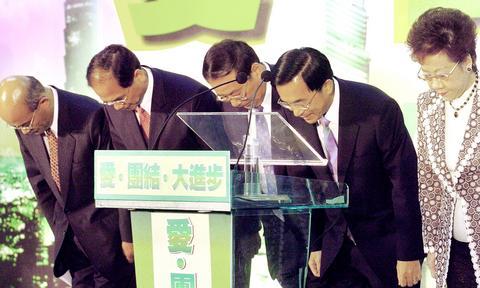
PHOTO: CHANG CHIA-MING, TAIPEI TIMES
Yesterday's voter turnout marked a historic low of just 59.16 percent of the nation's roughly 16 million voters eligible for this election, far lower than the Central Election Commission's (CEC) prediction of 67 percent one day earlier.
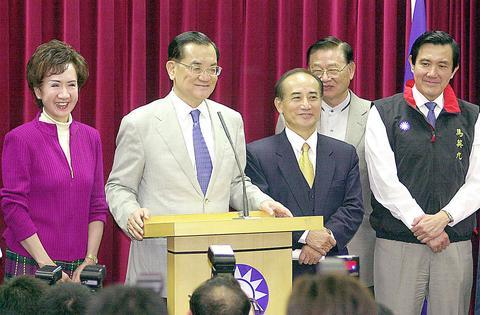
PHOTO: AFP
Among the four major parties, the KMT enjoyed the biggest leap in seats won, jumping from 68 seats in 2001's legislative poll to 79. The PFP suffered a decline, losing 12 of the 46 seats won in 2001. The New Party retained one seat.
The DPP remains the biggest party in the legislature.
"The showing is a victory for the pan-blues as well as for the Republic of China (ROC). The result shows that the people are longing for the nation's welfare. They wish for stability, development and reform. Of paramount importance, it shows the people's wishes are with us, the whole pan-blue alliance," KMT Chairman Lien Chan (
Lien vowed to stick to the party's commitment to issues regarding national identity, cross-strait relations, social harmony, the nation's development and to push for passage of critical draft bills in the legislature.
"The election results suggest that the people are expecting to see a capable and efficient governing team. We will make an all-out effort to assist the governing authorities, encourage more negotiation and dialogue and work together with the governing team," Lien said.
Lien did not elaborate on whether the pan-blues will attempt to form the Cabinet as he had pledged to do before the election.
According to KMT Secretary-General Lin Fong-cheng (林豐正), the pan-blue alliance, boosted by two other KMT candidates who had won election but had run in the poll without the party's consent, the pan-blues will in fact control 116 seats in next legislature.
Over at the pan-green camp, DPP Secretary-General Chang Chun-hsiung (
Chang, who was fourth on the party's legislator-at-large list, also offered to relinquish his legislative seat. As of press time, DPP chairman President Chen Shui-bian (
Chen, in a gesture to distinguish himself from Lien -- who hasn't yet conceded his defeat in March's presidential election -- expressed complete acceptance of the result in a concession speech last night.
"The DPP completely accepts the election result. We express congratulations to the elected candidates and our condolences to the defeated ones," Chen said.
Chen expressed thanks to the leaders of the four major parties for their efforts to support a smooth and peaceful election.
"Although the DPP has gained one more seat compared with the previous election, and the party's showing in this election also increased from last time's 33.38 percent to 35.72 percent, we will still conduct an overhaul of the party," Chen said.
The CEC's statistics show the DPP's share of the vote at 37.98 percent.
Chen also expressed thanks to TSU Chairman Huang Chu-wen (黃主文) and former president Lee Teng-hui (李登輝), the TSU's spiritual leader, for their assistance in the election.
"Though there was competition between the DPP and the TSU during the election, there was also cooperation. We will work more closely with the TSU after the election," Chen said.
Cabinet Spokesman Chen Chi-mai (陳其邁) yesterday said Premier Yu Shyi-kun, as the DPP's campaign manager, will take responsibility for the party's failure to win a legislative majority. But Chen Chi-mai did not elaborate as to whether Yu would offer to resign as premier.
PFP Chairman James Soong (
"Though the PFP's showing is not satisfactory, at least its position as the third largest party is unchanged," Soong said.
Huang Chu-wen, whose son David Huang (
"Facing our loss of one seat, the TSU will conduct a thorough review of the party. But we believe our insistence on creating a new constitution and the rectification movement is right," Huang said.
Early yesterday morning, Chen cast his vote with first lady Wu Shu-chen (
Chen first cheered the sunny day and said "the dream will be soon realized since the sunshine has cleared the sky."
"Today is a historic day and I believe the people of Taiwan will rewrite history by casting their votes. I also believe that Taiwan's people will give Taiwan, love, unity and peace a chance," Chen said.
Chen also showed respect and confidence in election officials' efforts to maintain a transparent and fair poll.
"I believe all election officials will carry out their duty fairly today, and I hope the losers of today's election will not accuse the staff of cheating," Chen said.
Former president Lee Teng-hui cast his vote in Tahsi, Taoyuan County, appearing at the poll without his wife Tseng Wen-hui (曾文惠).
When asked if Tseng would show up and vote later, Lee said Tseng probably would not, because she was not feeling well.
Lee did not make any comment on the elections yesterday morning.
Lien urged voters to head to the polls while casting his vote in Taipei yesterday morning.
"People must go to the polls and vote for the future as well as for the nation and their offspring," Lien said.
Soong yesterday morning voted in Linkou, where his household is registered. He urged voters to think rationally over whether to vote for love or hatred.
"Voters should chose their candidates rationally and resolve hatred through love and tolerance," Soong said.

A signaling system malfunction disrupted high-speed rail (HSR) services beginning at 8am today, with trains temporarily reduced to three northbound and three southbound trains per hour as authorities conduct inspections. The malfunction occurred on a section of track in Miaoli County during pre-operation checks early this morning, forcing northbound and southbound trains to use a single track, the HSR operator said. The regular schedule has been replaced with three hourly trains offering only nonreserved seating in each direction, stopping at every station, it said, adding that business class cars would still have reserved seating. Departures from terminal stations are scheduled at the top

DRONE CENTRAL: Taiwan aims to become Asia’s democratic hub for drones, with most exports focused on high-quality military-grade models, an official said Taiwan’s drone industry is expected to expand significantly by 2030, producing 100,000 units per month and exporting half of them, the Ministry of Economic Affairs said yesterday. Current drone production capacity is about 15,000 units per month, but the industry can quickly scale up as demand increases, Industrial Development Administration Director-General Chiou Chyou-huey (邱求慧) told a news conference in Taipei. Taiwan’s drone output grew 2.5-fold last year to NT$12.9 billion (US$408.3 million) under a government program to develop the uncrewed vehicle sector, he said. The Executive Yuan in October last year approved plans to invest NT$44.2 billion into domestic production of uncrewed aerial

VERBOSE VESSELS: A CGA cutter and a China Coast Guard exchanged verbal barbs for more than a day in Taiwanese-controlled waters before the Chinese vessel left The Taiwanese and Chinese coast guards had a standoff near the strategically located Pratas Islands (Dongsha Islands, 東沙群島) in the north of the South China Sea, the Coast Guard Administration (CGA) said yesterday. The two sides engaged in intense radio exchanges over sovereignty claims during the 33-hour standoff. China Coast Guard vessel 3501 eventually left the restricted waters, 26.6 nautical miles (49.2km) west of the Pratas Islands, at 5pm yesterday, the CGA said. Lying approximately between southern Taiwan and Hong Kong, the Taiwan-controlled Pratas are seen by some security experts as vulnerable to Chinese attack due to their distance — more than

WARNING: China should stop engaging in actions that undermine regional peace and stability, as it would only build resentment among people across the Strait, the CGA said China has deployed more than 100 navy, coast guard and other vessels in waters from the Yellow Sea to the South China Sea and the western Pacific since US President Donald Trump and Chinese President Xi Jinping (習近平) met in Beijing, National Security Council Secretary-General Joseph Wu (吳釗燮) said yesterday. “In this part of the world, #China is the one & only PROBLEM wrecking the #StatusQuo & threatening regional peace & stability,” Wu wrote on X. In a separate post, he said Beijing was coercing Taiwan’s maritime domain, calling it illegal and provocative, after the Coast Guard Administration (CGA) expelled a


 RSS
RSS