

The Taiwan Solidarity Union (TSU) and the Chinese Nationalist Party (KMT) yesterday held simultaneous large-scale campaign parades in Taipei, with no major clashes between supporters of the two rival camps.
Both parties claimed to have attracted more than 100,000 supporters each to the events.
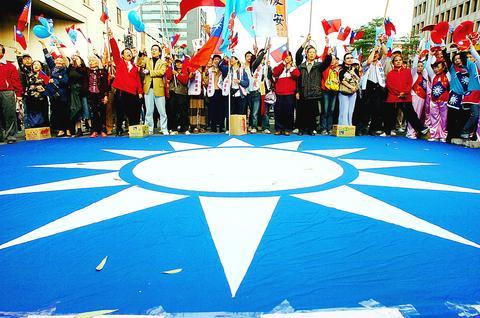
PHOTO: SEAN CHAO, TAIPEI TIMES
The TSU event called for a new constitution for the yet-to-be-rectified country, while the KMT outlined its campaign as a battle between two groups of people -- one trying to defend the Republic of China (ROC) and the other determined to terminate it.
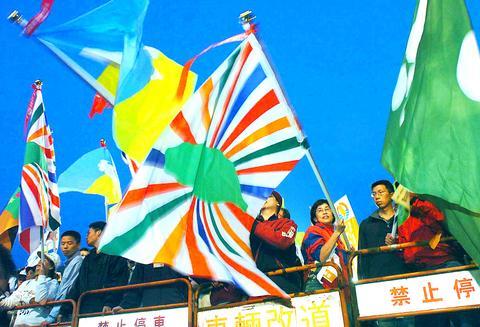
PHOTO: CHIANG YING-YING, TAIPEI TIMES
"Taiwan's current name and Constitution bind Taiwan and prevent Taiwan from becoming a normal country," former president Lee Teng-hui (
Only by solving this "fast knot" does Taiwan has a bright future in building a nation, he said.
Lee also urged voters to support the TSU and help it outshine its rivals in this Saturday's legislative elections, stressing that the TSU is an indispensable political party for Taiwan to build its own country and will provide steadfast and reliable oversight of the government.
Lee made the statements in a massive campaign rally held on Ketagalan Boulevard in front of the Presidential Office yesterday evening.
"Although the TSU only obtained 13 legislative seats in the previous election, its steadfast stance in guarding Taiwan proves the TSU is the only opposition power that truly cares about Taiwan's future," Lee said.
Opposition Party
"The TSU is not a decoration of the Democratic Progressive Party (DPP). The TSU is an opposition party with stances and viewpoints," Lee said. "Although the TSU supports President Chen Shui-bian (陳水扁), it will also oversee the government and try its best to carry out the people's wishes."
"The TSU is the most important power in the legislature and is the agent of the interests of the Taiwanese people," he said.
Meanwhile, Lee also reiterated that the ROC does not exist and that Taiwan should stop using the ROC's Constitution and instead form a new one.
This demonstrates that Taiwan-centered consciousness has reached a new high from the name-change rally held last September, the 228 Hand-in-Handy Rally this February, to Chen's re-election victory, and to today's rally, Lee said.
Participants gave Lee a standing ovation when he entered the rally, crying out "I love you!" and waving thousands of campaign flags and placards.
Lee's daughter, Annie Lee (
"In fact, they oppose Taiwan. They exist for opposing [Taiwan] and are for China, which is not worthy of the people's support," she said.
Senior Presidential Adviser Koo Kwang-ming (
Hosts Chao Tien-lin (
The audience responded loudly and enthusiastically with "Taiwan."
At the end of the rally, the TSU hosts unveiled five new national flags to the participants. Taiwan's national flag should be chosen by referendum, they said.
Pan-blue Camp Marches
Although the pan-blue camp also held a massive march and campaign rally around the Legislative Yuan, which is near the presidential office, no major conflicts were reported between the groups.
Braving chilling winds, tens of thousands of pan-blue supporters also took to the streets to join what the opposition parities called the "Unite, Protect the Nation and Save Taiwan" march, designed to boost chances of the parties' legislative candidates.
Converging at the square in front of the Taipei City Hall at noon, the marchers started walking toward the legislature at 1:30pm. KMT Chairman Lien Chan (連戰), PFP Chairman James Soong (
With the legislative election less than a week away, Lien -- despite suggestions by his security team not to march along the route -- decided to join the crowd "in order to boost their morale."
"We have more than 100,000 people joining the event. The atmosphere is grand. Our legislature is the last fortress of Taiwan's democracy. We can never allow it to fall," Lien said in a speech at the legislature as the march concluded.
With the pro-independence TSU rally only a few blocks away from the legislature calling for the rectification of the country's name to Taiwan, pan-blue march organizers said the event was virtually a battle between two groups of people -- one defending the ROC and the other determined to terminate it.
Lien blasted Chen and the DPP administration as unjust and incompetent, alleging they were dividing Taiwanese society by manipulating various issues.
"The green camp is the biggest source of chaos in our country. They have mixed up party and government affairs and failed to run a just judicial system. They have cruelly torn apart our society and have been unable to revive the country's economic development," Lien said.
The pan-blue camp wanted to highlight seven issues through the march, KMT spokesman Chang Jung-kung (
Seven Issues
The DPP has "distorted history, tried to write a new constitution to push for independence, squandered the government's money, wantonly purchased weapons, raised commodity prices, worsened social security and sacrificed farmers' interests," Chang said.
"We are opposed to all of these and have taken to the streets to express our discontent. The DPP government has brought our people great pain ? I hope voters will help the pan-blue camp retain its majority on election day," Chang said.
Taipei Mayor Ma Ying-jeou (馬英九) and Legislative Speaker Wang Jin-pyng (王金平) also gave speeches at the legislature, urging voters to support pan-blue candidates so that they may "supervise the government's budgets and law-making process" for the people.
Ma accused the DPP of manipulating this year's presidential election by launching a referendum on the same day of the election. Blaming the DPP for using "illegal and irrational" approaches to win elections, Ma said pan-blue supporters should not learn from the pan-green camp.
Criticizing the government's recent revision of history textbooks, Ma said even though the old history textbooks did not contain enough Taiwanese history, it is unnecessary to cross out everything about China from the books.
"There is no need to cut Taiwanese history from Chinese history. Some parts of history would look really ridiculous if they insisted on doing so," Ma said.


PATROL PARTNERS: The ‘Chiayi’ and the ‘Penghu’ departed for a two-day joint patrol of Palau’s exclusive economic zone, the CGA’s second diplomatic visit to the country The Coast Guard Administration (CGA) set a record for its southernmost deployment of a coast guard vessel as the vessels Chiayi and the Penghu reached Palau’s Pulo Anna Island on Saturday in a cooperative exercise between the two countries. The island, about 217 nautical miles (401km) southwest of Koror in the Palauan state of Sonsorol and 1,220 nautical miles from Taiwan’s southernmost point, Oluanpi (鵝鑾鼻), is the furthest south a CGA vessel has sailed. The two vessels are in Palau for the coast guard’s second diplomatic visit to the country. They docked at Malakal Harbor on Tuesday last week. The coast guard

BATCH 1: The military has plans to assign the weapons to the army to defend Taiwan proper, as well as outlying islands and the navy for the Marine Corps, the official said Taiwan is to receive 500 Stinger missiles and 178 launchers from the US by the end of the year, the first batch under a planned two-stage acquisition totaling 2,621 missiles and 763 launchers, a defense official said yesterday on condition of anonymity. The portable missiles would play a vital role in the nation’s air defense capabilities, the source said. The army plans to deploy 2,235 missiles and 657 launchers to defend Taiwan proper and outlying islands, they said, citing military documents. The navy is allotted 295 missiles and 85 launchers to arm the Marine Corps and some surface vessels that lack air defense
The government is monitoring online rumors that a pneumonic plague outbreak has spread from Russia into China, and it might enhance quarantine measures, Premier Cho Jung-tai (卓榮泰) said yesterday. During a legislative meeting, Democratic Progressive Party Legislator Wang Ting-yu (王定宇) said that rumors had circulated that the disease had spread across several Chinese provinces. He asked Cho whether the government was prepared to prevent the disease spreading to Taiwan, given the volume of traffic between the two sides, and how concerned the government was about the alleged outbreak. The Ministry of Health and Welfare had implemented border quarantine measures after briefing the Executive

The European Parliament on Wednesday adopted a recommendation on EU-China political relations that rejected China’s efforts to restrict Taiwan’s participation in international organizations and exchanges. The recommendation, addressed to the European Council, the European Commission and EU High Representative for Foreign Affairs and Security Policy Kaja Kallas, includes several references to EU-Taiwan relations and expresses support for closer ties, saying they would bring positive benefits and have strategic importance. Describing Taiwan as a valuable partner in trade and technology, the European Parliament said it “rejects China’s attempts to coerce international organizations, third countries and other actors into restricting Taiwan’s international participation and


 RSS
RSS