


Rescuers scrambled yesterday to reach thousands of people stranded by a powerful typhoon that sliced through the Philippines on the heels of a storm which left more than 650 people dead and hundreds missing.
Mudslides and flash floods have turned entire provinces facing the Pacific Ocean into a sea of chocolate-brown mud littered with bodies, uprooted trees, collapsed homes and bridges. Nearly 170,000 people have fled their homes to higher ground.
Yesterday, soldiers reported finding about 100 dead in Dumingan in Aurora province, about 100km northeast of Manila, Major General Romeo Tolentino told ABS-CBN TV.
"We found out today that there is a district in the village of Dumingan, where more or less 100 people are dead," he said. "Our soldiers now are helping the populace to recover the survivors and bury the dead."
He had no details how the residents died. Previously, officials said 20 people died in Aurora.
President Gloria Macapagal Arroyo appealed to the nation to "come together ... [and] reach out to those who need help."
"We need one great heave to deliver the relief supplies, find the missing, rescue the isolated, feed the hungry and shelter the homeless," Arroyo said in a televised statement.
Most of the deaths occurred when a powerful tropical storm hit six northeastern provinces late Monday, killing at least 527 people, the military's Chief of Staff General Efren Abu said yesterday. Hardest hit was Quezon, where 484 bodies were recovered and 352 were still missing.
Typhoon Nanmadol swiped the same area late Thursday, killing at least 30, including 25 in a landslide in Aurora, the Office of Civil Defense reported.
Exact casualty figures were hard to establish, with many towns cut off by landslides. Soldiers, police and medical workers trekked with relief supplies across flood-ravaged roads and bare mountains to try to reach the victims.
"We're getting reports of bodies still floating in the rivers," said air force spokesman Lieutenant Colonel Restituto Padilla.
In Real, in Quezon province, Mayor Arsenio Ramallosa said the storm had left scores of dead and missing.
"We have been severely devastated," he said. "Our food supply is dwindling and good for only another three days."
He said a building at a beach resort, where about 100 people sought shelter during the storm, collapsed when it was hit by a landslide and that most of the people were still buried.
One man was miraculously dug out of the rubble alive early yesterday, he said.
He said most of the town's 40,000 residents had been evacuated. Floodwaters in some places reached more than 2m high, he said.
Meanwhile, about 400 soldiers carrying relief supplies on foot were approaching Real, Cabuay said.
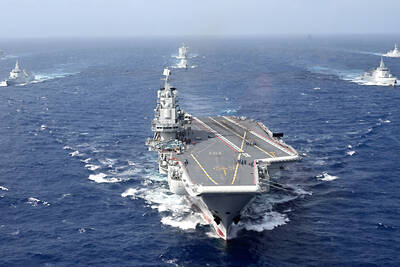
PROVOCATIVE: Chinese Deputy Ambassador to the UN Sun Lei accused Japan of sending military vessels to deliberately provoke tensions in the Taiwan Strait China denounced remarks by Japan and the EU about the South China Sea at a UN Security Council meeting on Monday, and accused Tokyo of provocative behavior in the Taiwan Strait and planning military expansion. Ayano Kunimitsu, a Japanese vice foreign minister, told the Council meeting on maritime security that Tokyo was seriously concerned about the situation in the East China and South China seas, and reiterated Japan’s opposition to any attempt to change the “status quo” by force, and obstruction of freedom of navigation and overflight. Stavros Lambrinidis, head of the EU delegation to the UN, also highlighted South China Sea
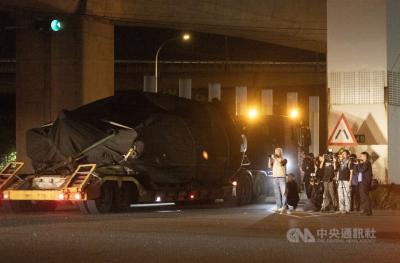
The final batch of 28 M1A2T Abrams tanks purchased from the US arrived at Taipei Port last night and were transported to the Armor Training Command in Hsinchu County’s Hukou Township (湖口), completing the military’s multi-year procurement of 108 of the tanks. Starting at 12:10am today, reporters observed more than a dozen civilian flatbed trailers departing from Taipei Port, each carrying an M1A2T tank covered with black waterproof tarps. Escorted by military vehicles, the convoy traveled via the West Coast Expressway to the Armor Training Command, with police implementing traffic control. The army operates about 1,000 tanks, including CM-11 Brave Tiger
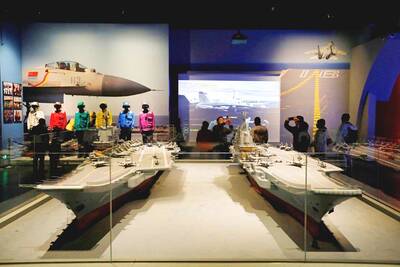
China on Wednesday teased in a video an aircraft carrier that could be its fourth, and the first using nuclear power, while making an allusion to Taiwan and vowing to further build up its islands, as it looks to boost maritime power, secure resources and bolster territorial claims. The video, issued on the eve of the 77th founding anniversary of the Chinese People’s Liberation Army Navy, featured fictional officers with names that are homophones of three commissioned aircraft carriers, the Liaoning (遼寧), Shandong (山東) and Fujian (福建). Titled Into the Deep, it showed a 19-year-old named “Hejian” (何劍) joining the group, sparking
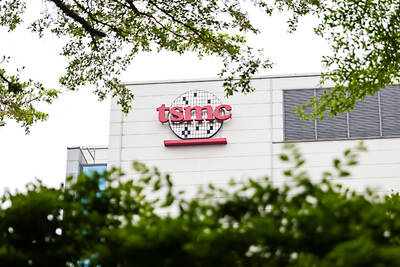
Taiwan Semiconductor Manufacturing Co (TSMC, 台積電), the world’s largest contract chipmaker, said it expects its 2-nanometer (2nm) chip capacity to grow at a compound annual rate of 70 percent from this year to 2028. The projection comes as five fabs begin volume production of 2-nanometer chips this year — two in Hsinchu and three in Kaohsiung — TSMC senior vice president and deputy cochief operating officer Cliff Hou (侯永清) said at the company’s annual technology symposium in Silicon Valley, California, last week. Output in the first year of 2-nanometer production, which began in the fourth quarter of last year, is expected to


 RSS
RSS