


Three UN workers kidnapped in Afghanistan were released unharmed yesterday after nearly four weeks in captivity, and officials insisted that no deal had been made to secure their freedom.
The release was a relief to foreign aid workers and UN staffers among Kabul's 2,000-strong expatriate community, under virtual lockdown since the kidnapping. Large tracts of the country are already off-limits to relief workers because of a stubborn Taliban-led insurgency.
"They are out," UN spokesman Manoel de Almeida e Silva said. "I'm told they are in good spirits and they seem to be fine."
Philippine diplomat Angelito Nayan, British-Irish citizen Annetta Flanigan and Shqipe Hebibi of Kosovo were seized at gunpoint from a UN vehicle on Oct. 28 in Kabul.
They were the first foreigners seized in the Afghan capital since the Taliban were driven from power three years ago, and their abductions raised fears that the Afghan capital could fall prey to the kind of deadly kidnappings by insurgents that have plagued Iraq.
Afghan Interior Minister Ali Ahmad Jalali said the trio were "abandoned in one location inside Kabul" at around 6am yesterday.
Jalali said discussions had been held with the kidnappers, whom he declined to identify, but insisted no deal was done and that the releases were unconditional.
"None of the hostage-takers conditions have been met," he told a news conference. "All those people who had a hand in this -- directly or indirectly -- will be brought to justice."
Afghan officials have said they believe a criminal gang carried out the abductions, and that a ransom had been demanded.
Jalali also said it was "possible" that a Taliban-linked group which claimed responsibility had hired some criminals to abduct the three, who were in Afghanistan to organize Oct. 9 presidential elections.
The group, Jaish-al Muslimeen, or Army of Muslims, had demanded that Afghan and US authorities free jailed comrades.
Syed Khalid, a spokesman for the militants, told The Associated Press on Tuesday it had freed the hostages against an "assurance that the release of our 24 people would begin today."
His claims could not be verified.
Silvestre Afable, a Philippine government spokesman, also insisted there was no prisoner-for-hostage exchange.
The foreigners were freed a day after US forces raided two houses in downtown Kabul on Monday and detained 10 people in connection with the abductions.
Most of the detainees were released after being questioned, an Afghan intelligence official said, and it was not clear if the arrest of a doctor who worked at a UN clinic in the city had hastened the hostages' release.
Jalali also said one person was killed and four wounded in another police operation linked to the kidnapping north of Kabul on Monday.

PROVOCATIVE: Chinese Deputy Ambassador to the UN Sun Lei accused Japan of sending military vessels to deliberately provoke tensions in the Taiwan Strait China denounced remarks by Japan and the EU about the South China Sea at a UN Security Council meeting on Monday, and accused Tokyo of provocative behavior in the Taiwan Strait and planning military expansion. Ayano Kunimitsu, a Japanese vice foreign minister, told the Council meeting on maritime security that Tokyo was seriously concerned about the situation in the East China and South China seas, and reiterated Japan’s opposition to any attempt to change the “status quo” by force, and obstruction of freedom of navigation and overflight. Stavros Lambrinidis, head of the EU delegation to the UN, also highlighted South China Sea
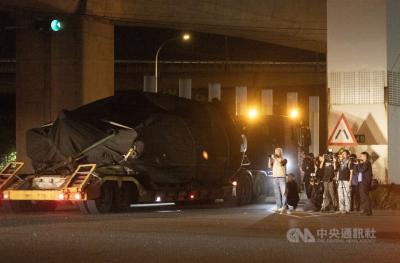
The final batch of 28 M1A2T Abrams tanks purchased from the US arrived at Taipei Port last night and were transported to the Armor Training Command in Hsinchu County’s Hukou Township (湖口), completing the military’s multi-year procurement of 108 of the tanks. Starting at 12:10am today, reporters observed more than a dozen civilian flatbed trailers departing from Taipei Port, each carrying an M1A2T tank covered with black waterproof tarps. Escorted by military vehicles, the convoy traveled via the West Coast Expressway to the Armor Training Command, with police implementing traffic control. The army operates about 1,000 tanks, including CM-11 Brave Tiger
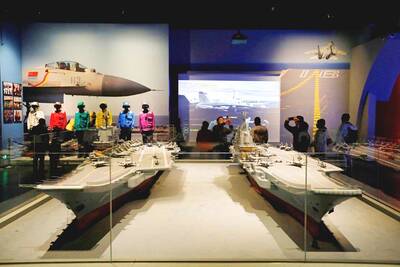
China on Wednesday teased in a video an aircraft carrier that could be its fourth, and the first using nuclear power, while making an allusion to Taiwan and vowing to further build up its islands, as it looks to boost maritime power, secure resources and bolster territorial claims. The video, issued on the eve of the 77th founding anniversary of the Chinese People’s Liberation Army Navy, featured fictional officers with names that are homophones of three commissioned aircraft carriers, the Liaoning (遼寧), Shandong (山東) and Fujian (福建). Titled Into the Deep, it showed a 19-year-old named “Hejian” (何劍) joining the group, sparking
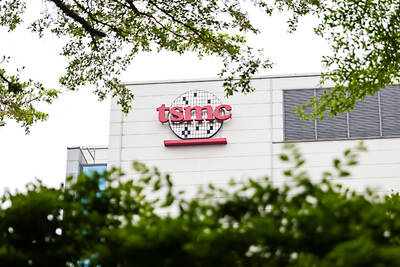
Taiwan Semiconductor Manufacturing Co (TSMC, 台積電), the world’s largest contract chipmaker, said it expects its 2-nanometer (2nm) chip capacity to grow at a compound annual rate of 70 percent from this year to 2028. The projection comes as five fabs begin volume production of 2-nanometer chips this year — two in Hsinchu and three in Kaohsiung — TSMC senior vice president and deputy cochief operating officer Cliff Hou (侯永清) said at the company’s annual technology symposium in Silicon Valley, California, last week. Output in the first year of 2-nanometer production, which began in the fourth quarter of last year, is expected to


 RSS
RSS