


At least 28 people were killed and scores injured when car bombs exploded at resorts packed with Israeli holidaymakers on the Red Sea coast of Egypt's Sinai desert in attacks Israel blamed yesterday on al-Qaeda.
The most powerful of the explosions late Thursday left a trail of carnage and destruction at the 10-story Hilton hotel in Taba, a town just across the Israeli border, that hosted Israeli-Palestinian peace talks in 2001.
"According to our first information, it appears to be an international terror attack with the hallmarks of al-Qaeda," said Israel's deputy defense minister, Zeev Boim.
The explosions followed official warnings that Israelis should keep out of the Sinai because of possible attacks.
They occurred as Israelis were celebrating the end of the Jewish holiday of Sukkot, which commemorates the years that the Jews spent in the Sinai desert on their way to the "Promised Land," and celebrates the way in which God protected them.
Estimates of the number of dead varied through the night as rescuers combed the rubble of the hotel searching for survivors and bodies after the attacks, one of the deadliest on Egyptian soil.
An Israeli army general at the site said yesterday that 23 Israelis and five Egyptians were killed, stressing it was a provisional toll.
"For the moment, 28 bodies have been recovered, including those of 23 Israelis and five Egyptians," General Yair Naveh told Israeli public radio.
"We think there are more dead under the rubble, but work to clear the rubble will take time, no doubt several days," the general said, adding that around 20 people were hospitalized in Israel.
Shamun Romash, the Israeli rescue operations chief at the hotel, added: "There is minimal hope of finding survivors because the explosion was very powerful."
According to Israeli officials, the Hilton attack was carried out by a suicide bomber in a car carrying 200kg of explosives. A second suicide bomber blew himself up by the hotel's pool.
Israeli public radio reported that two car engines were recovered from the site, supposing that two cars were used in the attack. The Egyptian news agency MENA said one of them was a green Ford.
Two people were also killed in attacks in a restaurant in the backpacker resort of Ras Sultan, near Nuweiba further south.
The attack was carried out by a suicide bomber who blew himself up in a parking lot close to a restaurant. A second suicide bomber who tried to enter the same restaurant detonated himself prematurely, killing only himself, an Israeli official told reporters.
Israel's ambassador to Egypt, Eli Shaked, said he had been informed that most of the casualties there were Egyptians, while Moscow said one Russian was killed and eight injured.
London said two Britons were among the wounded in the Sinai blasts.
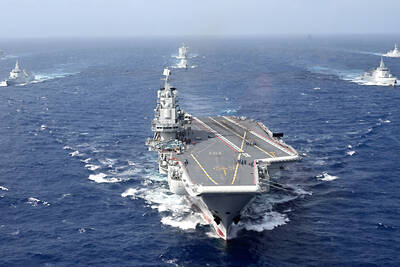
PROVOCATIVE: Chinese Deputy Ambassador to the UN Sun Lei accused Japan of sending military vessels to deliberately provoke tensions in the Taiwan Strait China denounced remarks by Japan and the EU about the South China Sea at a UN Security Council meeting on Monday, and accused Tokyo of provocative behavior in the Taiwan Strait and planning military expansion. Ayano Kunimitsu, a Japanese vice foreign minister, told the Council meeting on maritime security that Tokyo was seriously concerned about the situation in the East China and South China seas, and reiterated Japan’s opposition to any attempt to change the “status quo” by force, and obstruction of freedom of navigation and overflight. Stavros Lambrinidis, head of the EU delegation to the UN, also highlighted South China Sea
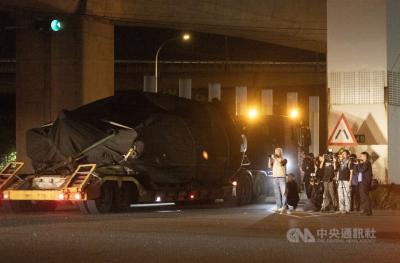
The final batch of 28 M1A2T Abrams tanks purchased from the US arrived at Taipei Port last night and were transported to the Armor Training Command in Hsinchu County’s Hukou Township (湖口), completing the military’s multi-year procurement of 108 of the tanks. Starting at 12:10am today, reporters observed more than a dozen civilian flatbed trailers departing from Taipei Port, each carrying an M1A2T tank covered with black waterproof tarps. Escorted by military vehicles, the convoy traveled via the West Coast Expressway to the Armor Training Command, with police implementing traffic control. The army operates about 1,000 tanks, including CM-11 Brave Tiger
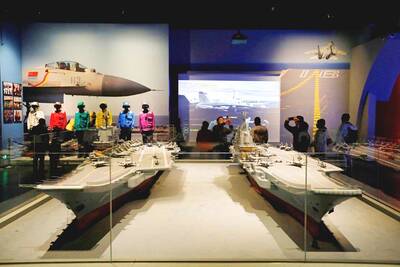
China on Wednesday teased in a video an aircraft carrier that could be its fourth, and the first using nuclear power, while making an allusion to Taiwan and vowing to further build up its islands, as it looks to boost maritime power, secure resources and bolster territorial claims. The video, issued on the eve of the 77th founding anniversary of the Chinese People’s Liberation Army Navy, featured fictional officers with names that are homophones of three commissioned aircraft carriers, the Liaoning (遼寧), Shandong (山東) and Fujian (福建). Titled Into the Deep, it showed a 19-year-old named “Hejian” (何劍) joining the group, sparking
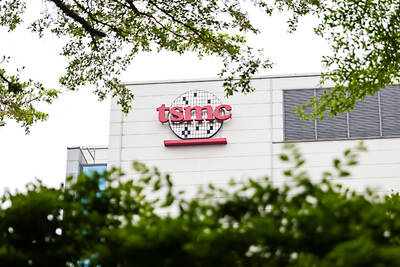
Taiwan Semiconductor Manufacturing Co (TSMC, 台積電), the world’s largest contract chipmaker, said it expects its 2-nanometer (2nm) chip capacity to grow at a compound annual rate of 70 percent from this year to 2028. The projection comes as five fabs begin volume production of 2-nanometer chips this year — two in Hsinchu and three in Kaohsiung — TSMC senior vice president and deputy cochief operating officer Cliff Hou (侯永清) said at the company’s annual technology symposium in Silicon Valley, California, last week. Output in the first year of 2-nanometer production, which began in the fourth quarter of last year, is expected to


 RSS
RSS