


Saudi Arabia aired photographs yesterday on national TV of four wanted militants killed in a firefight after dumping the mutilated body of a US hostage, including the bloodied corpse of the reputed leader of al-Qaeda in the kingdom.
The al-Qaeda cell allegedly led by Abdulaziz al-Moqrin fulfilled its threat to kill Paul M. Johnson, Jr., beheading him and showing the grisly photos on the Internet on Friday.
Afterward, US and Saudi officials said privately that al-Moqrin was killed in a shootout.
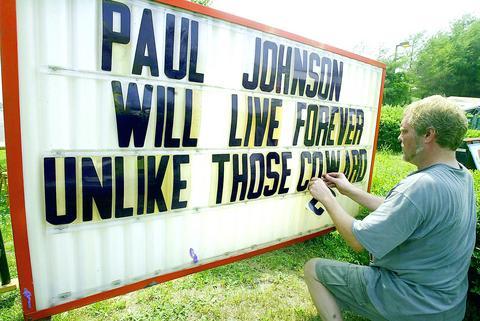
PHOTO: AP
A statement posted yesterday on an Islamist Web site denied that, saying such claims were "aimed at dissuading the holy warriors and crushing their spirits."
The killing of al-Moqrin, 31, would be a coup for the Saudi government, which has been pressed to halt a wave of attacks against Westerners in the kingdom.
Condemnation of Johnson's killing came from around the world, with even one of the US' staunchest foes, Syria, calling it a "shameful crime."
One of the photographs, the Saudi TV announcer said, was of Abdulaziz al-Moqrin, the kingdom's most-wanted terror suspect. It showed the face of a young man, clean-shaven except for his mustache and resembling past pictures believed to be of al-Moqrin, apparently dead. Saudi news channel Al-Ekhbariya showed a full shot of al-Moqrin's corpse covered with blood.
A trickle of blood ran from the mouth of another of the militants pictured, and the teeth of a third appeared smashed.
The official Saudi Press Agency (SPA) identified the three other militants killed as Faisal Abdul-Rahman al-Dikheel, Turki bin Fuheid al-Muteiry and Ibrahim bin Abdullah al-Dreiham.
The four were cornered at a gas station in the al-Malaz neighborhood in the capital Riyadh, and died in a heavy exchange of gunfire with Saudi security forces. Al-Ekhbariya featured footage of the gas station where the shootout took place, with blood on the street and covering some merchandise inside.
According to the SPA statement, al-Dikheel -- also on the kingdom's list of the top 26 wanted militants -- was involved in a number of killings and was apparently featured in video footage of Johnson's killing. Al-Muteiry was among the militants to flee the scene of the May 29 shooting and hostage-taking attack on the oil hub of Khobar that killed 22 people, and al-Dreiham was linked to last Nov. 8's suicide bombing at Riyadh housing compounds that killed 17, the statement added.
One security officer was killed in the Friday raid and two others were injured, the statement on SPA said.
Saudi officials in Washington said on condition of anonymity that five Saudi security officers were killed in the gunbattle. Two suspects escaped, said a Saudi security official who participated.
Al-Moqrin was believed to be behind numerous attacks on foreigners in the kingdom, including the kidnapping and ultimate beheading of Johnson, an employee of the US defense contractor Lockheed Martin whose death was reported on Friday.
Saudi newspapers denounced Johnson's killers and hailed the efforts of Saudi security forces. The Interior Ministry provided no details on how the operation -- said to have begun with a citizen calling in the number of the vehicle from which Johnson's body was dumped -- played out.
However, the statement said that authorities also confiscated three cars used by the cell, including one believed to have been used in the June 6 killing of Irish cameraman Simon Cumbers.
Forged identity papers and a large amount of weapons also were confiscated, including three rocket-propelled grenade launchers, hand grenades and automatic rifles, the statement said.
Johnson's severed head was shown on a Web site on Friday. A statement, in the name of Fallujah Brigade of al-Qaeda in the Arabian Peninsula, said "the infidel got his fair treatment. ... Let him taste something of what Muslims have long tasted from Apache helicopter fire and missiles."
Johnson had worked on Apache helicopters for Lockheed Martin.
Also See Story:
World leaders slam hostage beheading
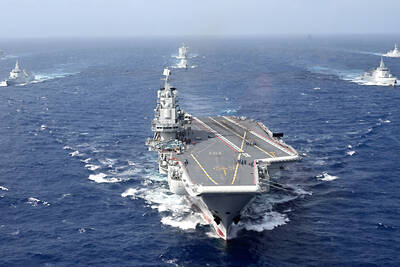
PROVOCATIVE: Chinese Deputy Ambassador to the UN Sun Lei accused Japan of sending military vessels to deliberately provoke tensions in the Taiwan Strait China denounced remarks by Japan and the EU about the South China Sea at a UN Security Council meeting on Monday, and accused Tokyo of provocative behavior in the Taiwan Strait and planning military expansion. Ayano Kunimitsu, a Japanese vice foreign minister, told the Council meeting on maritime security that Tokyo was seriously concerned about the situation in the East China and South China seas, and reiterated Japan’s opposition to any attempt to change the “status quo” by force, and obstruction of freedom of navigation and overflight. Stavros Lambrinidis, head of the EU delegation to the UN, also highlighted South China Sea
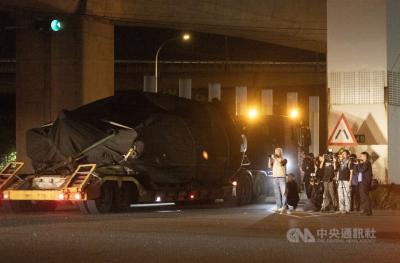
The final batch of 28 M1A2T Abrams tanks purchased from the US arrived at Taipei Port last night and were transported to the Armor Training Command in Hsinchu County’s Hukou Township (湖口), completing the military’s multi-year procurement of 108 of the tanks. Starting at 12:10am today, reporters observed more than a dozen civilian flatbed trailers departing from Taipei Port, each carrying an M1A2T tank covered with black waterproof tarps. Escorted by military vehicles, the convoy traveled via the West Coast Expressway to the Armor Training Command, with police implementing traffic control. The army operates about 1,000 tanks, including CM-11 Brave Tiger
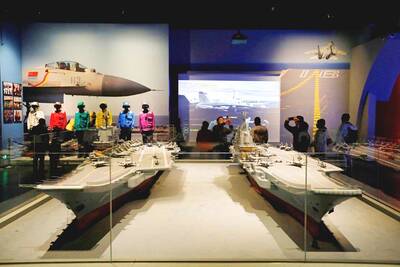
China on Wednesday teased in a video an aircraft carrier that could be its fourth, and the first using nuclear power, while making an allusion to Taiwan and vowing to further build up its islands, as it looks to boost maritime power, secure resources and bolster territorial claims. The video, issued on the eve of the 77th founding anniversary of the Chinese People’s Liberation Army Navy, featured fictional officers with names that are homophones of three commissioned aircraft carriers, the Liaoning (遼寧), Shandong (山東) and Fujian (福建). Titled Into the Deep, it showed a 19-year-old named “Hejian” (何劍) joining the group, sparking
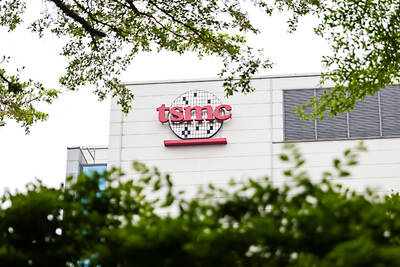
Taiwan Semiconductor Manufacturing Co (TSMC, 台積電), the world’s largest contract chipmaker, said it expects its 2-nanometer (2nm) chip capacity to grow at a compound annual rate of 70 percent from this year to 2028. The projection comes as five fabs begin volume production of 2-nanometer chips this year — two in Hsinchu and three in Kaohsiung — TSMC senior vice president and deputy cochief operating officer Cliff Hou (侯永清) said at the company’s annual technology symposium in Silicon Valley, California, last week. Output in the first year of 2-nanometer production, which began in the fourth quarter of last year, is expected to


 RSS
RSS