


The Cabinet and the Ministry of Defense yesterday dismissed a proposal by China to withdraw its missiles as a trick aimed at preventing the US government from selling arms to Taiwan.
"Instead of using the media to spread rumors, why don't they sit down and talk with us about how to develop a military trust mechanism and how to create a peaceful and stable environment across the Strait," Cabinet Spokesman Chen Chi-mai (陳其邁) said.
Chen made the remark in response to a report in the pro-China Hong Kong newspaper Wen Wei Po that claimed Beijing would consider withdrawing ballistic missiles deployed along its southeast coast if the US government stops selling advanced weapons to Taiwan.
Dubbing the media report as hearsay, Chen said China would never withdraw its missiles.
"I'd like to point out that China has made double-digit increases in its military budget every year since 1995, which seriously threatens security across the Taiwan Strait," he said. "Take last year for example; its military expenses were recorded at between US$50 billion and NT$70 billion."
Taiwan, on the other hand, has been cutting military spending. Military expenditures accounted for 24.3 percent of the total budget in 1994. They accounted for only 16.5 percent last year. The Cabinet has requested NT$251.9 billion, or 15.6 percent of next year's annual budget, for national defense.
Commenting on the media report, Minister of National Defense Lee Jye (李傑) and National Security Council Secretary-General Chiou I-jen (邱義仁) said it would be of little meaning to withdraw the missiles because they can be relocated elsewhere and then brought back again.
Also dismissing the proposal, Vice Minister of National Defense Huo Shou-yeh (
Huo made the remark in response to a media inquiry about the Wen Wei Po report yesterday morning after briefing independent lawmakers on the planned NT$614.1 billion (US$18.4 billion) special budget for arms purchases from the US.
The bill is awaiting approval by the legislature.
The money is to be spent over the next 15 years, with NT$412 billion earmarked for eight diesel-electric submarines, NT$145 billion for six Patriot anti-missile systems and NT$53 billion for 12 P-3C anti-submarine aircraft.
Defense ministry spokesman Major-General Huang Suei-sheng (黃穗生) said China pulling back its missiles along the coast would be meaningless since it has long-range missiles located elsewhere and is developing its armed forces.
"As long as China does not give up the intention to launch a military assault against Taiwan, we should be on high alert," Huang said. "It's just another of China's tricks to prevent the US government from selling arms to us."
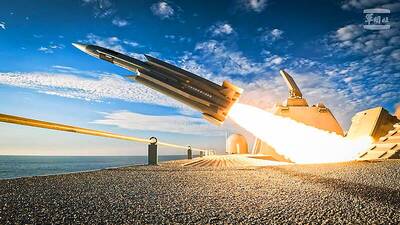
DETERRENCE: With 1,000 indigenous Hsiung Feng II and III missiles and 400 Harpoon missiles, the nation would boast the highest anti-ship missile density in the world With Taiwan wrapping up mass production of Hsiung Feng II and III missiles by December and an influx of Harpoon missiles from the US, Taiwan would have the highest density of anti-ship missiles in the world, a source said yesterday. Taiwan is to wrap up mass production of the indigenous anti-ship missiles by the end of year, as the Chungshan Institute of Science and Technology has been meeting production targets ahead of schedule, a defense official with knowledge of the matter said. Combined with the 400 Harpoon anti-ship missiles Taiwan expects to receive from the US by 2028, the nation would have

POSSIBILITIES EMERGE: With Taiwan’s victory and Japan’s narrow win over Australia, Taiwan now have a chance to advance if South Korea also beat the Aussies Taiwan has high hopes that the national baseball team would advance to the World Baseball Classic (WBC) quarter-finals after clinching a crucial 5-4 victory over South Korea in a nail-biting extra-inning game at the Tokyo Dome yesterday. Boosted by three home runs — two solo shots by Yu Chang (張育成) and Cheng Tsung-che (鄭宗哲) and a two-run homer by Stuart Fairchild — the triumph gave Taiwan a much-needed second victory in the five-team Pool C, where only the top two finishers would advance to the knockout stage in Miami, Florida. Entering extra innings with the game tied at four apiece, Taiwan scored
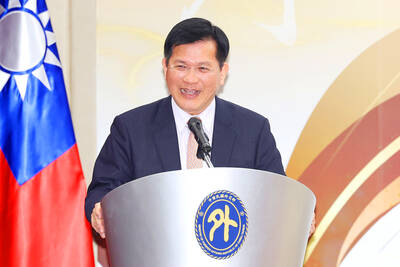
MISSION OF PEACE: The foreign minister urged Beijing to respect Taiwan’s existence as an independent nation, and work together to ensure peace and stability in the region Minister of Foreign Affairs Lin Chia-lung (林佳龍) yesterday rejected Chinese Minister of Foreign Affairs Wang Yi’s (王毅) comments about Taiwan, criticizing China as a “troublemaker” in the international community and a disruptor of cross-strait peace. Speaking at a news conference on the sidelines of the Chinese National People’s Congress, Wang said that Taiwan has always been a territory of China and that it would be impossible for it to become its own country. The “return” of Taiwan to China was the natural outcome of the Chinese people’s resistance against Japan in World War II, and that any pursuit of independence was “doomed

‘UNWAVERING FRIENDSHIP’: A representative of a Japanese group that co-organized a memorial, said he hopes Japanese never forget Taiwan’s kindness President William Lai (賴清德) yesterday marked the 15th anniversary of the Tohoku earthquake and tsunami, urging continued cooperation between Taiwan and Japan on disaster prevention and humanitarian assistance. Lai wrote on social media that Taiwan and Japan have always helped each other in the aftermath of major disasters. The magnitude 9 earthquake struck northeastern Japan on March 11, 2011, triggering a massive tsunami that claimed more than 19,000 lives, according to data from Japanese authorities. Following the disaster, Taiwan donated more than US$240 million in aid, making it one of the largest contributors of financial assistance to Japan. In addition to cash donations and


 RSS
RSS