


Polish and Bulgarian troops battled Shiite militiamen in the Iraqi shrine city of Kerbala yesterday as US-led forces struggled to quell the worst violence since Saddam Hussein's fall a year ago.
Fighting raged for a fourth day between Sunni rebels and US Marines in Falluja, west of Baghdad, where the director of the main hospital said up to 300 Iraqis had been killed and at least 400 wounded since Sunday.
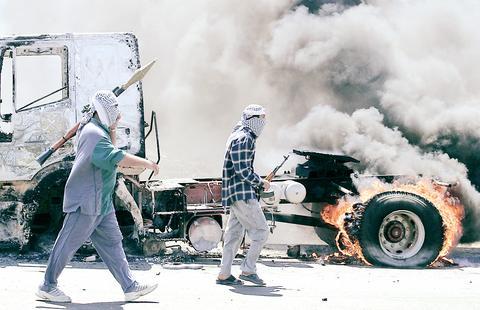
PHOTO: REUTERS
Townspeople were told by mosque loudspeakers to take their dead to a sports stadium for burial. Fighting has made it impossible to reach cemeteries on the town's outskirts.
Thousands of Sunni and Shiite protesters gathered outside the Um al-Qura mosque in Baghdad, chanting slogans in solidarity with people in Falluja, Kerbala and other conflict zones. Similar rallies took place in Mosul and Baquba, north of the capital.
"We will carry our swords and strike the Americans on their heads," a Sunni cleric yelled.
The US said it might keep combat-hardened troops in Iraq longer than planned to help tackle Sunni and Shiite insurgents trying to expel American-led occupiers.
This week's intense two-front fighting has killed 35 American and allied soldiers and several hundred Iraqis.
Polish and Bulgarian soldiers traded fire with Shiite Mehdi Army fighters in Kerbala.
"There was shooting all night," said Polish spokesman Lieutenant-Colonel Robert Strzelecki.
A health official, Mehdi al-Hasnawi, said four Iraqis had been killed and 16 wounded. Witnesses said the Mehdi Army was in control of the city. More clashes erupted later in the day.
Hundreds of thousands of Shiite pilgrims, including many from Iran, have converged on Kerbala for Arbain, a major religious occasion that reaches its climax this weekend.
The Mehdi Army militia led by firebrand cleric Moqtada al-Sadr swept onto the streets of Shiite cities across Iraq this week, clashing frequently with US-led troops.
An aide to Sadr reiterated a claim that the militia had captured several foreign troops, including Americans, and offered to exchange them for captured militiamen. A US commander denied any foreign troops had been captured in Najaf.
In Falluja, hospital director Rafi Hayat said between 280 to 300 Iraqis had been killed and at least 400 wounded in fighting this week as US Marines mounted a major mission to root out guerrillas in the town.
The Marines launched a big crackdown in the city after last week's killing and mutilation of four US private security guards there. Twelve Marines were killed in a guerrilla attack on Tuesday in the town of Ramadi, also engulfed in fighting.
Also See Story:
Japan vows to make no hasty decisions on Iraq troops
US underestimated and misidentified Iraq threats

PROVOCATIVE: Chinese Deputy Ambassador to the UN Sun Lei accused Japan of sending military vessels to deliberately provoke tensions in the Taiwan Strait China denounced remarks by Japan and the EU about the South China Sea at a UN Security Council meeting on Monday, and accused Tokyo of provocative behavior in the Taiwan Strait and planning military expansion. Ayano Kunimitsu, a Japanese vice foreign minister, told the Council meeting on maritime security that Tokyo was seriously concerned about the situation in the East China and South China seas, and reiterated Japan’s opposition to any attempt to change the “status quo” by force, and obstruction of freedom of navigation and overflight. Stavros Lambrinidis, head of the EU delegation to the UN, also highlighted South China Sea
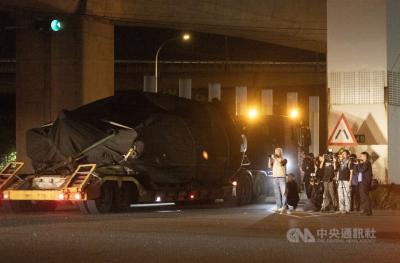
The final batch of 28 M1A2T Abrams tanks purchased from the US arrived at Taipei Port last night and were transported to the Armor Training Command in Hsinchu County’s Hukou Township (湖口), completing the military’s multi-year procurement of 108 of the tanks. Starting at 12:10am today, reporters observed more than a dozen civilian flatbed trailers departing from Taipei Port, each carrying an M1A2T tank covered with black waterproof tarps. Escorted by military vehicles, the convoy traveled via the West Coast Expressway to the Armor Training Command, with police implementing traffic control. The army operates about 1,000 tanks, including CM-11 Brave Tiger
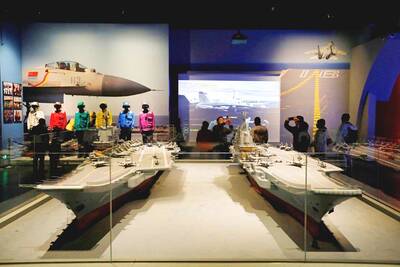
China on Wednesday teased in a video an aircraft carrier that could be its fourth, and the first using nuclear power, while making an allusion to Taiwan and vowing to further build up its islands, as it looks to boost maritime power, secure resources and bolster territorial claims. The video, issued on the eve of the 77th founding anniversary of the Chinese People’s Liberation Army Navy, featured fictional officers with names that are homophones of three commissioned aircraft carriers, the Liaoning (遼寧), Shandong (山東) and Fujian (福建). Titled Into the Deep, it showed a 19-year-old named “Hejian” (何劍) joining the group, sparking
Taiwan Semiconductor Manufacturing Co (TSMC, 台積電), the world’s largest contract chipmaker, said it expects its 2-nanometer (2nm) chip capacity to grow at a compound annual rate of 70 percent from this year to 2028. The projection comes as five fabs begin volume production of 2-nanometer chips this year — two in Hsinchu and three in Kaohsiung — TSMC senior vice president and deputy cochief operating officer Cliff Hou (侯永清) said at the company’s annual technology symposium in Silicon Valley, California, last week. Output in the first year of 2-nanometer production, which began in the fourth quarter of last year, is expected to


 RSS
RSS