


US troops battled with insurgents in two central Iraqi towns yesterday, with at least 60 Iraqis killed and more than 120 wounded in overnight fighting in Fallujah, hospital officials said.
Meanwhile, a top US general in Iraq vowed to "destroy" a Shiite militia that, along with Sunni Muslim guerrillas, waged the most extensive fighting since US President George W. Bush declared the war over in May. Up to a dozen Marines, two other coalition soldiers and scores of Iraqis were killed in battles on Tuesday.
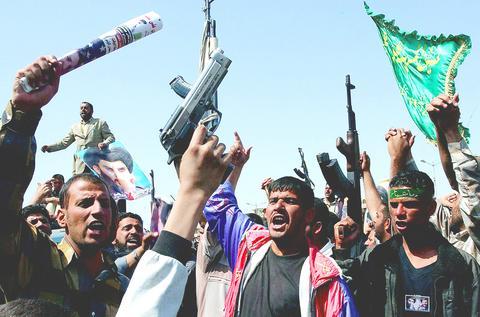
PHOTO: EPA
"The coalition and Iraqi security forces will continue deliberate, precise and powerful offensive operations to destroy the al-Mahdi Army throughout Iraq," Brigadier General Mark Kimmitt, the US military's deputy head of operations, told reporters in Baghdad.
He said US forces were trying to hunt down members of the al-Mahdi Army in the mainly Shiite neighborhood of Sadr City in Baghdad, while US and coalition forces were working to prevent militiamen from seizing government buildings and police stations in southern cities.
He called on the militia's leader -- Moqtada al-Sadr, a radical Shiite cleric wanted by US officials -- to surrender.
"If he wants to calm the situation ... he can turn himself in to a local Iraqi police station and he can face justice," Kimmitt said.
While al-Sadr supporters attacked coalition forces in the south, US Marines have been besieging Fallujah, west of Baghdad, to uproot Sunni Muslim guerrillas.
US Marines and gunmen were engaged in heavy battles in the Dubat neighborhood on the eastern side of Fallujah and elsewhere in the city, witnesses said.
US warplanes opened fire on groups of Iraqis in the street. Rocket-propelled grenade fire set a US humvee ablaze, wounding soldiers inside, witnesses said.
Mosques in the city called for jihad, or holy war, against Americans. Some gunmen in the street were seen carrying mortars, and some women carried automatic weapons.
Among the 60 dead in the city, 26 people -- including 16 children and up to eight women -- were killed when warplanes struck four houses late Tuesday, said Hatem Samir, head of the clinic at Fallujah Hospital. Others were killed in ongoing street battles.
US Marines this week launched a major operation to root out Sunni Muslim guerrillas from Fallujah, 60km west of Baghdad, one of their strongest bastions. But on Tuesday, the insurgents opened a new front with a bloody attack on Marines in the nearby town of Ramadi.
Gunmen hiding in Ramadi's main cemetery opened fire on US patrols, sparking a gunbattle in alleys and near the governor's palace, witnesses said, adding that at least two Iraqis were killed.
"A significant number" of Marines were killed Tuesday, and initial reports indicate it may be up to a dozen, a senior defense official said from Washington.
New fighting erupted in the same Ramadi neighborhood yesterday, witnesses said.
In the south, Shiite militiamen attacked coalition troops in five cities Tuesday in battles in a revolt sparked by a US crackdown on al-Sadr.
Al-Sadr urged Iraqis to rise up against the US occupation and vowed to die rather than be captured by US forces.
"America has shown its evil intentions, and the proud Iraqi people cannot accept it," he said in a statement. "They must defend their rights by any means they see fit."
Depending on the number of Ramadi deaths, Tuesday and yesterday's casualties could have brought the total since Sunday as high as about 30 Americans and more than 150 Iraqis killed in the fighting.
Clashes continued overnight between militiamen from al-Sadr's al-Mahdi Army and coalition troops in Kut, Karbala and Sadr City in Baghdad.
At least 12 Iraqis were killed in Kut and four in Baghdad, along with two Iranians caught in the crossfire in Karbala, according to doctors.
The al-Mahdi Army appeared to be in control of Kut and Kufa, occupying government buildings and roaming the streets, as Iraqi police stood aside.
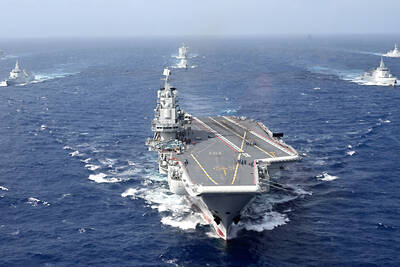
PROVOCATIVE: Chinese Deputy Ambassador to the UN Sun Lei accused Japan of sending military vessels to deliberately provoke tensions in the Taiwan Strait China denounced remarks by Japan and the EU about the South China Sea at a UN Security Council meeting on Monday, and accused Tokyo of provocative behavior in the Taiwan Strait and planning military expansion. Ayano Kunimitsu, a Japanese vice foreign minister, told the Council meeting on maritime security that Tokyo was seriously concerned about the situation in the East China and South China seas, and reiterated Japan’s opposition to any attempt to change the “status quo” by force, and obstruction of freedom of navigation and overflight. Stavros Lambrinidis, head of the EU delegation to the UN, also highlighted South China Sea
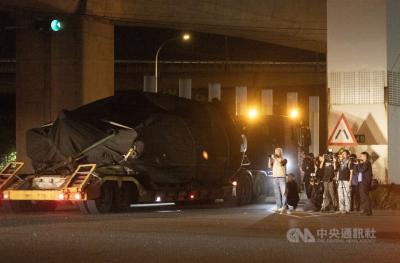
The final batch of 28 M1A2T Abrams tanks purchased from the US arrived at Taipei Port last night and were transported to the Armor Training Command in Hsinchu County’s Hukou Township (湖口), completing the military’s multi-year procurement of 108 of the tanks. Starting at 12:10am today, reporters observed more than a dozen civilian flatbed trailers departing from Taipei Port, each carrying an M1A2T tank covered with black waterproof tarps. Escorted by military vehicles, the convoy traveled via the West Coast Expressway to the Armor Training Command, with police implementing traffic control. The army operates about 1,000 tanks, including CM-11 Brave Tiger
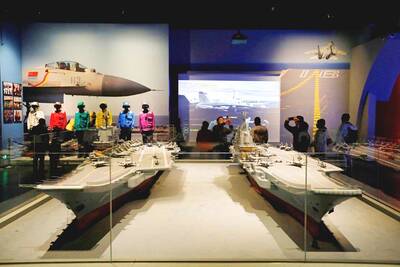
China on Wednesday teased in a video an aircraft carrier that could be its fourth, and the first using nuclear power, while making an allusion to Taiwan and vowing to further build up its islands, as it looks to boost maritime power, secure resources and bolster territorial claims. The video, issued on the eve of the 77th founding anniversary of the Chinese People’s Liberation Army Navy, featured fictional officers with names that are homophones of three commissioned aircraft carriers, the Liaoning (遼寧), Shandong (山東) and Fujian (福建). Titled Into the Deep, it showed a 19-year-old named “Hejian” (何劍) joining the group, sparking
Taiwan Semiconductor Manufacturing Co (TSMC, 台積電), the world’s largest contract chipmaker, said it expects its 2-nanometer (2nm) chip capacity to grow at a compound annual rate of 70 percent from this year to 2028. The projection comes as five fabs begin volume production of 2-nanometer chips this year — two in Hsinchu and three in Kaohsiung — TSMC senior vice president and deputy cochief operating officer Cliff Hou (侯永清) said at the company’s annual technology symposium in Silicon Valley, California, last week. Output in the first year of 2-nanometer production, which began in the fourth quarter of last year, is expected to


 RSS
RSS