


Spaniards voted yesterday in a general election thrown wide open by a reported al-Qaeda claim that it staged the Madrid rail bombings to punish the government for supporting the Iraq war.
Ruling Popular Party candidate Mariano Rajoy led most polls until last Thursday's bombing which killed 200 and injured 1,500 others. His conservative party had been projected to win the most seats in the 350-member Congress of Deputies, and maybe retain its outright majority.
Prime Minister Jose Maria Aznar's government initially blamed the Basque separatist group ETA for the rail attack, even as evidence mounted of an Islamic link and the opposition accused the government of withholding information.
Then on Saturday night Interior Minister Angel Acebes announced the arrests of three Moroccans and two Indians and later disclosed the existence of a videotape in which a man speaking Arabic said Osama bin Laden's al-Qaeda terror group claims responsibility for the rail blasts.
The videotape was recovered from a trash basket near a Madrid mosque, after an Arabic-speaking man called a Madrid TV station to say it was there, Acebes said.
"We declare our responsibility for what happened in Madrid," said the man on the video, according to a government translation of the statement delivered in Arabic. "It is a response to your collaboration with the criminals Bush and his allies."
The man noted that the bombings came exactly 2 1/2 years after the Sept. 11, 2001, attacks in the US.
The news was broadcast on national TV and could sway the election.
Twenty people in the Basque city of Bilbao said early yesterday that recent events would not influence their vote. None would say which party they planned to vote for.
"I had already decided," said Maria Sonjuaisti, 42, "The attacks confirmed what I already had in mind."
Another voter in Madrid said he was upset by the attacks.
"It was the worst attack since the (1936-39) Civil War," said Angel Bueno, 51. "We want to know who is responsible for this massacre. It looks as if it was al-Qaeda. This shouldn't happen in Spain or the United States."
Spaniards including the main opposition candidate, Jose Luis Rodriguez Zapatero of the Socialist party, opposed last year's US-led invasion of Iraq, which Aznar endorsed. He later sent 1,300 peacekeeping troops.
Thousands of demonstrators gathered outside Popular Party headquarters in Madrid and other cities Saturday night demanding the truth about who carried out the bombing, and also shouting criticism of the government.
"No more cover-ups," read a banner carried by the protesters, who were being watched by riot police.

PROVOCATIVE: Chinese Deputy Ambassador to the UN Sun Lei accused Japan of sending military vessels to deliberately provoke tensions in the Taiwan Strait China denounced remarks by Japan and the EU about the South China Sea at a UN Security Council meeting on Monday, and accused Tokyo of provocative behavior in the Taiwan Strait and planning military expansion. Ayano Kunimitsu, a Japanese vice foreign minister, told the Council meeting on maritime security that Tokyo was seriously concerned about the situation in the East China and South China seas, and reiterated Japan’s opposition to any attempt to change the “status quo” by force, and obstruction of freedom of navigation and overflight. Stavros Lambrinidis, head of the EU delegation to the UN, also highlighted South China Sea
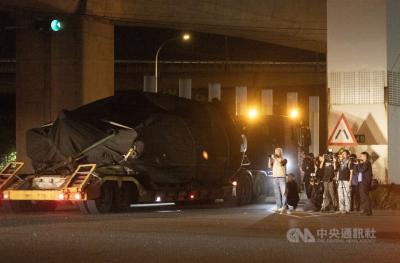
The final batch of 28 M1A2T Abrams tanks purchased from the US arrived at Taipei Port last night and were transported to the Armor Training Command in Hsinchu County’s Hukou Township (湖口), completing the military’s multi-year procurement of 108 of the tanks. Starting at 12:10am today, reporters observed more than a dozen civilian flatbed trailers departing from Taipei Port, each carrying an M1A2T tank covered with black waterproof tarps. Escorted by military vehicles, the convoy traveled via the West Coast Expressway to the Armor Training Command, with police implementing traffic control. The army operates about 1,000 tanks, including CM-11 Brave Tiger
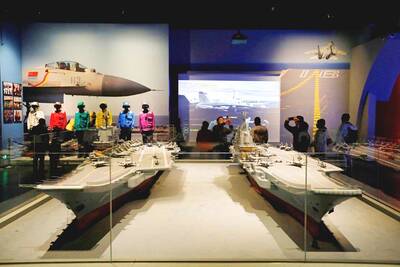
China on Wednesday teased in a video an aircraft carrier that could be its fourth, and the first using nuclear power, while making an allusion to Taiwan and vowing to further build up its islands, as it looks to boost maritime power, secure resources and bolster territorial claims. The video, issued on the eve of the 77th founding anniversary of the Chinese People’s Liberation Army Navy, featured fictional officers with names that are homophones of three commissioned aircraft carriers, the Liaoning (遼寧), Shandong (山東) and Fujian (福建). Titled Into the Deep, it showed a 19-year-old named “Hejian” (何劍) joining the group, sparking

Taiwan Semiconductor Manufacturing Co (TSMC, 台積電), the world’s largest contract chipmaker, said it expects its 2-nanometer (2nm) chip capacity to grow at a compound annual rate of 70 percent from this year to 2028. The projection comes as five fabs begin volume production of 2-nanometer chips this year — two in Hsinchu and three in Kaohsiung — TSMC senior vice president and deputy cochief operating officer Cliff Hou (侯永清) said at the company’s annual technology symposium in Silicon Valley, California, last week. Output in the first year of 2-nanometer production, which began in the fourth quarter of last year, is expected to


 RSS
RSS