


Rebels patrolled the streets of Haiti's capital yesterday after rebel leader Guy Philippe declared himself the new military chief and threatened to arrest the prime minister. US Marines barely ventured out of the city's airport.
Dozens of officials of ousted leader Jean-Bertrand Aristide's party rushed to the airport, with rebels in hot pursuit who were held of by the Marines, witnesses said.
The stage appeared set for yet another bloody confrontation in this Caribbean nation born in the blood and tumult of the world's sole successful slave rebellion 200 years ago.
"The country is in my hands!" Philippe announced on Tuesday on the radio in between touring the city in the back of a pickup truck and greeting throngs of admiring Haitians.
"This is one of darker moments in Haiti's history," said Brian Concannon, who had successfully prosecuted another rebel leader, Louis-Jodel Chamblain, in absentia for a 1994 massacre.
"I'm extremely afraid for all people who have fought for democracy because they all could be killed," he said.
Chamblain said rebel patrols may go to the Cite Soleil seaside slum that is a stronghold of die-hard supporters of Aristide.
US Marine Colonel Dave Berger told a news conference that the Marines, who began arriving on Sunday night hours after Aristide left the country for exile in Africa, will increase their presence throughout Haiti following Philippe's comments.
The Marine's mission expanded, Staff Sergeant Timothy Edwards said at the airport, "to protect Haitians from reprisal attacks."
"Part of our mission is to step in if we think there is a threat of bodily harm or deadly force to a [Haitian] citizen," Edwards said.
The US and French troops in Haiti -- the vanguard of an international peacekeeping force authorized by the UN Security Council -- have no orders to disarm Haiti's factions and instead are to secure key sites and protect their countries' citizens and government property, said Berger and the commander of the French forces.
Chile said it was sending 120 special forces to Haiti yesterday, the first of about 300 Chileans to join the international force.
France said it would have some 420 soldiers and police in place by the end of the week.
Philippe, meanwhile, appeared on the second-floor balcony of the colonnaded former army headquarters and raised a fist as hundreds of onlookers wildly cheered. A burly rebel standing next to Philippe urged them to accompany the rebel chief to Prime Minister Yvon Neptune's house.
"Arrest Neptune!" the crowd chanted.
Hours later, some 300 people gathered outside the gates of Neptune's office, guarded by a handful of US Marines. The crowd again demanded Neptune's arrest.
"The head is gone, but the tail remains!" they chanted.
The whereabouts of Neptune, a top member of Aristide's Lavalas party and his former spokesman, were unknown.
Speaking in Washington, Assistant US Secretary of State Roger Noriega said Philippe had no real power even as his rebels sought to take advantage of a power vacuum.
"He is not in control of anything but a ragtag band of people," Noriega told lawmakers on Tuesday.
No permanent home has yet been found for Aristide, and the he was staying in the presidential palace in the Central African Republic, that country's foreign minister said.
Also See Story:
US forced me out, says Aristide
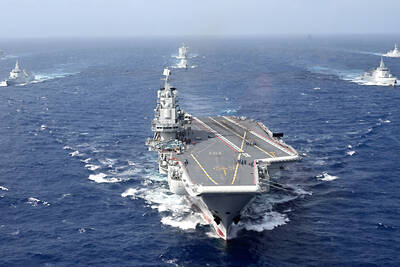
PROVOCATIVE: Chinese Deputy Ambassador to the UN Sun Lei accused Japan of sending military vessels to deliberately provoke tensions in the Taiwan Strait China denounced remarks by Japan and the EU about the South China Sea at a UN Security Council meeting on Monday, and accused Tokyo of provocative behavior in the Taiwan Strait and planning military expansion. Ayano Kunimitsu, a Japanese vice foreign minister, told the Council meeting on maritime security that Tokyo was seriously concerned about the situation in the East China and South China seas, and reiterated Japan’s opposition to any attempt to change the “status quo” by force, and obstruction of freedom of navigation and overflight. Stavros Lambrinidis, head of the EU delegation to the UN, also highlighted South China Sea
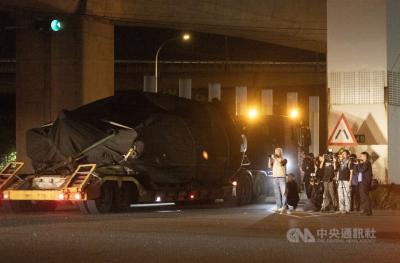
The final batch of 28 M1A2T Abrams tanks purchased from the US arrived at Taipei Port last night and were transported to the Armor Training Command in Hsinchu County’s Hukou Township (湖口), completing the military’s multi-year procurement of 108 of the tanks. Starting at 12:10am today, reporters observed more than a dozen civilian flatbed trailers departing from Taipei Port, each carrying an M1A2T tank covered with black waterproof tarps. Escorted by military vehicles, the convoy traveled via the West Coast Expressway to the Armor Training Command, with police implementing traffic control. The army operates about 1,000 tanks, including CM-11 Brave Tiger
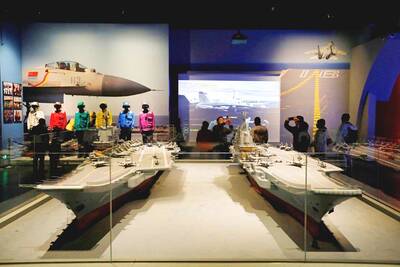
China on Wednesday teased in a video an aircraft carrier that could be its fourth, and the first using nuclear power, while making an allusion to Taiwan and vowing to further build up its islands, as it looks to boost maritime power, secure resources and bolster territorial claims. The video, issued on the eve of the 77th founding anniversary of the Chinese People’s Liberation Army Navy, featured fictional officers with names that are homophones of three commissioned aircraft carriers, the Liaoning (遼寧), Shandong (山東) and Fujian (福建). Titled Into the Deep, it showed a 19-year-old named “Hejian” (何劍) joining the group, sparking
Taiwan Semiconductor Manufacturing Co (TSMC, 台積電), the world’s largest contract chipmaker, said it expects its 2-nanometer (2nm) chip capacity to grow at a compound annual rate of 70 percent from this year to 2028. The projection comes as five fabs begin volume production of 2-nanometer chips this year — two in Hsinchu and three in Kaohsiung — TSMC senior vice president and deputy cochief operating officer Cliff Hou (侯永清) said at the company’s annual technology symposium in Silicon Valley, California, last week. Output in the first year of 2-nanometer production, which began in the fourth quarter of last year, is expected to


 RSS
RSS