


Israeli Prime Minister Ariel Sharon said in newspaper interviews published yesterday that he will not resign despite corruption allegations and the possibility that he might be indicted in coming weeks.
"I am not about to resign. I emphasize, I am not about to resign. I am busy with work from morning to night, and I do not intend to make time for issues that are under investigation," the Yediot Ahronot daily quoted Sharon as saying in a telephone interview.
Justice Ministry officials said Wednesday they would decide in the coming weeks or months whether to indict the prime minister for allegedly accepting bribes of nearly US$700,000 after a real-estate developer was charged with giving him the money.
Sharon said the burgeoning scandal would not deflect his attention from what he considers to be more pressing issues.
"There are many issues that I am dealing with," Sharon told Yediot, referring to, among other things, an upcoming hearing at the world court in The Hague, the Netherlands, on the legality of the separation barrier Israel is building in the West Bank.
An Israeli court on Wednesday indicted real-estate developer David Appel for allegedly paying US$690,000 in bribes to Sharon. The indictment raises the chances that Sharon will be indicted as well.
A Dahaf Institute poll published in Yediot yesterday found that 49 percent of Israelis think the prime minister should resign or suspend himself now; 38 percent said he should continue his job. Pollsters questioned 504 people. The margin of error was 4.4 percentage points.
The focus of the scandal is widely known as the "Greek Island Affair" -- in which Sharon's son Gilad allegedly received large sums from Appel, an activist in Sharon's Likud Party who was trying to promote a massive tourism project in Greece in 1999. Sharon was then foreign minister.
Opposition politicians urged Sharon to resign now, and a leadership struggle in the ruling Likud Party already was brewing.
Sharon's spokesman, Assaf Shariv, said Sharon could not comment on the case because of the pending investigation.
"I can guarantee there will not be an indictment," he said.
While there is precedent to Israeli politicians resigning as a result of scandal, there have also been cases where despite suspicion, no indictments were handed down, and leaders, despite public criticism, have held on.
A former general, Sharon is considered likely to fight a fierce battle to maintain his leadership.
"He will fight until the last bullet," Israel Radio political analyst Hanan Crystal said. "But Richard Nixon was a fighter. You cannot fight against everything."
In order for Sharon to be charged, prosecutors must be convinced that a bribe was accepted with criminal intent. Justice Ministry officials, speaking on condition of anonymity, said they expected to complete an investigation within several months, possibly sooner, and decide on an indictment.
Appel was indicted in the Tel Aviv Magistrates Court for allegedly giving Sharon hundreds of thousands of dollars to promote the Greek Island project, and also to help rezone urban land near Tel Aviv before and during Sharon's term as prime minister.
Sharon was allegedly asked to use his influence to push forward both projects, although neither came to fruition.
During 1998-1999, the indictment said, Appel "gave Ariel Sharon a bribe in recognition of activities connected to the fulfillment of his public positions."
It said Appel sent a total of US$690,000 to Sharon's family ranch in the Negev desert. Appel also promised his support to Sharon in party primary elections, the indictment said.
The indictment also charged Appel with giving a bribe to Vice Premier Ehud Olmert to promote the Greek project, when Olmert was mayor of Jerusalem in the late 1990s.
The indictment said Gilad Sharon, while hired as a consultant in the Greek project, served as a middleman in accepting the bribes.
"[Appel] and Gilad agreed to this arrangement despite the fact that the defendant knew that Gilad had no relevant professional qualifications," it said.
Appel's lawyer, Moshe Israel, denied the charges.
"There is no doubt he is innocent," he said.
Still, the indictment further complicated Sharon's legal problems. He is also being investigated for alleged involvement in illegal campaign financing.
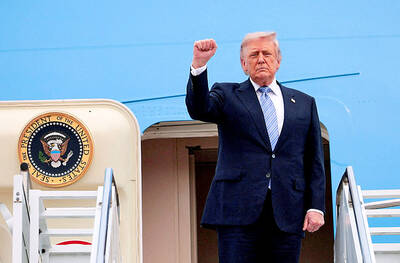
US-CHINA SUMMIT: MOFA welcomed US reassurance of no change in its Taiwan policy; Trump said he did not comment when Xi talked of opposing independence US President Donald Trump yesterday said he has not made a decision on whether to move forward with a major arms package for Taiwan after hearing concerns about it from Chinese President Xi Jinping (習近平). Trump’s comments on Taiwan came as he flew back to Washington after wrapping up critical talks in which both leaders said important progress was made in stabilizing US-China relations even as deep differences persist between the world’s two biggest powers on Iran and Taiwan. “I will make a determination,” Trump said, adding: “I’ll be making decisions. But, you know, I think the last thing we need right
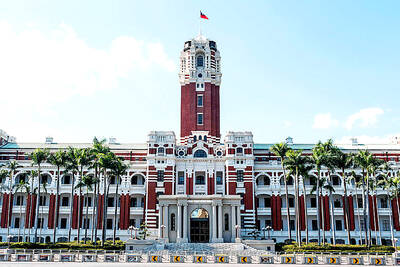
SECURITY: Taipei presses the US for arms supplies, saying the arms sales are not only a reflection of the US security commitment to Taiwan but also serve as a mutual deterrent against regional threats Taiwan is committed to preserving the cross-strait “status quo” and contributing to regional peace and stability, the Presidential Office said yesterday. “It is an undeniable fact that the Republic of China is a sovereign and independent democratic nation,” Presidential Office spokeswoman Karen Kuo (郭雅慧) reiterated, adding that Beijing has no right to claim sovereignty over Taiwan. The statements came after US President Donald Trump warned against Taiwanese independence. Trump wrapped up a state visit to Beijing on Friday, during which Chinese President Xi Jinping (習近平) had pressed him not to support Taiwan. Taiwan depends heavily on US security backing to deter China from carrying
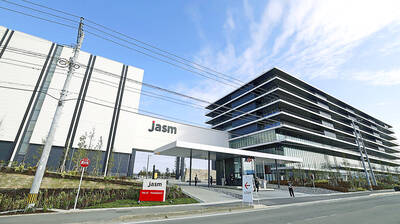
The subsidiary of Taiwan Semiconductor Manufacturing Co (TSMC, 台積電) in Kumamoto, Japan, turned a profit in the first quarter of this year, marking the first time the first fab of the unit has become profitable since mass production started at the end of 2024. According to the contract chipmaker’s financial statement released on Friday, Japan Advanced Semiconductor Manufacturing Inc (JASM), a joint venture running the fab in Kumamoto, posted NT$951 million (US$30.19 million) in profit in the January-to-March period, compared with a loss of NT$1.39 billion in the previous quarter, and a loss of NT$3.25 billion in the first quarter of
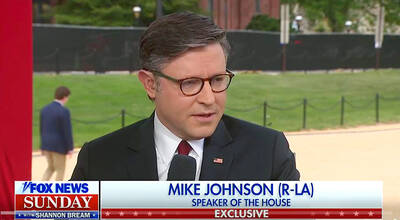
RESOLUTE BACKING: Two Republican senators are planning to introduce legislation that would impose immediate sanctions on China if it attempts to invade Taiwan US House of Representatives Speaker Mike Johnson on Sunday reaffirmed US congressional support for Taiwan, saying the US and “all freedom-loving people” have a stake in preventing China from seizing Taiwan by force. Johnson made the remarks in an interview with Fox News Sunday on US President Donald Trump’s summit with Chinese President Xi Jinping (習近平) last week. In an interview that aired on Friday on Fox News, just as Trump wrapped up a high-stakes visit to China, he said he has yet to green-light a new US$14 billion arms package to Taiwan and that it “depends on China.” “It’s a very good


 RSS
RSS