


British troops said they opened fire on grenade-throwing Iraqi protesters in a clash in which at least five people were killed on Saturday, while Danish forces reported finding possible chemical weapons in southern Iraq.
The violence began when Iraqi police believed they were the target of gunfire during a protest over unemployment in the southeastern city of Amara, Britain's Defense Ministry said in a statement in London.
The police opened fire and British troops with armored vehicles were deployed to support them, the ministry said.
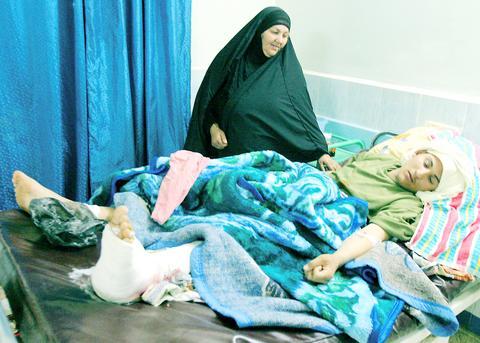
PHOTO: REUTERS
The British troops also opened fire when grenades were hurled at them, it said.
"It is our understanding that there have been six casualties -- five fatalities and one injured," the ministry said. It said it could give few details on the deaths, but no British or Iraqi police casualties were reported.
Iraqi police said earlier they opened fire after the protesters began throwing stones at the provincial government's headquarters.
A number of protests over lack of jobs have been staged in Iraq since former Iraqi leader Saddam Hussein was toppled by US-led forces last April and some have turned violent.
Denmark said its troops had found 36 mortar shells buried in southern Iraq that initial chemical weapons tests showed could contain blister gas. The shells had been buried for at least 10 years and the site may contain another 100, it said.
"All the instruments showed indications of the same type of chemical compound, namely blister gas," the Danish Army Operational Command said on its Web site, cautioning further tests were needed. Final results were likely in about two days.
Blister gas, an illegal weapon which Saddam said he had destroyed, was used extensively against the Iranians during the 1980-1988 Iran-Iraq War.
Icelandic bomb experts working with the Danes said the 120mm shells were concealed in road construction some 75km south of Amara and close to the Iranian border.
US President George W. Bush ordered US-led forces to invade Iraq after accusing Saddam of possessing weapons of mass destruction. No such arms have been found so far.
Former US Treasury secretary Paul O'Neill, fired in December 2002 as part of a shake-up of Bush's economic team, said in a new book The Price of Loyalty the president entered office in January 2001 intent on invading Iraq.
O'Neill, who likened Bush at Cabinet meetings to a "blind man in a room full of deaf people," was quoted in the book as saying: "It was all about finding a way to do it ... The president saying, `Go find me a way to do this.'"
"For me, the notion of pre-emption, that the US has the unilateral right to do whatever we decide to do, is a really huge leap," O'Neill said in a CBS interview that was to be aired yesterday to promote the book by journalist Ron Suskind.
The White House rejected O'Neill's charges.
The US military said a preliminary investigation showed the US Black Hawk helicopter that crashed near the town of Falluja in central Iraq last Thursday was shot down by guerrillas. All nine soldiers on board were killed.
Washington blames Saddam supporters and foreign Islamic militants for attacks on US-led forces and Iraqis cooperating with US governor Paul Bremer's administration in Baghdad.
The US military said US soldiers shot and killed two Iraqi policemen embroiled in a family feud in the northern city of Kirkuk after mistaking them for assailants.
Occupation Watch, an international group of peace and justice organizations monitoring the conduct of US-led forces, said Washington was negligent and callous with Iraqis seeking compensation for relatives accidentally killed or maimed.
After Washington declared major combat over on May 1, the US military said it would hear claims from Iraqis whose family members were killed or wounded in incidents involving US troops as long as they occurred in non-combat circumstances.
"There is a culture of impunity," Occupation Watch's researcher Paola Gasparoli told a news conference in Baghdad at which the group presented a 30-page report.
The image of Saddam, captured by US troops in December, was officially erased from another walk of Iraqi life when new postage stamps were unveiled at Baghdad's main post office.
"It makes a nice change because Saddam's face was everywhere -- not just on stamps," said postal worker Leila Khadar.
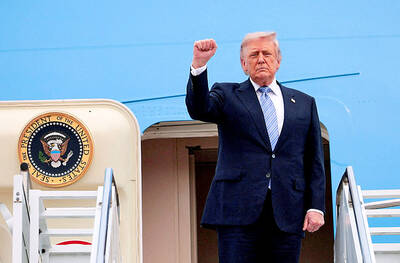
US-CHINA SUMMIT: MOFA welcomed US reassurance of no change in its Taiwan policy; Trump said he did not comment when Xi talked of opposing independence US President Donald Trump yesterday said he has not made a decision on whether to move forward with a major arms package for Taiwan after hearing concerns about it from Chinese President Xi Jinping (習近平). Trump’s comments on Taiwan came as he flew back to Washington after wrapping up critical talks in which both leaders said important progress was made in stabilizing US-China relations even as deep differences persist between the world’s two biggest powers on Iran and Taiwan. “I will make a determination,” Trump said, adding: “I’ll be making decisions. But, you know, I think the last thing we need right
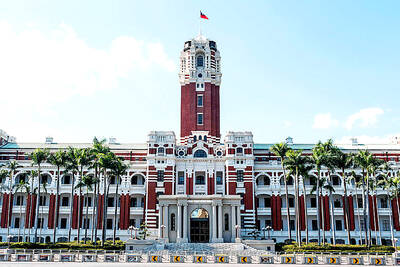
SECURITY: Taipei presses the US for arms supplies, saying the arms sales are not only a reflection of the US security commitment to Taiwan but also serve as a mutual deterrent against regional threats Taiwan is committed to preserving the cross-strait “status quo” and contributing to regional peace and stability, the Presidential Office said yesterday. “It is an undeniable fact that the Republic of China is a sovereign and independent democratic nation,” Presidential Office spokeswoman Karen Kuo (郭雅慧) reiterated, adding that Beijing has no right to claim sovereignty over Taiwan. The statements came after US President Donald Trump warned against Taiwanese independence. Trump wrapped up a state visit to Beijing on Friday, during which Chinese President Xi Jinping (習近平) had pressed him not to support Taiwan. Taiwan depends heavily on US security backing to deter China from carrying
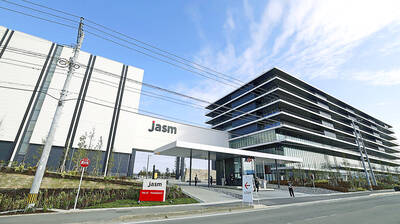
The subsidiary of Taiwan Semiconductor Manufacturing Co (TSMC, 台積電) in Kumamoto, Japan, turned a profit in the first quarter of this year, marking the first time the first fab of the unit has become profitable since mass production started at the end of 2024. According to the contract chipmaker’s financial statement released on Friday, Japan Advanced Semiconductor Manufacturing Inc (JASM), a joint venture running the fab in Kumamoto, posted NT$951 million (US$30.19 million) in profit in the January-to-March period, compared with a loss of NT$1.39 billion in the previous quarter, and a loss of NT$3.25 billion in the first quarter of
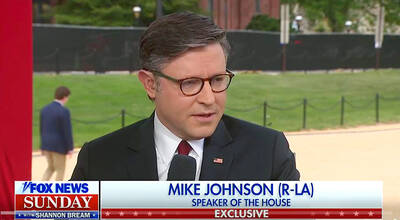
RESOLUTE BACKING: Two Republican senators are planning to introduce legislation that would impose immediate sanctions on China if it attempts to invade Taiwan US House of Representatives Speaker Mike Johnson on Sunday reaffirmed US congressional support for Taiwan, saying the US and “all freedom-loving people” have a stake in preventing China from seizing Taiwan by force. Johnson made the remarks in an interview with Fox News Sunday on US President Donald Trump’s summit with Chinese President Xi Jinping (習近平) last week. In an interview that aired on Friday on Fox News, just as Trump wrapped up a high-stakes visit to China, he said he has yet to green-light a new US$14 billion arms package to Taiwan and that it “depends on China.” “It’s a very good


 RSS
RSS