


Climate change over the next 50 years is expected to drive a quarter of land animals and plants into extinction, according to the first comprehensive study into the effect of higher temperatures on the natural world.
The sheer scale of the disaster facing the planet shocked those involved in the research. They estimate that more than 1 million species will be lost by 2050.
The results are described as "terrifying" by Chris Thomas, professor of conservation biology at Leeds University, England, who is lead author of the research from four continents published yesterday in the magazine Nature.
Much of that loss -- more than one in 10 of all plants and animals -- is already irreversible because of the extra global-warming gases already discharged into the atmosphere. But the scientists say that action to curb greenhouse gases now could save many more from the same fate.
It took two years for the largest global collaboration of experts to make the first major assessment of the effect of climate change on six biologically rich regions of the world taking in 20 percent of the land surface.
The research in Europe, Australia, Central and South America and South Africa, showed that species living in mountainous areas had a greater chance of survival because they could simply move uphill to get cooler.
Those in flatter areas such as Brazil, Mexico and Australia, were more vulnerable, faced with the impossible task of moving thousands of miles to find suitable conditions.
Birds, which had the greatest chance of escape, could in theory move to a more suitable climate but the trees and other habitat they needed for survival could not keep pace and all would die.
Professor Thomas said: "When scientists set about research they hope to come up with definite results, but what we found we wish we had not. It was far, far worse than we thought, and what we have discovered may even be an underestimate."
Among the the more startling findings of the scientists was that of 24 species of butterfly studied in Australia, all but three would disappear in much of their current range, and half would become extinct.
In South Africa major conservation areas such as Kruger National Park risked losing up to 60 percent of the species under their protection.
In the Cerrado region of Brazil -- also known as the Brazilian Savannah -- which covers one fifth of the country, a study of 163 tree species showed that up to 70 would become extinct. Many of the plants and trees that exist in this savannah occur nowhere else in the world. The scientists concluded that 1,700 to 2,100 of these species -- between 39 percent and 48 percent of the total -- would disappear.
In Europe, the continent least affected by climate change, survival rates were better, but even here under the higher estimates of climate change a quarter of the birds could become extinct, and between 11 percent and 17 percent of plant species.
In Mexico, studies in the Chihuahuan desert confirmed that on flatter land extinction was more likely because a small change in climate would require migrations over vast distances for survival.
One third of 1,870 species examined would be in trouble and three small rodents, the smokey pocket gopher, Alcorn's pocket gopher and jico deer mouse would go the way of the dodo.
In South Africa, where many popular garden plants originate, 300 plant species were studied and more than one third were expected to die out, including South Africa's national flower, the king protea.
Commenting on the findings in Nature, two other scientists, Alan Pounds and Robert Puschendorf, who has studied the extinction of frogs in the mountains of Costa Rica since the 1980s as a result of climate change, say their colleagues have been "optimistic."
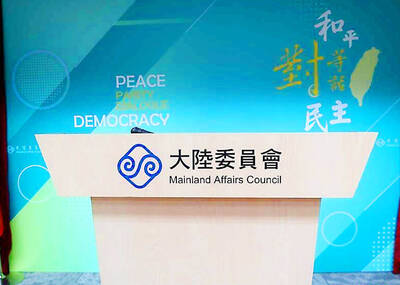
NO RECIPROCITY: Taipei has called for cross-strait group travel to resume fully, but Beijing is only allowing people from its Fujian Province to travel to Matsu, the MAC said The Mainland Affairs Council (MAC) yesterday criticized an announcement by the Chinese Ministry of Culture and Tourism that it would lift a travel ban to Taiwan only for residents of China’s Fujian Province, saying that the policy does not meet the principles of reciprocity and openness. Chinese Deputy Minister of Culture and Tourism Rao Quan (饒權) yesterday morning told a delegation of Chinese Nationalist Party (KMT) lawmakers in a meeting in Beijing that the ministry would first allow Fujian residents to visit Lienchiang County (Matsu), adding that they would be able to travel to Taiwan proper directly once express ferry

FAST RELEASE: The council lauded the developer for completing model testing in only four days and releasing a commercial version for use by academia and industry The National Science and Technology Council (NSTC) yesterday released the latest artificial intelligence (AI) language model in traditional Chinese embedded with Taiwanese cultural values. The council launched the Trustworthy AI Dialogue Engine (TAIDE) program in April last year to develop and train traditional Chinese-language models based on LLaMA, the open-source AI language model released by Meta. The program aims to tackle the information bias that is often present in international large-scale language models and take Taiwanese culture and values into consideration, it said. Llama 3-TAIDE-LX-8B-Chat-Alpha1, released yesterday, is the latest large language model in traditional Chinese. It was trained based on Meta’s Llama-3-8B

STUMPED: KMT and TPP lawmakers approved a resolution to suspend the rate hike, which the government said was unavoidable in view of rising global energy costs The Ministry of Economic Affairs yesterday said it has a mandate to raise electricity prices as planned after the legislature passed a non-binding resolution along partisan lines to freeze rates. Chinese Nationalist Party (KMT) lawmakers proposed the resolution to suspend the price hike, which passed by a 59-50 vote. The Taiwan People’s Party (TPP) voted with the KMT. Legislative Speaker Han Kuo-yu (韓國瑜) of the KMT said the resolution is a mandate for the “immediate suspension of electricity price hikes” and for the Executive Yuan to review its energy policy and propose supplementary measures. A government-organized electricity price evaluation board in March

NOVEL METHODS: The PLA has adopted new approaches and recently conducted three combat readiness drills at night which included aircraft and ships, an official said Taiwan is monitoring China’s People’s Liberation Army (PLA) exercises for changes in their size or pattern as the nation prepares for president-elect William Lai’s (賴清德) inauguration on May 20, National Security Bureau (NSB) Director-General Tsai Ming-yen (蔡明彥) said yesterday. Tsai made the comment at a meeting of the Legislative Yuan’s Foreign Affairs and National Defense Committee, in response to Democratic Progressive Party (DPP) Legislator Wang Ting-yu’s (王定宇) questions. China continues to employ a carrot-and-stick approach, in which it applies pressure with “gray zone” tactics, while attempting to entice Taiwanese with perks, Tsai said. These actions aim to help Beijing look like it has


 RSS
RSS