


British Airways canceled its afternoon flight from London to Washington for the second day yesterday following security advice from the British government, an airline spokeswoman said.
The same flight, BA223, was canceled Thursday with the same explanation.
On Wednesday, BA223 was kept on the taxiway at Washington Dulles International Airport for several hours shortly after landing, while US authorities questioned passengers and crew.
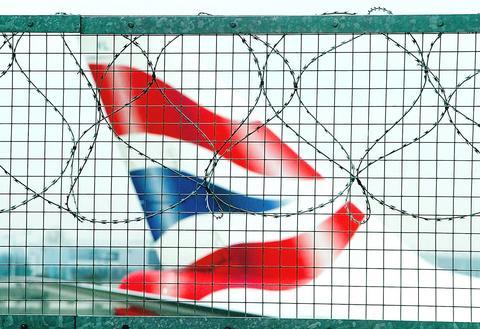
PHOTO: AP
Yesterday's cancelation came a week-and-a-half after the Bush administration raised the national terrorism alert to orange, its second-highest level. Security restrictions on US airspace were tightened over the New Year holiday.
Yesterday's British Airways service was due to leave at 3:05pm, and was canceled less than two hours before take-off. Some passengers had already begun to check in.
The airline declined to comment on the nature of the security advice yesterday.
"It was following advice from the UK government regarding security, we can't comment further than that," a spokeswoman for British Airways said on condition of anonymity.
Paul Beaver, a British defense analyst, said he had been told that Washington was ``the definite target.''
``We have got intelligence, I am told, that there was a plan to take the aircraft and destroy it over Washington or fly it into something,'' Beaver said
British Airways said the 300 passengers booked for the flight would be offered refunds, or seats on other flights.
An earlier service, flight BA217, left Heathrow for Washington at 1pm. It had been delayed for two hours after US security authorities requested further information from the airline, the spokeswoman added, without elaborating.
BA's later service from Heathrow to Washington, was scheduled to leave on time at 6:40pm, the airline added.
A return flight to London, BA222, which was scheduled to leave Washington at 9:40pm local time, would also be canceled, the airline said.
Mexico had also canceled flights to the US while US warplanes have been tailing in-bound Air France flights for fear attackers might try to crash them into American targets, US officials said on Thursday.
Security fears amid a heightened terror alert also prompted a two-day suspension of oil shipments from Alaska's major port of Valdez, Coast Guard and Department of Homeland Security officials said. The halt of transfers of oil onto tankers began on Tuesday and was lifted on Thursday.
An Aeromexico flight to Los Angeles from Mexico City was canceled on New Year's Eve and Jan. 1 because of suspicions would-be hijackers might have booked tickets, Mexican and US officials said.
The oil suspension in Alaska was part of "a continuing effort to ensure the security of our homeland," consistent with Code Orange, the heightened alert level in effect since Dec. 21, said Russ Knocke, a Department of Homeland Security spokesman.
It was not clear what specifically triggered the decision to suspend the traffic.
Valdez is the terminal for the trans-Alaskan pipeline from Prudhoe Bay. The 1,280km pipeline normally carries about 1 million barrels a day to Valdez, or about 17 percent of US domestic production.
A Bush administration official said US intelligence remained particularly concerned about "credible" threats to Los Angeles-bound flights from Paris and Mexico City.
In boosting the alert level last month, Homeland Security Secretary Tom Ridge said Osama bin Laden's al-Qaeda movement appeared intent on matching or outdoing the Sept. 11, 2001, hijacked airliner attacks that killed about 3,000 people.
An administration official confirmed several Air France flights had been escorted by US fighter jets to make sure they stayed on course.
"When this happens in the middle of the day and there are two F-16s outside of an aircraft, you obviously don't keep it a secret," the official said.
Six flights between Paris and Los Angeles were canceled on Dec. 24 and Dec. 25 at the urging of Washington after US officials spotted what they believed were suspicious names on lists of those due to board the planes.
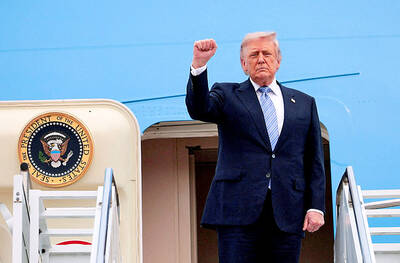
US-CHINA SUMMIT: MOFA welcomed US reassurance of no change in its Taiwan policy; Trump said he did not comment when Xi talked of opposing independence US President Donald Trump yesterday said he has not made a decision on whether to move forward with a major arms package for Taiwan after hearing concerns about it from Chinese President Xi Jinping (習近平). Trump’s comments on Taiwan came as he flew back to Washington after wrapping up critical talks in which both leaders said important progress was made in stabilizing US-China relations even as deep differences persist between the world’s two biggest powers on Iran and Taiwan. “I will make a determination,” Trump said, adding: “I’ll be making decisions. But, you know, I think the last thing we need right
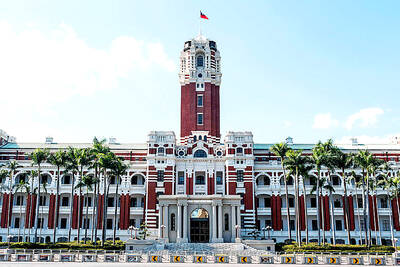
SECURITY: Taipei presses the US for arms supplies, saying the arms sales are not only a reflection of the US security commitment to Taiwan but also serve as a mutual deterrent against regional threats Taiwan is committed to preserving the cross-strait “status quo” and contributing to regional peace and stability, the Presidential Office said yesterday. “It is an undeniable fact that the Republic of China is a sovereign and independent democratic nation,” Presidential Office spokeswoman Karen Kuo (郭雅慧) reiterated, adding that Beijing has no right to claim sovereignty over Taiwan. The statements came after US President Donald Trump warned against Taiwanese independence. Trump wrapped up a state visit to Beijing on Friday, during which Chinese President Xi Jinping (習近平) had pressed him not to support Taiwan. Taiwan depends heavily on US security backing to deter China from carrying
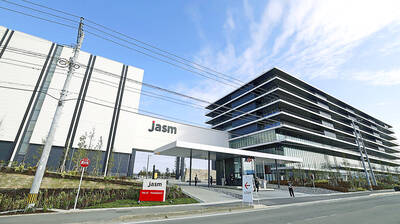
The subsidiary of Taiwan Semiconductor Manufacturing Co (TSMC, 台積電) in Kumamoto, Japan, turned a profit in the first quarter of this year, marking the first time the first fab of the unit has become profitable since mass production started at the end of 2024. According to the contract chipmaker’s financial statement released on Friday, Japan Advanced Semiconductor Manufacturing Inc (JASM), a joint venture running the fab in Kumamoto, posted NT$951 million (US$30.19 million) in profit in the January-to-March period, compared with a loss of NT$1.39 billion in the previous quarter, and a loss of NT$3.25 billion in the first quarter of
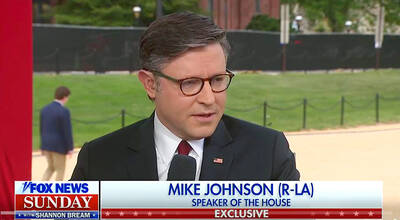
RESOLUTE BACKING: Two Republican senators are planning to introduce legislation that would impose immediate sanctions on China if it attempts to invade Taiwan US House of Representatives Speaker Mike Johnson on Sunday reaffirmed US congressional support for Taiwan, saying the US and “all freedom-loving people” have a stake in preventing China from seizing Taiwan by force. Johnson made the remarks in an interview with Fox News Sunday on US President Donald Trump’s summit with Chinese President Xi Jinping (習近平) last week. In an interview that aired on Friday on Fox News, just as Trump wrapped up a high-stakes visit to China, he said he has yet to green-light a new US$14 billion arms package to Taiwan and that it “depends on China.” “It’s a very good


 RSS
RSS