


Chinese Nationalist Party (KMT) Chairman Lien Chan (
Lien, who is challenging Chen in the upcoming presidential election, argued that the DPP had falsely claimed that his personal assets were worth NT$20 billion, while the true value was NT$1.34 billion.
"With the election approaching, the DPP recently attacked me personally with an array of false accusations with regard to my family's assets and how they were acquired," Lien said at a press conference accompanied by lawyers and accountants.
Lien was referring to the DPP's latest television advertising campaign, which called into question how Lien and his father were able to accumulate their fortune while just civil servants.
The DPP also distributed 500,000 campaign pamphlets last Monday accusing the Lien family of illegally accumulating assets worth NT$20 billion.
"I can no longer sit in silence in view of the acts that undermine my reputation and negatively influence the people's trust in politics ... I have no choice but to take legal action against the DPP," Lien said before proceeding to file the suit at the Taipei Prosecutors' Office.
This is the first time in Taiwan's political history that an opposition leader has filed a lawsuit against the incumbent president.
Chen's being president protects him from criminal prosecution unless he is charged with committing an act of rebellion or treason. However, the Taipei Prosecutors' Office will process the suits against the other three defendants: DPP Secretary-General Chang Chun-hsiung (
In a bid to rebut the DPP's claims concerning the Lien family's assets, Alex Tsai (蔡正元), spokesman for the KMT-People First Party (PFP), revealed detailed accounts of Lien's personal assets broken down into cash saving, stocks, bonds, real estate and others.
Tsai also presented figures for Chen's assets, saying that the value of Chen's stocks and bonds had increased 125 percent between 2000 and 2002, while Lien's had decreased by 22 percent from 1999 to 2003.
Tsai said he wondered "whether any secret deals were involved that enabled Chen to make such a rewarding investment in stocks and bonds."
Noting that Lien and his wife had together donated 15 percent of their assets, worth NT$250 million, to reconstruction efforts following the Sept. 21, 1999, earthquake, while Chen and his wife donated only 2 percent of their assets, worth NT$2 million, Tsai asked, "Who of the two really loves Taiwan more?"
Another alliance spokesman, Yu Tzu-shiang (
"Lien's property amounts to a mere 189 ping, yet the DPP exaggerated it 106 times in its campaign pamphlet and said it is big enough to build five Tienmu baseball fields on," Yu said. "The public should abandon a party that resorts to such negative campaigning."
Also see story:
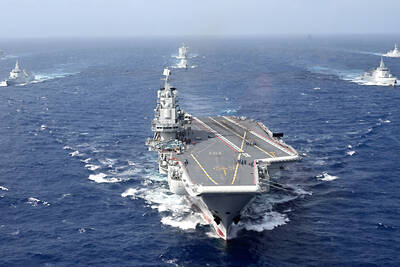
PROVOCATIVE: Chinese Deputy Ambassador to the UN Sun Lei accused Japan of sending military vessels to deliberately provoke tensions in the Taiwan Strait China denounced remarks by Japan and the EU about the South China Sea at a UN Security Council meeting on Monday, and accused Tokyo of provocative behavior in the Taiwan Strait and planning military expansion. Ayano Kunimitsu, a Japanese vice foreign minister, told the Council meeting on maritime security that Tokyo was seriously concerned about the situation in the East China and South China seas, and reiterated Japan’s opposition to any attempt to change the “status quo” by force, and obstruction of freedom of navigation and overflight. Stavros Lambrinidis, head of the EU delegation to the UN, also highlighted South China Sea
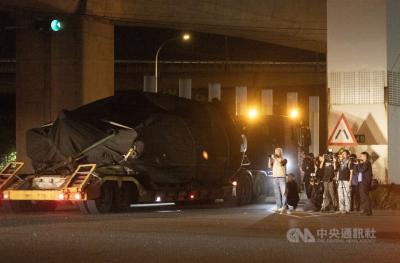
The final batch of 28 M1A2T Abrams tanks purchased from the US arrived at Taipei Port last night and were transported to the Armor Training Command in Hsinchu County’s Hukou Township (湖口), completing the military’s multi-year procurement of 108 of the tanks. Starting at 12:10am today, reporters observed more than a dozen civilian flatbed trailers departing from Taipei Port, each carrying an M1A2T tank covered with black waterproof tarps. Escorted by military vehicles, the convoy traveled via the West Coast Expressway to the Armor Training Command, with police implementing traffic control. The army operates about 1,000 tanks, including CM-11 Brave Tiger
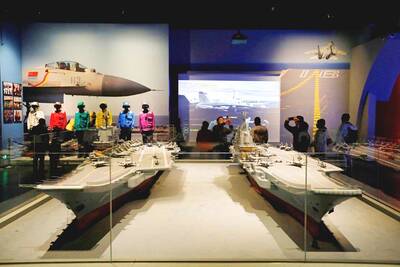
China on Wednesday teased in a video an aircraft carrier that could be its fourth, and the first using nuclear power, while making an allusion to Taiwan and vowing to further build up its islands, as it looks to boost maritime power, secure resources and bolster territorial claims. The video, issued on the eve of the 77th founding anniversary of the Chinese People’s Liberation Army Navy, featured fictional officers with names that are homophones of three commissioned aircraft carriers, the Liaoning (遼寧), Shandong (山東) and Fujian (福建). Titled Into the Deep, it showed a 19-year-old named “Hejian” (何劍) joining the group, sparking
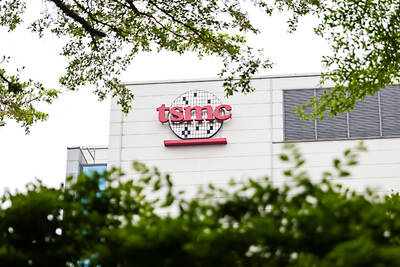
Taiwan Semiconductor Manufacturing Co (TSMC, 台積電), the world’s largest contract chipmaker, said it expects its 2-nanometer (2nm) chip capacity to grow at a compound annual rate of 70 percent from this year to 2028. The projection comes as five fabs begin volume production of 2-nanometer chips this year — two in Hsinchu and three in Kaohsiung — TSMC senior vice president and deputy cochief operating officer Cliff Hou (侯永清) said at the company’s annual technology symposium in Silicon Valley, California, last week. Output in the first year of 2-nanometer production, which began in the fourth quarter of last year, is expected to


 RSS
RSS