


Jessica Lynch, the Iraq war POW who has become a US icon, has criticized the Pentagon's dramatic film of her rescue by US troops, further stoking the debate about how defense chiefs are representing the conflict.
The former private, who was rescued in April, said she was upset by the way the Defense Department had portrayed the episode and that the film should not have been made.
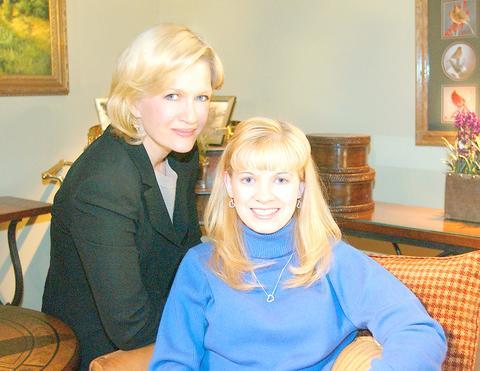
PHOTO: AP
Lynch's criticism comes as the Bush administration battles to win the hearts and minds of the US public over Iraq policy.
But media observers say the Pentagon's rosy version of Lynch's rescue should surprise no one, and point out that past US governments have also issued upbeat news stories in prior conflicts.
US television networks repeatedly aired footage of Lynch being carried on a stretcher after the rescue. The images were made even more dramatic by the use of green, night-vision optics.
Asked if the official portrayal of her rescue troubled her, Lynch replied: "Yeah, it does. It does that they used me as a way to symbolize all this stuff. I mean, yeah, it's wrong ... I don't know what they had ... or why they filmed it."
Extracts of the interview to be broadcast on Tuesday have been released in advance.
It was reported at the time that the troops who rescued Lynch had engaged in a fire-fight during the operation, but Lynch said "I don't think it happened quite like that."
Lynch's company was captured after a convoy took a wrong turn and drove into Iraqi hands. Eleven Americans were killed and Lynch suffered multiple injuries.
But while critical of the Pentagon, Lynch remained full of praise for her rescuers.
The Defense Department had no immediate comment on Friday. But Lynch's remarks have stoked a mounting debate about how the Iraq war is being presented.
"The Pentagon is doing everything it can to spin the war in a way that is favorable to management," said Mark Crispin Miller, a media studies professor at New York University.
"Whether you are talking about outright stagecraft or denigration of certain news stories, the aim is the same," Miller said.
Josh Friedman, director of international studies at Columbia University's Graduate School of Journalism, said the media should have debunked the story earlier.
"[Lynch] did the right thing: She told the truth. They've run the whole war like some kind of a docu-drama. And they've been extremely attentive to public relations," Friedman said.
"You have to justify sacrifice and death and give people some sense of purpose, and you have to demonize the enemy. That's really what the subplot was," Friedman, a Pulitzer Prize holder, added.
Media observers said that the Bush administration has a vested interest in presenting an upbeat picture of Iraq as it turns an eye toward the looming 2004 presidential election.
However, recent polls suggest the public is ever more unsettled about rising US casualties in Iraq.
A poll released Thursday showed the public approval rating for Bush's handling of Iraq had fallen to 41 percent. A total 58 percent of respondents said they disapproved of Bush's handling of Iraq.

‘NO SECURITY RISK’: The Railway Bureau reassured the public that the technicians’ activities were limited to technical guidance and did not involve sensitive systems The Railway Bureau yesterday said it had invited eight Chinese technicians to assist with an airport MRT construction project. The bureau issued the confirmation after an Internet user said Chinese nationals had entered the construction zone of Taiwan Taoyuan International Airport’s Terminal 3 project. They asked why “individuals from an enemy state” were allowed access to such a major national infrastructure project, which raised serious concerns over Taiwan’s industrial safety, sensitive systems and information security. The bureau’s Northern Region Engineering Branch Office said subcontractor Taiwan Handle Industrial Co (台灣手把工業) of the Taoyuan airport MRT’s “Contract No. CU05 Project A14 Station Civil, MEP &

A US uncrewed surface vessel (USV) encountered multiple Chinese warships during an autonomous transit of the Taiwan Strait, US defense company Seasats said in a statement on Wednesday. Seasats announced that a Lightfish USV had completed the first autonomous transit of the Taiwan Strait. Over five days, the USV traversed the entire length of the Strait while constantly monitoring surface vessel traffic, the company said. The Lightfish encountered multiple Chinese warships, one of which was a Chinese People’s Liberation Army Navy (PLAN) Type 056 corvette, it said. The Chinese vessels were operating “well within Taiwan’s exclusive economic zone without transmitting their identity via the
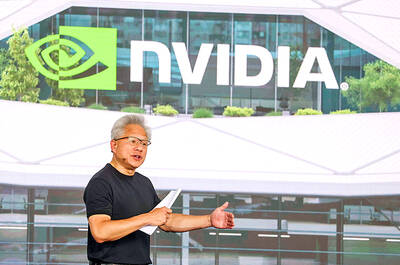
‘BOOMING’: ’ The number of partners we have here is incredible. You can see from their stock prices. They’re doing so well, they’re so happy,’ Jensen Huang said Nvidia Corp’s spending in Taiwan has ballooned to about US$150 billion a year, 10 times the US$10 billion to US$15 billion the company spent five years ago, Nvidia chief executive officer Jensen Huang (黃仁勳) said yesterday, suggesting Taiwan’s strategic importance in the global artificial intelligence (AI) supply chain. “Taiwan is the epicenter of the AI revolution. This is where the chips come, packaging comes. This is where the systems are made. This is where AI supercomputers were created,” Huang said at a meeting for the company’s employees in Beitou-Shilin Technology Park (北投士林科技園區) in Taipei, the planned site of Nvidia’s Taipei headquarters. “Taiwan
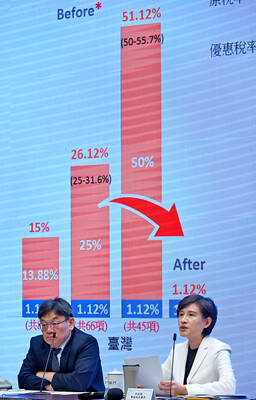
GREATER REACH? Auto parts and wood products would face tariffs of up to 15%, matching those targeting the EU, Japan and South Korea, Vice Premier said The US has announced that preferential tariff treatment for Taiwan’s non-semiconductor Section 232 goods would take effect retroactively from May 1, the Executive Yuan said yesterday. The US government yesterday posted a notice on the Federal Register’s public inspection Web site previewing tariff concessions for Taiwan under a memorandum of understanding (MOU) on Taiwan-US investment after two months of negotiations. The MOU signed on Jan. 15 stipulated three major preferential tariff arrangements: a 15 percent “reciprocal” tariff rate for Taiwan without stacking most-favored nation (MFN) rates; preferential Section 232 treatment for semiconductors and related products; and preferential Section 232 treatment for non-semiconductor


 RSS
RSS