


In a capital city where cows roam the streets and elephants plod along in the bus lanes, it's no surprise to find government buildings overrun with monkeys.
But the officials who work there are fed up. They've been bitten, robbed and otherwise tormented by monkeys that ransack files, bring down power lines, screech at visitors and bang on office windows.

PHOTO: AP
The Supreme Court has stepped in, decreeing that New Delhi should be a monkey-free city after citizens filed a lawsuit demanding protection from the animals.
Easier said than done. A past initiative to scare off the Rhesus macaques with ultrahigh frequency loudspeakers didn't work.
There's an ape patrol of fierce-looking primates called langurs, led about on leashes by keepers. But whenever a langur looms, the pink-faced, two-foot-tall hooligans simply move elsewhere on government grounds.
"Please do not feed the monkeys," implores a sign at Raisina Hill, the complex of colonnaded buildings that includes the president's residence, Parliament, and Cabinet offices.
To no avail. Hindus believe that monkeys are manifestations of the monkey god, Hanuman, and worshippers come to Raisina Hill every Tuesday handing out bananas.
"It's a big problem, especially in the evening," says Defense Ministry spokesman Amitabha Chakrabarti. Monkeys break into offices at night and paw through the files looking for food, he said. "Those who work late hours have to be careful when it is dark."
The city estimates at least 1,500 of New Delhi's more than 5,000 macaques live on Raisina Hill.
In the latest effort, a monkey relocation initiative, 400 monkeys have been caught at Raisina Hill in the past year and moved to a holding area to await their return to forests in neighboring states, said a municipality spokesman.
But governments of those states have so far refused to take the furry exiles, saying they have more than enough of their own.
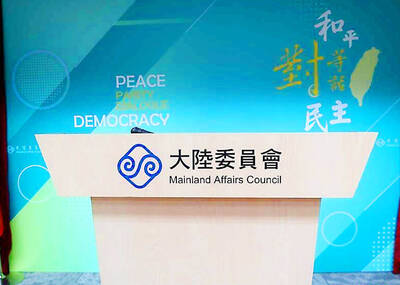
NO RECIPROCITY: Taipei has called for cross-strait group travel to resume fully, but Beijing is only allowing people from its Fujian Province to travel to Matsu, the MAC said The Mainland Affairs Council (MAC) yesterday criticized an announcement by the Chinese Ministry of Culture and Tourism that it would lift a travel ban to Taiwan only for residents of China’s Fujian Province, saying that the policy does not meet the principles of reciprocity and openness. Chinese Deputy Minister of Culture and Tourism Rao Quan (饒權) yesterday morning told a delegation of Chinese Nationalist Party (KMT) lawmakers in a meeting in Beijing that the ministry would first allow Fujian residents to visit Lienchiang County (Matsu), adding that they would be able to travel to Taiwan proper directly once express ferry

STUMPED: KMT and TPP lawmakers approved a resolution to suspend the rate hike, which the government said was unavoidable in view of rising global energy costs The Ministry of Economic Affairs yesterday said it has a mandate to raise electricity prices as planned after the legislature passed a non-binding resolution along partisan lines to freeze rates. Chinese Nationalist Party (KMT) lawmakers proposed the resolution to suspend the price hike, which passed by a 59-50 vote. The Taiwan People’s Party (TPP) voted with the KMT. Legislative Speaker Han Kuo-yu (韓國瑜) of the KMT said the resolution is a mandate for the “immediate suspension of electricity price hikes” and for the Executive Yuan to review its energy policy and propose supplementary measures. A government-organized electricity price evaluation board in March

FAST RELEASE: The council lauded the developer for completing model testing in only four days and releasing a commercial version for use by academia and industry The National Science and Technology Council (NSTC) yesterday released the latest artificial intelligence (AI) language model in traditional Chinese embedded with Taiwanese cultural values. The council launched the Trustworthy AI Dialogue Engine (TAIDE) program in April last year to develop and train traditional Chinese-language models based on LLaMA, the open-source AI language model released by Meta. The program aims to tackle the information bias that is often present in international large-scale language models and take Taiwanese culture and values into consideration, it said. Llama 3-TAIDE-LX-8B-Chat-Alpha1, released yesterday, is the latest large language model in traditional Chinese. It was trained based on Meta’s Llama-3-8B

NOVEL METHODS: The PLA has adopted new approaches and recently conducted three combat readiness drills at night which included aircraft and ships, an official said Taiwan is monitoring China’s People’s Liberation Army (PLA) exercises for changes in their size or pattern as the nation prepares for president-elect William Lai’s (賴清德) inauguration on May 20, National Security Bureau (NSB) Director-General Tsai Ming-yen (蔡明彥) said yesterday. Tsai made the comment at a meeting of the Legislative Yuan’s Foreign Affairs and National Defense Committee, in response to Democratic Progressive Party (DPP) Legislator Wang Ting-yu’s (王定宇) questions. China continues to employ a carrot-and-stick approach, in which it applies pressure with “gray zone” tactics, while attempting to entice Taiwanese with perks, Tsai said. These actions aim to help Beijing look like it has


 RSS
RSS