


US President George W. Bush, saying the world was a safer place without Saddam Hussein, sought on Saturday to justify his war with Iraq to the American people.
His weekly radio broadcast came amid continuing unrest in Iraq, with a guerrilla rocket attack on a Baghdad hotel housing officials in the US-led administration and Iraqi police saying American soldiers had killed four more civilians.
"The world is safer today because, in Iraq, our coalition ended a regime that cultivated ties to terror while it built weapons of mass destruction," Bush said.
US troops said they had found 23 SA-7 surface-to-air missiles and hundreds of weapons, including plastic explosives, buried in an orchard near Saddam's home town of Tikrit on Saturday.
A US military spokesman described the haul as one of the most significant weapons seizures of recent weeks and a sign of how Saddam loyalists were still equipped to pose a threat to US forces.
But it was a tough week for the American leader, and for his staunch ally, British Prime Minister Tony Blair.
Bush's appeal at the UN for foreign troops and cash to bolster security and reconstruction in Iraq met a cool response, and in Washington members of congress raised concerns over a multibillion-dollar bill for the Middle East nation.
Russian President Vladimir Putin said after talks with Bush at his Camp David retreat outside Washington that Moscow would wait for details of a proposed US resolution to the UN before deciding on participation in Iraq's reconstruction.
In another blow for Bush and Blair, US officials said an interim report was expected to say no conclusive evidence had been found that Iraq possessed weapons of mass destruction -- the key claim Washington and London used for going to war in March.
Blair's standing in opinion polls has plummeted -- like Bush -- amid questions of his reasons for war.
Blair's inner circle has also been hit by a judicial inquiry into responsibility for the suicide of one of the nation's top weapons experts on Iraq, David Kelly, which cast an unprecedented light on the inner workings of government.
The US currently has around 130,000 troops and Britain around 20,000 in Iraq, but the security situation remains fraught. Some 80 American troops have died in action and many have been wounded since Bush declared major war over in Iraq on May 1.
The turmoil fueled protests on Saturday in cities around the world, with demonstrators calling for an end to the US-led occupation.
In Iraq, US and British soldiers have struggled to bring stability for the country's 26 million people. Washington activated 10,000 National Guard troops on Friday for Iraq duty and put another 5,000 on standby.
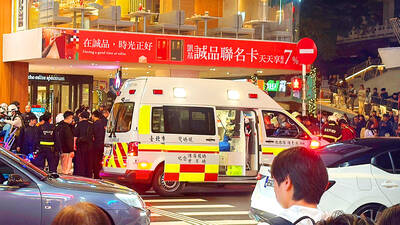
TRAGEDY STRIKES TAIPEI: The suspect died after falling off a building after he threw smoke grenades into Taipei Main Station and went on a killing spree in Zhongshan A 27-year-old suspect allegedly threw smoke grenades in Taipei Main Station and then proceeded to Zhongshan MRT Station in a random killing spree that resulted in the death of the suspect and two other civilians, and seven injured, including one in critical condition, as of press time last night. The suspect, identified as a man surnamed Chang Wen (張文), allegedly began the attack at Taipei Main Station, the Taipei Fire Department said, adding that it received a report at 5:24pm that smoke grenades had been thrown in the station. One man in his 50s was rushed to hospital after a cardiac arrest
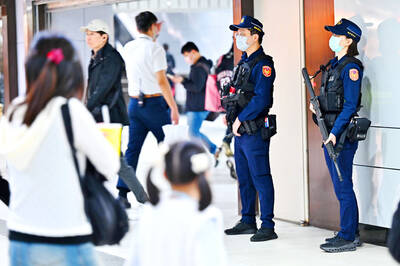
PUBLIC SAFETY: The premier said that security would be tightened in transport hubs, while President Lai commended the public for their bravery The government is to deploy more police, including rapid response units, in crowded public areas to ensure a swift response to any threats, President William Lai (賴清德) said yesterday after a knife attack killed three people and injured 11 in Taipei the previous day. Lai made the remarks following a briefing by the National Police Agency on the progress of the investigation, saying that the attack underscored the importance of cooperation in public security between the central and local governments. The attack unfolded in the early evening on Friday around Taipei Main Station’s M7 exit and later near the Taipei MRT’s Zhongshan

SAFETY FIRST: Double the number of police were deployed at the Taipei Marathon, while other cities released plans to bolster public event safety Authorities across Taiwan have stepped up security measures ahead of Christmas and New Year events, following a knife and smoke bomb attack in Taipei on Friday that left four people dead and 11 injured. In a bid to prevent potential copycat incidents, police deployments have been expanded for large gatherings, transport hubs, and other crowded public spaces, according to official statements from police and city authorities. Taipei Mayor Chiang Wan-an (蔣萬安) said the city has “comprehensively raised security readiness” in crowded areas, increased police deployments with armed officers, and intensified patrols during weekends and nighttime hours. For large-scale events, security checkpoints and explosives
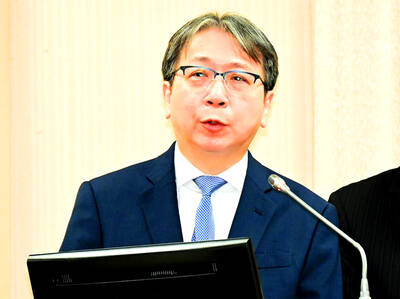
ON ALERT: Taiwan’s partners would issue warnings if China attempted to use Interpol to target Taiwanese, and the global body has mechanisms to prevent it, an official said China has stationed two to four people specializing in Taiwan affairs at its embassies in several democratic countries to monitor and harass Taiwanese, actions that the host nations would not tolerate, National Security Bureau (NSB) Director-General Tsai Ming-yen (蔡明彥) said yesterday. Tsai made the comments at a meeting of the legislature’s Foreign Affairs and National Defense Committee, which asked him and Minister of National Defense Wellington Koo (顧立雄) to report on potential conflicts in the Taiwan Strait and military preparedness. Democratic Progressive Party (DPP) Legislator Michelle Lin (林楚茵) expressed concern that Beijing has posted personnel from China’s Taiwan Affairs Office to its


 RSS
RSS