


President Chen Shui-bian (陳水扁) said yesterday he is confident the cross-strait relationship will greatly improve after next March's presidential election and that he has a three-phase project to realize direct links by the end of next year.
"The normalization of the trade relationship between Taiwan and China is a road we must take, especially cross-strait direct flights and shipments," Chen said during a trip to the south with nearly 50 editors-in-chief from local newspapers, magazines and TV and radio stations.
"Now we are in the first stage of preparation on the facilitation of consignment," he said. "And after next year's presidential election, I am confident that I can remove all the barricades and resolve hesitation on the Chinese side [to direct links]."
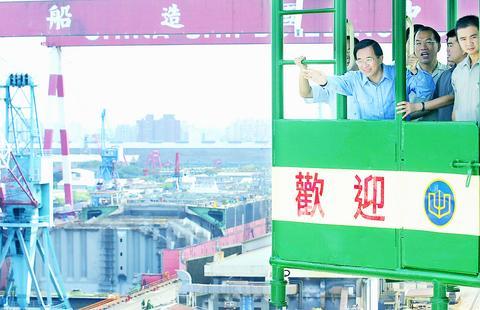
PHOTO: CHANG CHUNG-YI, TAIPEI TIMES
"I believe that the negotiations will be conducted under the principles that Taiwan's security will be preserved and Taiwan's status be respected on an equal level," Chen said.
"In the final stage, both sides will accomplish all negotiations on the direct-links issue and begin to carry out our plans step-by-step. And that time, I believe, will come before the end of next year," he said.
Chen implied that the stagnation of cross-strait relations since he took office was not his fault but should be blamed instead on the pan-blue camp's actions.
The pan-blue camp worked to block the government's cross-strait policy and that was the crucial factor in preventing negotiations on direct links, according to Chen.
"If the KMT and PFP had not tried to have me recalled in 2000, creating instability in society, I believe the situation between both sides of the [Taiwan] Strait would not be what it is today," Chen said.
As a result of political posturing on either side of the Strait, there is little possibility of direct flights or shipments between Taiwan and China before the March election, Chen said.
He said he believes that he will win reelection and that Beijing will then have no choice but to deal with him.
"I think after March 20 everything will be better and then, it [cross-strait stagnation] will change," he said.
As for the economy, Chen said the government should be allowed a higher debt limit in order to increase public spending to boost the economy and create more jobs.
The total national debt amounts to one-third of GDP, far lower than that of several major countries, Chen said.
"It will not be a problem if the government borrows another NT$1 trillion under the current circumstances," he said
The government has drafted a five-year infrastructure plan costing NT$500 billion, which, if approved by the Legislative Yuan, would be mainly funded with money from the private sector.
The Public Debt Law (
Chen's trip with top media officials was part of an effort to showcase the government's progress on infrastructure and economic development over the last three years.
Chen reiterated that the government would strengthen its efforts to attract foreign investment.
He announced on July 7 that the government would, in the near future, scrap a US$3 billion cap on single qualified foreign institutional investors (QFII) in the nation's stock market.
As a small economy, more foreign investment would greatly help the process of internationalization and liberalization of Taiwan's economic development, Chen said yesterday, adding that he continued to work on this issue.
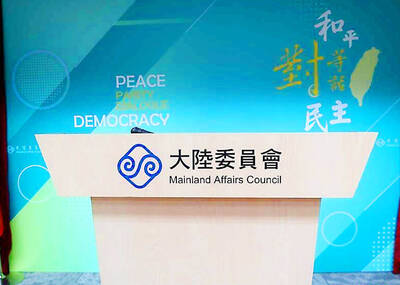
NO RECIPROCITY: Taipei has called for cross-strait group travel to resume fully, but Beijing is only allowing people from its Fujian Province to travel to Matsu, the MAC said The Mainland Affairs Council (MAC) yesterday criticized an announcement by the Chinese Ministry of Culture and Tourism that it would lift a travel ban to Taiwan only for residents of China’s Fujian Province, saying that the policy does not meet the principles of reciprocity and openness. Chinese Deputy Minister of Culture and Tourism Rao Quan (饒權) yesterday morning told a delegation of Chinese Nationalist Party (KMT) lawmakers in a meeting in Beijing that the ministry would first allow Fujian residents to visit Lienchiang County (Matsu), adding that they would be able to travel to Taiwan proper directly once express ferry

FAST RELEASE: The council lauded the developer for completing model testing in only four days and releasing a commercial version for use by academia and industry The National Science and Technology Council (NSTC) yesterday released the latest artificial intelligence (AI) language model in traditional Chinese embedded with Taiwanese cultural values. The council launched the Trustworthy AI Dialogue Engine (TAIDE) program in April last year to develop and train traditional Chinese-language models based on LLaMA, the open-source AI language model released by Meta. The program aims to tackle the information bias that is often present in international large-scale language models and take Taiwanese culture and values into consideration, it said. Llama 3-TAIDE-LX-8B-Chat-Alpha1, released yesterday, is the latest large language model in traditional Chinese. It was trained based on Meta’s Llama-3-8B

STUMPED: KMT and TPP lawmakers approved a resolution to suspend the rate hike, which the government said was unavoidable in view of rising global energy costs The Ministry of Economic Affairs yesterday said it has a mandate to raise electricity prices as planned after the legislature passed a non-binding resolution along partisan lines to freeze rates. Chinese Nationalist Party (KMT) lawmakers proposed the resolution to suspend the price hike, which passed by a 59-50 vote. The Taiwan People’s Party (TPP) voted with the KMT. Legislative Speaker Han Kuo-yu (韓國瑜) of the KMT said the resolution is a mandate for the “immediate suspension of electricity price hikes” and for the Executive Yuan to review its energy policy and propose supplementary measures. A government-organized electricity price evaluation board in March

NOVEL METHODS: The PLA has adopted new approaches and recently conducted three combat readiness drills at night which included aircraft and ships, an official said Taiwan is monitoring China’s People’s Liberation Army (PLA) exercises for changes in their size or pattern as the nation prepares for president-elect William Lai’s (賴清德) inauguration on May 20, National Security Bureau (NSB) Director-General Tsai Ming-yen (蔡明彥) said yesterday. Tsai made the comment at a meeting of the Legislative Yuan’s Foreign Affairs and National Defense Committee, in response to Democratic Progressive Party (DPP) Legislator Wang Ting-yu’s (王定宇) questions. China continues to employ a carrot-and-stick approach, in which it applies pressure with “gray zone” tactics, while attempting to entice Taiwanese with perks, Tsai said. These actions aim to help Beijing look like it has


 RSS
RSS