


The Ministry of the Interior unveiled a plan yesterday to place videoconferencing systems in the homes of people under SARS quarantine in order to have them closely monitored.
Minister Yu Cheng-hsien (余政憲) said the first batch of systems will be installed today.
"The first 2,000 systems will go to Taipei City and Taipei County, the two areas that have been affected by SARS the most, and to people who have broken quarantine rules," Yu said.
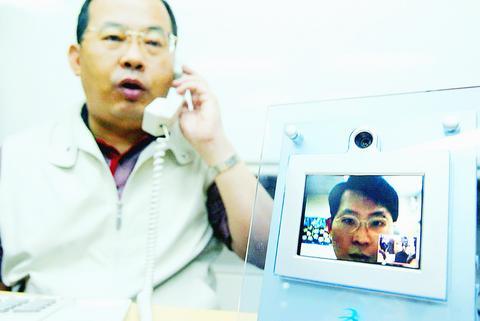
PHOTO: LIU HSIN-TEH, TAIPEI TIMES
Taipei Mayor Ma Ying-jeou (
"There are still the questions of who is going to install the system inside these homes and how it is going to be installed," Ma said.
Yu said the ministry would leave the details of the plan to the city and county governments.
The Taipei City Government also responded yesterday to other anti-SARS measures put forward by the Cabinet.
Yu suggested two days ago that everyone who entered and left the Wanhua District wash their hands and have their temperature taken.
But Ma said there are difficulties in putting this plan into place.
"Wanhua is where Taipei City and Taipei County meet, so there is a lot of inbound and outbound traffic. If we are going to stop every driver and person, traffic would be paralyzed," he said.
Regarding those who had not returned to the Huachang Public Housing Complex, the city said it has asked the police to look for the escapees and plans to fine them NT$60,000 each.
The fine would increase by NT$20,000 a day until the escapee returns or until the 10-day confinement comes to an end.
As of yesterday morning, 182 people had not returned to the complex to be quarantined.
Ma also presented a relief plan for Wanhua.
Beginning today, "we will send civil servants from all other districts to Wanhua to help out. Changcheng District will not be enlisted though, because it still has Hoping Hospital to deal with," he said.
"Civil servants from other districts will help with epidemic prevention and emergency response programs," Ma said.
A cleanup of the Wanhua District is planned for today and the city is calling on the public to avoid the area, adding the cleanup will affect traffic.

‘NO SECURITY RISK’: The Railway Bureau reassured the public that the technicians’ activities were limited to technical guidance and did not involve sensitive systems The Railway Bureau yesterday said it had invited eight Chinese technicians to assist with an airport MRT construction project. The bureau issued the confirmation after an Internet user said Chinese nationals had entered the construction zone of Taiwan Taoyuan International Airport’s Terminal 3 project. They asked why “individuals from an enemy state” were allowed access to such a major national infrastructure project, which raised serious concerns over Taiwan’s industrial safety, sensitive systems and information security. The bureau’s Northern Region Engineering Branch Office said subcontractor Taiwan Handle Industrial Co (台灣手把工業) of the Taoyuan airport MRT’s “Contract No. CU05 Project A14 Station Civil, MEP &

A US uncrewed surface vessel (USV) encountered multiple Chinese warships during an autonomous transit of the Taiwan Strait, US defense company Seasats said in a statement on Wednesday. Seasats announced that a Lightfish USV had completed the first autonomous transit of the Taiwan Strait. Over five days, the USV traversed the entire length of the Strait while constantly monitoring surface vessel traffic, the company said. The Lightfish encountered multiple Chinese warships, one of which was a Chinese People’s Liberation Army Navy (PLAN) Type 056 corvette, it said. The Chinese vessels were operating “well within Taiwan’s exclusive economic zone without transmitting their identity via the
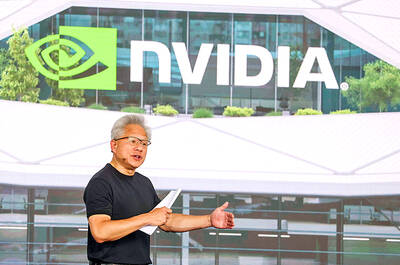
‘BOOMING’: ’ The number of partners we have here is incredible. You can see from their stock prices. They’re doing so well, they’re so happy,’ Jensen Huang said Nvidia Corp’s spending in Taiwan has ballooned to about US$150 billion a year, 10 times the US$10 billion to US$15 billion the company spent five years ago, Nvidia chief executive officer Jensen Huang (黃仁勳) said yesterday, suggesting Taiwan’s strategic importance in the global artificial intelligence (AI) supply chain. “Taiwan is the epicenter of the AI revolution. This is where the chips come, packaging comes. This is where the systems are made. This is where AI supercomputers were created,” Huang said at a meeting for the company’s employees in Beitou-Shilin Technology Park (北投士林科技園區) in Taipei, the planned site of Nvidia’s Taipei headquarters. “Taiwan
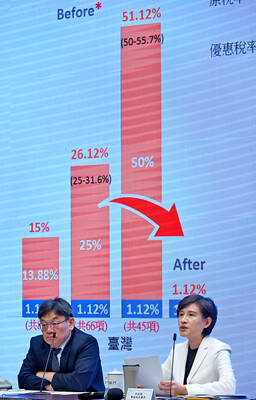
GREATER REACH? Auto parts and wood products would face tariffs of up to 15%, matching those targeting the EU, Japan and South Korea, Vice Premier said The US has announced that preferential tariff treatment for Taiwan’s non-semiconductor Section 232 goods would take effect retroactively from May 1, the Executive Yuan said yesterday. The US government yesterday posted a notice on the Federal Register’s public inspection Web site previewing tariff concessions for Taiwan under a memorandum of understanding (MOU) on Taiwan-US investment after two months of negotiations. The MOU signed on Jan. 15 stipulated three major preferential tariff arrangements: a 15 percent “reciprocal” tariff rate for Taiwan without stacking most-favored nation (MFN) rates; preferential Section 232 treatment for semiconductors and related products; and preferential Section 232 treatment for non-semiconductor


 RSS
RSS