

The global toll from severe acute respiratory syndrome (SARS) climbed above 500 dead and 7,000 infected yesterday as China described its crisis as "grim" and announced that 120 bureaucrats had been fired or punished for mishandling or even concealing cases of the disease.
In one province, Communist Party members have been told to revive the ancient custom of bowing instead of shaking hands to prevent disease transmission.
"The current SARS situation is still grim, and the economic impact is more pronounced each day," the official Xinhua News Agency said in its report of a Chinese Cabinet meeting that ordered measures to protect exports and investments.
Li Kui-wai, an economist at the City University of Hong Kong, predicted China's gross domestic product could fall by 1 percent to 2 percent due to SARS.
In Moscow, Russian officials ordered airlines to suspend reservations on flights to China, Hong Kong and Taiwan because of SARS and to be prepared to cancel all flights.
China announced five more SARS fatalities and Hong Kong four, raising the global number of deaths to at least 507 yesterday.
SARS has killed 208 people in Hong Kong and 224 in China -- half in Beijing.
In Hong Kong a 100-year-old woman was among the new victims. One of the Chinese victims was from Shanghai -- the first reported SARS fatality in the nation's most populous city.
So far, SARS has mostly been an urban disease. But authorities fear it might spread into the countryside, where the majority of China's 1.3 billion people live amid a shortage of doctors and hospitals unable to cope with epidemics.
WHO investigators were due yesterday to go to Hebei, a province bordering Beijing and where there has been a marked surge in cases.
A new unidentified pneumonia has appeared in the jungles of Cambodia. An outbreak has been controlled, but seven people have died. Doctors say they are baffled by it, just like they were initially by SARS.
SARS first surfaced as a mystery illness in southern China last November, when it was described only as an atypical pneumonia.
The new illness has SARS-like symptoms including fever, coughing and breathing problems, but sufferers also have diarrhea and maintain normal white blood cell counts.
SARS has taken the lives of many health professionals. Doctors and nurses working in SARS wards across Asia are being hailed as heroes who put their own lives at risk to save others.
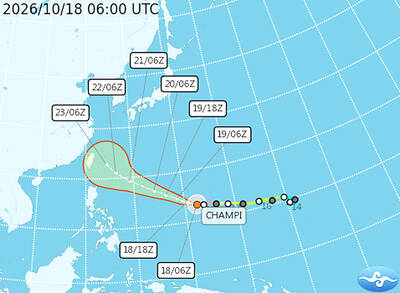
A sea warning for Typhoon Champi could be issued as early as Wednesday night, possibly followed by a land warning on Thursday night or Friday, as the storm approaches Taiwan, the Central Weather Administration (CWA) said yesterday. The typhoon is expected to have its greatest impact on Taiwan on Friday and Saturday, bringing heavy rain to central and northern Taiwan and to Yilan and Hualien counties in the east, CWA forecaster Liu Pei-teng (劉沛滕) said. As of 2pm yesterday, Champi was about 2,470km east-southeast of Oluanpi (鵝鑾鼻), Taiwan’s southernmost tip, moving westnorthwest at 20kph. It had maximum sustained winds of 191kph and a
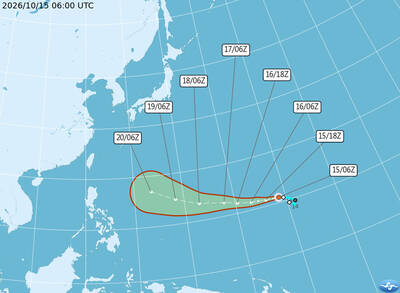
EAST OF GUAM: Tropical Storm Champi is forecast to strengthen into a typhoon, but its effect on Taiwan is uncertain due to the presence of a high-pressure system Tropical Storm Champi formed yesterday and has the potential to increase in strength, the Central Weather Administration (CWA) said yesterday. Forecasters are closely monitoring a Pacific high-pressure system that would dictate whether the storm turns north or moves toward Taiwan next week, the CWA said. The most likely scenario is that it turns northward after passing the Ryukyu Islands, CWA forecaster Cheng Chieh-jen (鄭傑仁) said. As of 8pm yesterday, Champi was east of Guam moving west-northwest at 20kph, CWA data showed. It had maximum sustained winds near the center of 72kph and gusts of up to 101kph, the data showed. If the Pacific high-pressure system
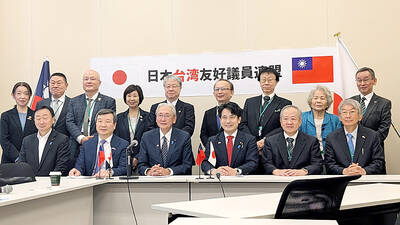
ORIGINS: A Taiwanese doctor practicing in Japan said he no longer needed to cover the nationality label on his license with a sticker, as it used to confuse his patients Starting this month, Taiwanese professionals working in Japan can list “Taiwan” as their place of origin following Tokyo’s easing of rules on “nationality” in official licensing documents. The change was announced yesterday by the Japan-Taiwan Friendship Parliamentarians’ League in Tokyo. The license revision covers 322 professions, including doctors and nurses. Previously, Taiwanese had to list “China” as their nationality on professional certifications and licenses, but the new rules updated the “nationality” to “nationality and region” or “nationality, etc,” allowing Taiwanese to use the name “Taiwan.” The league held a meeting about the revision at the House of Representatives Members’ Office Building in Tokyo
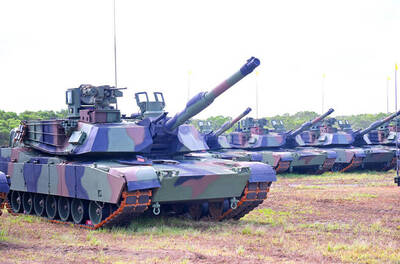
US-made M1A2T Abrams tanks are to participate in a major military exercise for the second time, when the Lien Yung exercise (聯勇操演) begin next month, a military source said yesterday. The army’s 584th Armored Brigade, which operates the US-built tanks, has already transported them to the Joint Operations Training Base in Pingtung County for the drills from late next month to December, the source said. During the month-long joint military exercise in southern Taiwan, the tanks’ crew would test their combat coordination, said the source, who asked not to be named. The M1A2T Abrams tanks were included in a major Taiwanese military exercise


 RSS
RSS