


The election of legislators with criminal or gangster backgrounds, or massive conflicts of interest as chairmen of the legislature's 12 standing committees has become a ritual of every legislative session; yesterdays elections for committee chairmen were no exception.
Independent lawmaker Yen Ching-piao (顏清標), who forfeited his convener's seat on the Economics and Energy Committee in the last session to calm an outcry over his business ties, managed to obtain the berth again.
Yen, convicted last year by a trial court of corruption, attempted murder and obstruction of justice, owns several quarrying companies in the region.
The Ministry of Economics Affairs is the highest regulatory agency on the nation's rivers and riverbeds where quarrying operations are carried out.
Last October, DPP lawmaker Su Chih-fen (蘇治芬) told a news conference that some of her colleagues, whose identities she refused to reveal, were behind illegal quarrying operations in central Taiwan.
Meanwhile DPP lawmaker Lin Wen-lang (林文郎) and PFP colleague Chen Chih-bin (陳志彬) were both elected as the conveners of the Finance Committee despite their deep involvement in the securities industry.
The committee, normally the most popular, is responsible for supervising the Ministry of Finance. Allegations abound that over the years Committee members have sought to pressure the ministry to adopt measures favorable to their portfolios as well as that of their family and friends.
After election, Lin and Chen said they would soon sever their business ties but offered no guarantee as how they would make good on their pledge.
There are three conveners for each of the standing committees. As they wield substantial influence over legislation by controlling the agenda of committee meetings, their opinions carry great weight with policy planners, whose agency falls under the oversight of the corresponding committee.
One of the most notorious beneficiaries of the committee chairmanship system in recent years has been former independent lawmaker Lo Fu-chu (羅福助), a convicted gangster who owns Tashin Securities, and is widely believed to have used his position on the committee to engage in many financial irregularities.
In line with cross-party agreements, the DPP won 13 convener seats; the KMT 10 seats; the PFP 8 seats; and the Non-Partisan Alliance two seats.
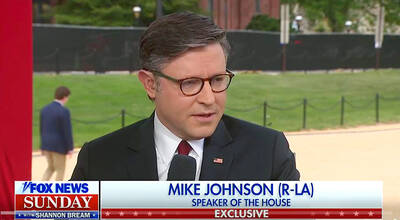
RESOLUTE BACKING: Two Republican senators are planning to introduce legislation that would impose immediate sanctions on China if it attempts to invade Taiwan US House of Representatives Speaker Mike Johnson on Sunday reaffirmed US congressional support for Taiwan, saying the US and “all freedom-loving people” have a stake in preventing China from seizing Taiwan by force. Johnson made the remarks in an interview with Fox News Sunday on US President Donald Trump’s summit with Chinese President Xi Jinping (習近平) last week. In an interview that aired on Friday on Fox News, just as Trump wrapped up a high-stakes visit to China, he said he has yet to green-light a new US$14 billion arms package to Taiwan and that it “depends on China.” “It’s a very good
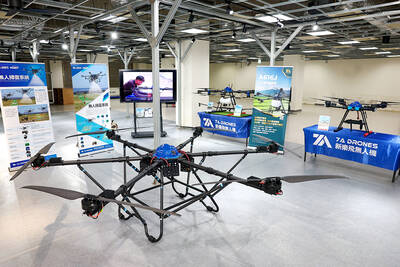
DRONE CENTRAL: Taiwan aims to become Asia’s democratic hub for drones, with most exports focused on high-quality military-grade models, an official said Taiwan’s drone industry is expected to expand significantly by 2030, producing 100,000 units per month and exporting half of them, the Ministry of Economic Affairs said yesterday. Current drone production capacity is about 15,000 units per month, but the industry can quickly scale up as demand increases, Industrial Development Administration Director-General Chiou Chyou-huey (邱求慧) told a news conference in Taipei. Taiwan’s drone output grew 2.5-fold last year to NT$12.9 billion (US$408.3 million) under a government program to develop the uncrewed vehicle sector, he said. The Executive Yuan in October last year approved plans to invest NT$44.2 billion into domestic production of uncrewed aerial
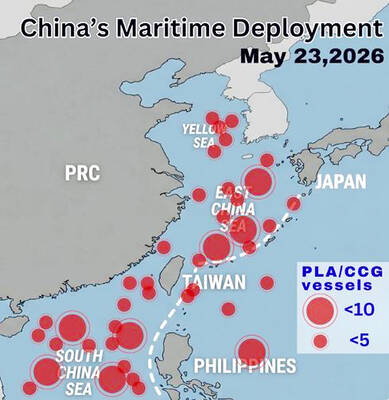
WARNING: China should stop engaging in actions that undermine regional peace and stability, as it would only build resentment among people across the Strait, the CGA said China has deployed more than 100 navy, coast guard and other vessels in waters from the Yellow Sea to the South China Sea and the western Pacific since US President Donald Trump and Chinese President Xi Jinping (習近平) met in Beijing, National Security Council Secretary-General Joseph Wu (吳釗燮) said yesterday. “In this part of the world, #China is the one & only PROBLEM wrecking the #StatusQuo & threatening regional peace & stability,” Wu wrote on X. In a separate post, he said Beijing was coercing Taiwan’s maritime domain, calling it illegal and provocative, after the Coast Guard Administration (CGA) expelled a
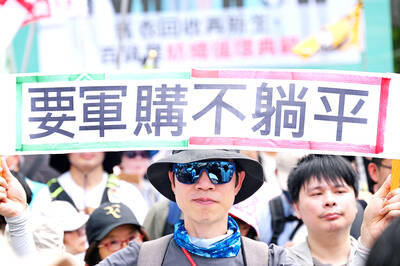
More than 8,000 people took part in a rally in Taipei yesterday to express support for more defense spending, after the opposition slashed the Cabinet’s proposed NT$1.25 trillion (US$39.6 billion) special defense budget and capped it at NT$780 billion. The demonstrators urged the Cabinet to propose another bill. Taiwan Economic Democracy Union convener Lai Chung-chiang (賴中強) said the main problem of the passed budget plan is the removal of funding for critical items, not just that the total amount is smaller. Critical budget items included purchasing or developing uncrewed vehicles, Strong Bow (強弓) missile systems, additional ammunition, artificial intelligence-powered combat systems and Taiwan-US


 RSS
RSS