


The US is conducting a secret "dirty tricks" campaign against UN Security Council delegations in New York as part of its battle to win votes in favour of war against Iraq.
Details of the aggressive surveillance operation, which involves interception of the home and office telephones and the ee-mailsmails of UN delegates in New York, are revealed in a document leaked to The Observer.
The disclosures were made in a memorandum written by a top official at the National Security Agency -- the US body which intercepts communications around the world -- and circulated to both senior agents in his organization and to a friendly foreign intelligence agency -- which cannot be identified -- asking for its input.
The memo describes orders to staff at the agency, whose work is clouded in secrecy, to step up its surveillance operations "particularly directed at ... UN Security Council Members (minus US and GBR, of course)" to provide up-to-the-minute intelligence for Bush officials on the voting intentions of UN members regarding the issue of Iraq.
The leaked memorandum makes clear that the target of the heightened surveillance efforts are the delegations from Angola, Cameroon, Chile, Mexico, Guinea and Pakistan at the UN headquarters in New York -- the so-called "Middle Six" delegations whose votes are being fought over by the pro-war party, led by the US and Britain, and the party arguing for more time for UN inspections, led by France, China and Russia.
The memo is directed at senior NSA officials and advises them that the agency is "mounting a surge" aimed at gleaning information not only on how delegations on the Security Council will vote on any second resolution on Iraq, but also "policies," "negotiating positions," "alliances' and 'dependencies" -- the "whole gamut of information that could give US policymakers an edge in obtaining results favorable to US goals or to head off surprises."
Dated 31 January 2003, the memo was circulated four days after the UN's chief weapons inspector, Hans Blix, produced his interim report on Iraqi compliance with UN resolution 1441.
It was sent by Frank Koza, chief of staff in the "Regional Targets" section of the NSA, which spies on countries that are viewed as strategically important for United States interests.
Koza specifies that the information will be used for the US's "QRC' -- Quick Response Capability -- "against" the key delegations.
Suggesting the levels of surveillance of both the office and home phones of UN delegation members, Koza also asks regional managers to make sure that their staff also "pay attention to existing non-UN Security Council Member UN-related and domestic comms [office and home telephones] for anything useful related to Security Council deliberations."
Koza also addresses the foreign agency, saying: "We'd appreciate your support in getting the word to your analysts who might have similar more indirect access to valuable information from accesses in your product lines [ie, intelligence sources]." Koza makes clear it is an informal request at this juncture, but adds: "I suspect that you'll be hearing more along these lines in formal channels."
Disclosure of the US operation comes in the week that Blix will make what many expect to be his final report to the Security Council.
It also comes amid increasingly threatening noises from the US towards undecided countries on the Security Council who have been warned of the unpleasant economic consequences of standing up to the US.
Sources in Washington familiar with the operation said last week that there had been a division among Bush administration officials over whether to pursue such a high-intensity surveillance campaign with some warning of the serious consequences of discovery.
The existence of the surveillance operation, understood to have been requested by President Bush's National Security Adviser, Condoleezza Rice, is deeply embarrassing to the Americans in the middle of their efforts to win over the undecided delegations.
The language and content of the memo were judged to be authentic by three former intelligence operatives shown it by The Observer. We were also able to establish that Koza works for the NSA and could confirm his senior post in the Regional Targets section of the organization.
The NSA main switchboard put The Observer through to extension 6727 at the agency, which was answered by an assistant, who confirmed it was Koza's office. However, when The Observer asked to talk to Koza about the surveillance of diplomatic missions at the UN, it was then told "You have reached the wrong number."
On protesting that the assistant had just said this was Koza's extension, the assistant repeated that it was an erroneous extension and hung up.
The full text of the e-mail is available at www.observer.co.uk/iraq

‘NO SECURITY RISK’: The Railway Bureau reassured the public that the technicians’ activities were limited to technical guidance and did not involve sensitive systems The Railway Bureau yesterday said it had invited eight Chinese technicians to assist with an airport MRT construction project. The bureau issued the confirmation after an Internet user said Chinese nationals had entered the construction zone of Taiwan Taoyuan International Airport’s Terminal 3 project. They asked why “individuals from an enemy state” were allowed access to such a major national infrastructure project, which raised serious concerns over Taiwan’s industrial safety, sensitive systems and information security. The bureau’s Northern Region Engineering Branch Office said subcontractor Taiwan Handle Industrial Co (台灣手把工業) of the Taoyuan airport MRT’s “Contract No. CU05 Project A14 Station Civil, MEP &

A US uncrewed surface vessel (USV) encountered multiple Chinese warships during an autonomous transit of the Taiwan Strait, US defense company Seasats said in a statement on Wednesday. Seasats announced that a Lightfish USV had completed the first autonomous transit of the Taiwan Strait. Over five days, the USV traversed the entire length of the Strait while constantly monitoring surface vessel traffic, the company said. The Lightfish encountered multiple Chinese warships, one of which was a Chinese People’s Liberation Army Navy (PLAN) Type 056 corvette, it said. The Chinese vessels were operating “well within Taiwan’s exclusive economic zone without transmitting their identity via the
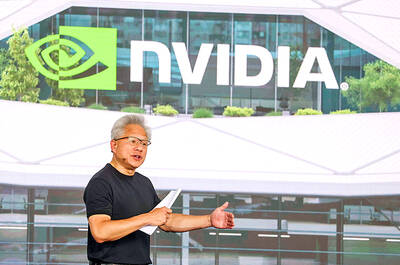
‘BOOMING’: ’ The number of partners we have here is incredible. You can see from their stock prices. They’re doing so well, they’re so happy,’ Jensen Huang said Nvidia Corp’s spending in Taiwan has ballooned to about US$150 billion a year, 10 times the US$10 billion to US$15 billion the company spent five years ago, Nvidia chief executive officer Jensen Huang (黃仁勳) said yesterday, suggesting Taiwan’s strategic importance in the global artificial intelligence (AI) supply chain. “Taiwan is the epicenter of the AI revolution. This is where the chips come, packaging comes. This is where the systems are made. This is where AI supercomputers were created,” Huang said at a meeting for the company’s employees in Beitou-Shilin Technology Park (北投士林科技園區) in Taipei, the planned site of Nvidia’s Taipei headquarters. “Taiwan
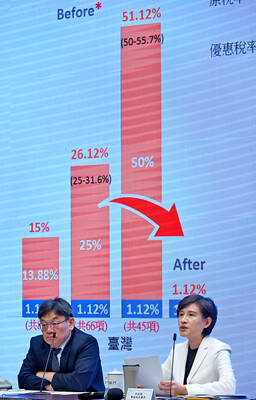
GREATER REACH? Auto parts and wood products would face tariffs of up to 15%, matching those targeting the EU, Japan and South Korea, Vice Premier said The US has announced that preferential tariff treatment for Taiwan’s non-semiconductor Section 232 goods would take effect retroactively from May 1, the Executive Yuan said yesterday. The US government yesterday posted a notice on the Federal Register’s public inspection Web site previewing tariff concessions for Taiwan under a memorandum of understanding (MOU) on Taiwan-US investment after two months of negotiations. The MOU signed on Jan. 15 stipulated three major preferential tariff arrangements: a 15 percent “reciprocal” tariff rate for Taiwan without stacking most-favored nation (MFN) rates; preferential Section 232 treatment for semiconductors and related products; and preferential Section 232 treatment for non-semiconductor


 RSS
RSS