


Turkey's parliament has failed to approve the deployment of US combat troops in Turkey, jeopardizing US war plans in Iraq and putting the country's strategic alliance with Washington at risk.
The leaders of the ruling Justice and Development Party were meeting yesterday to decide whether to resubmit the motion to parliament. The parliament on Saturday voted 264-250 in favor of stationing US troops, with 19 abstentions, but it fell three short of a simple majority for approval.
Washington has been counting on Turkish support.
Hundreds of US trucks and jeeps line a port in southern Turkey, waiting for parliamentary approval. Washington has been pressing Turkey for weeks to agree to a northern front, which would split Saddam Hussein's army between the north and the south, likely making a war shorter and less bloody.
US Ambassador Robert Pearson to Turkey expressed disappointment.
"We had certainly hoped for a favorable decision," Pearson said Saturday. "We will wait for further information and advice from the government of Turkey about how we should proceed."
The White House withheld official comment, but officials said privately that the administration remains convinced it ultimately will get its way.
However, it was not clear whether the government will push the controversial motion once again through the parliament when it reconvenes tomorrow. After a late night meeting Saturday, government officials, speaking on condition of anonymity, said the government was not planning to resubmit the motion to parliament, private NTV and CNN-Turk television stations reported. However, that report could not be independently confirmed.
The motion would have empowered the government to authorize the basing of up to 62,000 US troops, 255 warplanes and 65 helicopters.
Washington had offered Turkey US$15 billion in loans and grants if it accepted a basing deal to ease the impact of any war on the Turkish economy. That money may now be lost.
The failure of the government was a reflection of the overwhelming opposition felt in the public against war in neighboring Iraq. Tens of thousands of Turks protested against war while lawmakers discussed the motion. Many Turks fear retaliatory attacks from Baghdad.
Washington strongly supported Turkey when it secured billions of dollars in loans from the International Monetary Fund during the 2001 financial crisis. But if Turkey does not support the US war plans, many Turks fear that support will disappear.

‘NO SECURITY RISK’: The Railway Bureau reassured the public that the technicians’ activities were limited to technical guidance and did not involve sensitive systems The Railway Bureau yesterday said it had invited eight Chinese technicians to assist with an airport MRT construction project. The bureau issued the confirmation after an Internet user said Chinese nationals had entered the construction zone of Taiwan Taoyuan International Airport’s Terminal 3 project. They asked why “individuals from an enemy state” were allowed access to such a major national infrastructure project, which raised serious concerns over Taiwan’s industrial safety, sensitive systems and information security. The bureau’s Northern Region Engineering Branch Office said subcontractor Taiwan Handle Industrial Co (台灣手把工業) of the Taoyuan airport MRT’s “Contract No. CU05 Project A14 Station Civil, MEP &

A US uncrewed surface vessel (USV) encountered multiple Chinese warships during an autonomous transit of the Taiwan Strait, US defense company Seasats said in a statement on Wednesday. Seasats announced that a Lightfish USV had completed the first autonomous transit of the Taiwan Strait. Over five days, the USV traversed the entire length of the Strait while constantly monitoring surface vessel traffic, the company said. The Lightfish encountered multiple Chinese warships, one of which was a Chinese People’s Liberation Army Navy (PLAN) Type 056 corvette, it said. The Chinese vessels were operating “well within Taiwan’s exclusive economic zone without transmitting their identity via the
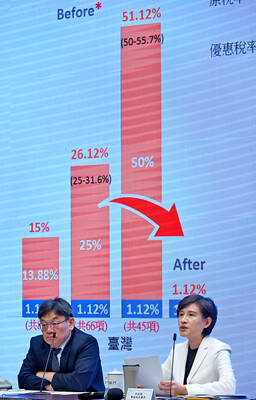
GREATER REACH? Auto parts and wood products would face tariffs of up to 15%, matching those targeting the EU, Japan and South Korea, Vice Premier said The US has announced that preferential tariff treatment for Taiwan’s non-semiconductor Section 232 goods would take effect retroactively from May 1, the Executive Yuan said yesterday. The US government yesterday posted a notice on the Federal Register’s public inspection Web site previewing tariff concessions for Taiwan under a memorandum of understanding (MOU) on Taiwan-US investment after two months of negotiations. The MOU signed on Jan. 15 stipulated three major preferential tariff arrangements: a 15 percent “reciprocal” tariff rate for Taiwan without stacking most-favored nation (MFN) rates; preferential Section 232 treatment for semiconductors and related products; and preferential Section 232 treatment for non-semiconductor

TIT-FOR-TAT: The US allegedly revoked the visa of a Chinese national working at Xinhua News Agency in the US in response to Beijing’s expulsion of Vivian Wang The Presidential Office yesterday condemned China for expelling a New York Times correspondent from Beijing following the newspaper’s interview with President William Lai (賴清德), saying the move highlighted Beijing’s suppression of press freedom and its threat to international news media. Taiwan has noted a series of recent incidents in which Beijing used similar tactics to “threaten and pressure international media outlets and journalists,” Presidential Office spokeswoman Karen Kuo (郭雅慧) said in a statement. “This concerns not only press freedom and freedom of expression, but also the safety of journalists, and Taiwan and relevant partners are paying close attention to the situation,” she


 RSS
RSS